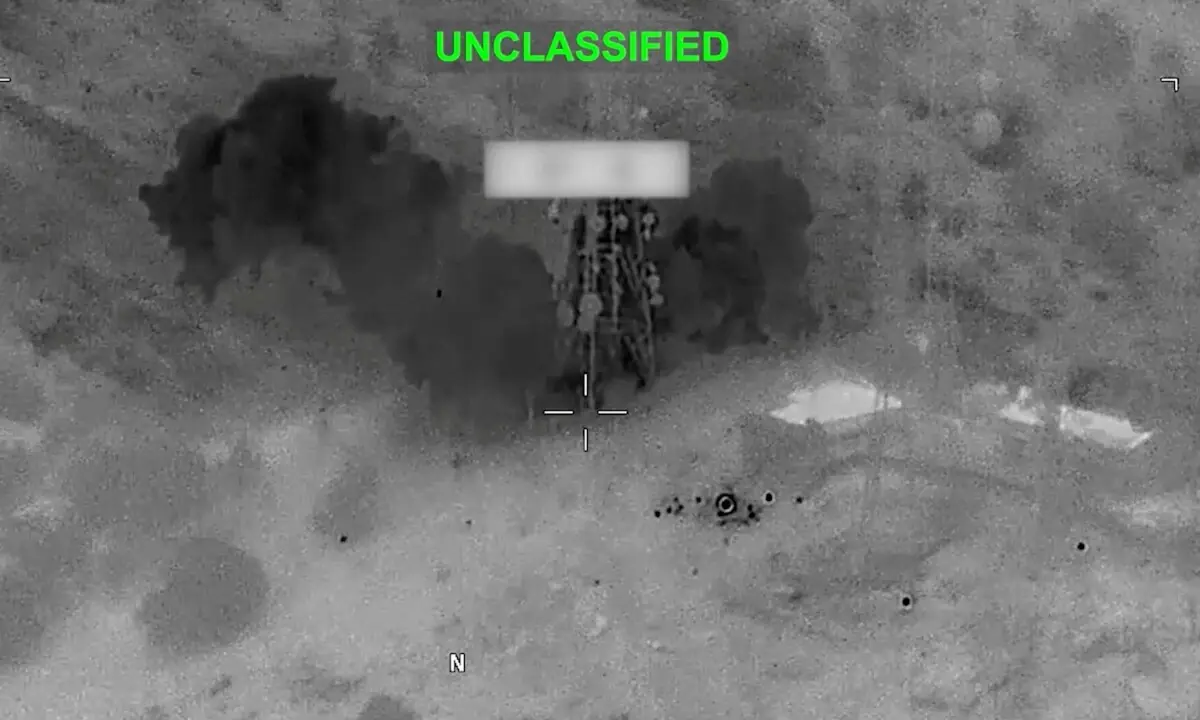
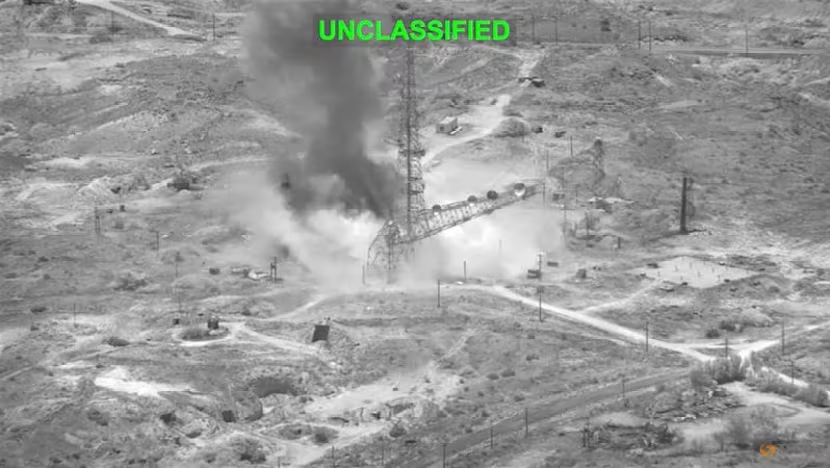
The United States and Iran have entered their most dangerous phase of open conflict in weeks, with American forces completing a seventh consecutive night of strikes on Iranian military sites while Iran hit US military bases in Kuwait and Jordan on Saturday. A ceasefire that briefly held collapsed roughly a week ago, and both sides are now actively testing how far the other will escalate before pulling back.
The US military's Central Command said its latest strikes targeted surveillance sites, underground weapons storage, military logistics infrastructure, and maritime capabilities, using fighter aircraft, aerial drones, and warships. The statement noted that more than 50,000 American service members are currently operating across the Middle East. For the first time in over a week, Central Command specifically mentioned "military logistics infrastructure" as a target, a signal that US strikes are broadening beyond purely military hardware.
Iran's response was direct and multi-front. Its army said it struck an ammunition depot at Kuwait's Al-Adiri camp, headquarters buildings and depots at the Ali Al-Salem base, and fuel tanks at Jordan's Al-Azraq base. Iranian media, citing the Revolutionary Guards, also reported that two oil tankers caught fire and exploded after passing through a mined route south of the Strait of Hormuz, though the US military called that report false.
The Strait of Hormuz Is Now a War Zone
The most consequential battleground right now is the Strait of Hormuz, the narrow waterway through which roughly one-fifth of the world's oil supply passes. The US says it is enforcing a naval blockade of Iran and has redirected four commercial vessels, disabled one, and boarded another. Iran's Revolutionary Guards say they stopped four vessels that violated their own shipping rules using a combined missile and drone operation. Armed men also seized a vessel off Yemen, adding pressure at the mouth of the Red Sea, another major oil shipping route.
Iran's Revolutionary Guards warned, via state television, that no oil, gas, or chemical fertilisers would leave the region until US strikes stop. That is not just rhetoric. With both sides now actively interfering with commercial shipping at the strait, the threat to global energy flows is immediate and physical, not hypothetical.
Oil prices responded accordingly, rising more than four percent on Friday to their highest level in over a month. That price surge lands directly on US President Donald Trump at a politically sensitive moment: his Republican Party is trying to hold congressional seats in November elections, and rising fuel costs increase pressure on his administration to either resolve or escalate the conflict decisively.
Civilian Infrastructure Under Fire on Both Sides
Attacks are no longer confined to military hardware. Iranian media reported that missiles struck power facilities and desalination pumps in the southern city of Jask, cutting off drinking water to surrounding villages. In Hormozgan Province, three people were killed and eight wounded, and two bridges and a road tunnel were damaged. Earlier in the week, at least five bridges were struck in Iran's south, with seven people killed in attacks around the port of Bandar Khamir, where a train station was also hit. A provincial airport in Iranshahr, near the Pakistan border, was reported struck as well.
United Nations Secretary General Antonio Guterres expressed concern specifically about attacks on civilian infrastructure in Iran and across the region, according to his spokesperson.
On the Iranian side, Mohsen Rezaei, an adviser to Iran's supreme leader, warned Friday against any US attempt to seize Iranian territory. Trump has publicly threatened broad-based strikes on Iranian infrastructure and has not ruled out a ground assault on Iran's coast or islands. US officials have said southern Iran strikes are designed in part to preserve those options for the president.
That logic carries a sharp risk. Expanding strikes into civilian infrastructure and threatening territorial incursions pushes Iran toward attacking the infrastructure of Gulf states, which are far more exposed and less defended. It also gives Iran's Yemeni allies a clearer justification to intensify attacks on Red Sea shipping, compounding pressure on global energy supply chains.
The key question now is whether either side has a defined stopping point. With the previous ceasefire already broken, no active diplomatic track publicly visible, and military operations expanding on both sides, the conflict is moving in a direction where the next escalation ladder rung is harder to reverse than the last.