
Qatar Signals Progress in US-Iran War Talks
Qatar's foreign ministry said mediators including Qatar, Pakistan, and Oman have reached "very progressive stages" in efforts to end the US-Iran war, pushing Brent crude down more than four percent.
Key Takeaways
May 2, 2026 · 3 min read · By Rishabh Bhardwaj
·
AI-assisted, human-reviewed · Our editorial standards
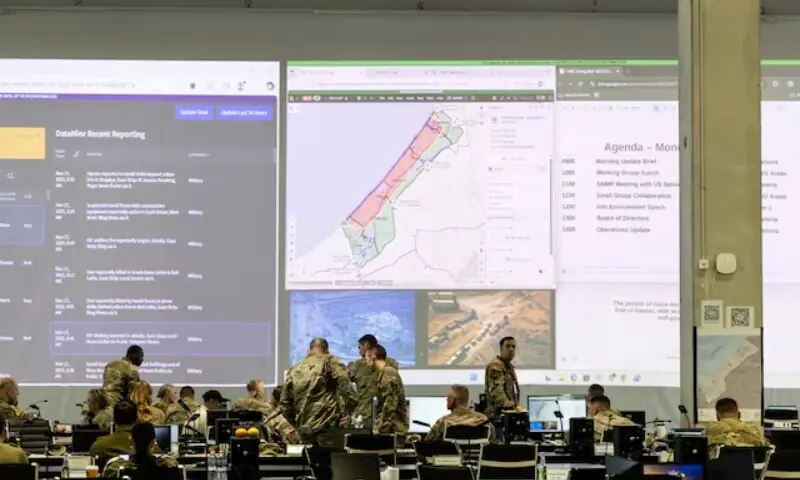
The Trump administration is preparing to shut down the Civil-Military Coordination Centre (CMCC), the US-run body in Israel that was meant to monitor the Gaza ceasefire and help coordinate aid deliveries to Palestinians, according to seven diplomats familiar with its operations who spoke to Reuters.
The CMCC was created as a centerpiece of Trump's 20-point Gaza peace plan. It was supposed to verify the October ceasefire, manage aid flows, and serve as a coordinating hub for allied countries that Trump had personally encouraged to send personnel and commit rebuilding funds. In practice, diplomats say it never had the authority to enforce the ceasefire or compel aid delivery, leaving its actual impact on the ground limited.
US officials are describing the move internally as an overhaul rather than a closure. The CMCC's responsibilities would transfer to the International Stabilisation Force (ISF), a US-commanded multinational body originally meant to deploy into Gaza to establish security. The combined entity is expected to be rebranded as the International Gaza Support Centre and would likely be commanded by US Major General Jasper Jeffers, the White House-appointed ISF commander.
The troop footprint would shrink significantly in the process. The number of US military personnel involved would fall from roughly 190 to around 40, with Washington hoping allied countries would fill the gap using civilian staff. That is a tall ask: the ISF has so far attracted only a handful of pledging countries, and none have agreed to take on security roles. The US has separately ruled out deploying its own troops into Gaza itself.
The CMCC's closure, if confirmed, would land at a difficult moment. Israel has continued military operations inside Gaza since the October truce, and Hamas retains control over significant parts of the territory. Trump's broader Gaza rebuilding plan has effectively been paused since the US and Israel launched joint military action against Iran. Allied governments that sent staff to the CMCC or pledged money based on Trump's assurances are now watching their investment in the diplomatic framework yield little visible result.
The Board of Peace, the White House-created body overseeing Gaza policy, denied after the Reuters report was published that the CMCC was closing, but did not address whether the ISF would absorb its functions. The White House and US military's Middle East command both deferred comment to the Board of Peace. Access to the ISF's annex inside the CMCC compound, a warehouse in southern Israel, has already been tightly controlled, with three sources saying US troops regularly block entry by allied country representatives.
Whether folding the CMCC into the ISF changes anything practically depends on whether the ISF can actually get forces into Gaza, which has not happened yet. Until it does, the shift looks more like a reorganisation on paper than a functioning replacement on the ground.
Qatar's foreign ministry said mediators including Qatar, Pakistan, and Oman have reached "very progressive stages" in efforts to end the US-Iran war, pushing Brent crude down more than four percent.
Qatar confirmed it is mediating between the US and Iran but said no direct talks are currently planned. The clarification follows conflicting statements from President Trump, who claimed talks are under way, and Tehran, which denied any dialogue is happening.
Saudi Aramco reported sharply higher second-quarter 2026 profits as the Iran war restricts global oil supply and pushes crude prices up. Other oil supermajors also posted outsized earnings, raising concerns about sustained fuel cost pressure for importing economies.
President Trump called current Iran negotiations the "last chance" to end five months of conflict, pushing oil prices higher. Tehran denied formal talks are taking place, raising the risk of a diplomatic breakdown with direct consequences for global energy markets.