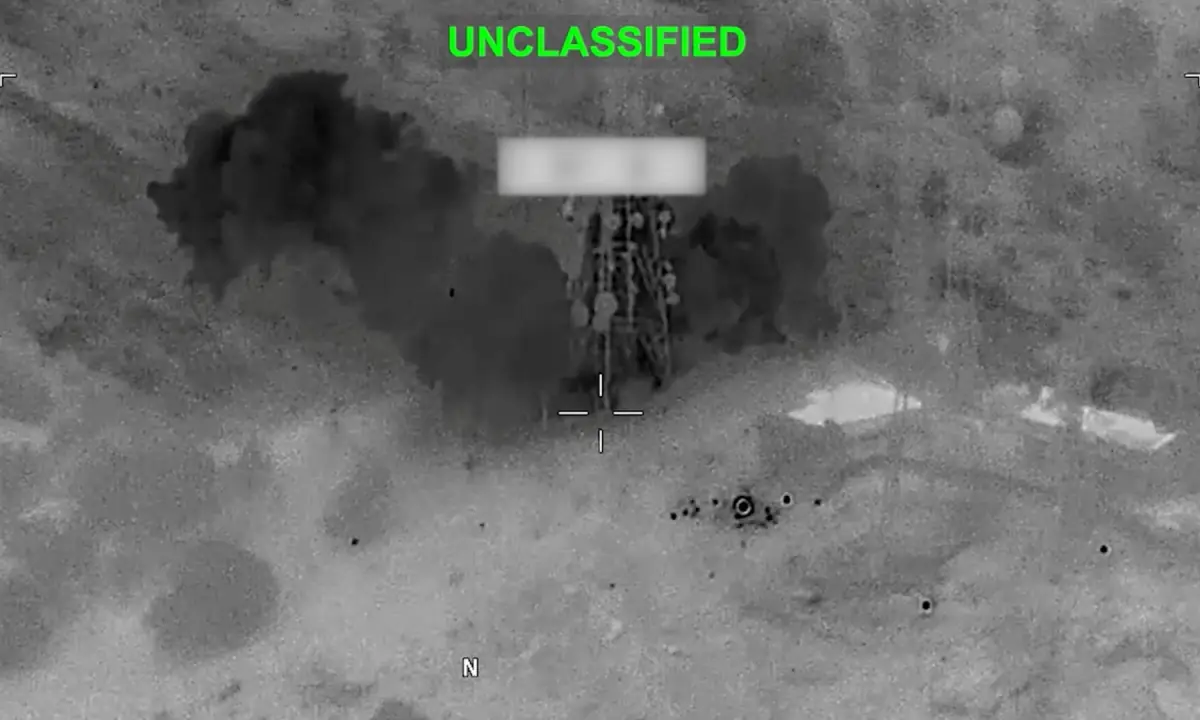
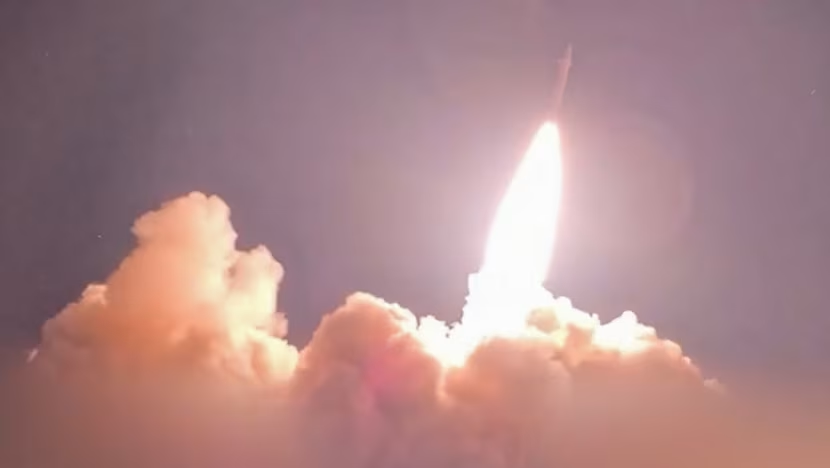
The United States launched fresh airstrikes on Iran early Sunday at President Donald Trump's direction, hours after two American troops were killed and a third went missing following an Iranian attack in Jordan. Iran responded by targeting two US bases in Kuwait with kamikaze drones, deepening a conflict that is now drawing in multiple countries across the Gulf region.
US Central Command said the strikes began at 6pm ET on Saturday and were designed to "further degrade Iran's ability to threaten commercial shipping in the Strait of Hormuz and swiftly punish Islamic Revolutionary Guard Corps (IRGC) forces" for the Jordan attack. The deaths bring the total number of American service members killed since the conflict began to 16, with more than 420 wounded. US Defence Secretary Pete Hegseth said on X that the soldiers' "sacrifice only stiffens our resolve."
Iran's army said it carried out "large-scale attacks with kamikaze drones" against Camp Udairi's ammunition depot and the Patriot radar and air surveillance system at Ali Al Salem Air Base in Kuwait. On the US side, Iran's Mehr news agency reported a strike near Sirik in southern Iran with no casualties, while Tasnim news agency reported at least six missiles hit Qeshm Island, with explosions heard in the port city of Bandar Abbas.
A ceasefire that collapsed, a war that is widening
The current escalation follows the collapse last week of an interim ceasefire deal signed roughly a month ago. The conflict itself started at the end of February when the US and Israel launched strikes on Iran aiming to disable Tehran's missile programme. Since then, the fighting has spread beyond Iran's borders, pulling in Kuwait, Bahrain, Jordan, and raising alerts in Saudi Arabia.
On Saturday, Kuwait's armed forces said they intercepted Iranian ballistic missiles and drones, though some firefighters and oil sector workers were injured. Kuwait Petroleum Corporation confirmed that one of its oil facilities was hit in what it called "repeated Iranian attacks," causing significant damage. The IRGC separately said it struck a US military support centre at Camp Arifjan in Kuwait and destroyed a radar facility at Ali Al Salem Air Base. In Bahrain, the IRGC said it targeted Sheikh Isa Air Base, where US combat aircraft were gathered, along with an intelligence data centre. In Jordan, Iranian state TV reported the destruction of at least two US fighter aircraft and three other aircraft at the Al Azraq base.
Saudi Arabia's early warning system issued alerts to residents of Al-Kharj, home to a base hosting US troops east of Riyadh, and Yanbu, a key Red Sea oil export terminal. The IRGC made no claim of attacking Saudi Arabia.
Hormuz at the centre, global energy at stake
The Strait of Hormuz is the operational and economic heart of this conflict. The strait normally handles around one-fifth of the world's oil supply. Iran's Foreign Ministry spokesperson Esmaeil Baghaei accused the US of seeking control over it. Both sides have now targeted shipping: the US says it is enforcing a naval blockade, while Iran says it is intercepting vessels that violate its navigation rules. US Central Command said earlier strikes hit Iranian surveillance sites, military logistics infrastructure, underground weapons storage, and maritime capabilities in the region bordering the strait.
Iran's Health Ministry said 50 people have been killed and more than 500 wounded inside Iran from US strikes over the past three weeks. In a statement carried by Iranian state media, Supreme Leader Ayatollah Mojtaba Khamenei said Trump's signature on the ceasefire deal was "utterly worthless and devoid of credibility" and warned of "even heavier costs and further humiliation" for the United States. Major General Mohsen Rezaei, a senior military adviser to Khamenei, warned that Tehran would resume "full-scale offensive operations" if US strikes continued and said Iran would "no longer limit itself to retaliatory, like-for-like responses."
The US State Department issued a worldwide travel alert for Americans abroad, citing heightened tensions and warning of possible flight cancellations and periodic airspace closures. The alert noted the "potential for unforeseen escalation," a phrase that carries real weight given how quickly the scope of the conflict has grown in days.
What to watch next: whether Iran follows through on the threat to shift from tit-for-tat strikes to broader offensive operations, how Gulf states respond to attacks on their soil, and whether the Strait of Hormuz remains navigable for energy tankers. Any sustained disruption there would accelerate the pressure on global oil supply and inflation that has already begun to build since the conflict started.