
Qatar Signals Progress in US-Iran War Talks
Qatar's foreign ministry said mediators including Qatar, Pakistan, and Oman have reached "very progressive stages" in efforts to end the US-Iran war, pushing Brent crude down more than four percent.
Key Takeaways
May 31, 2026 · 4 min read · By Rishabh Bhardwaj
·
AI-assisted, human-reviewed · Our editorial standards
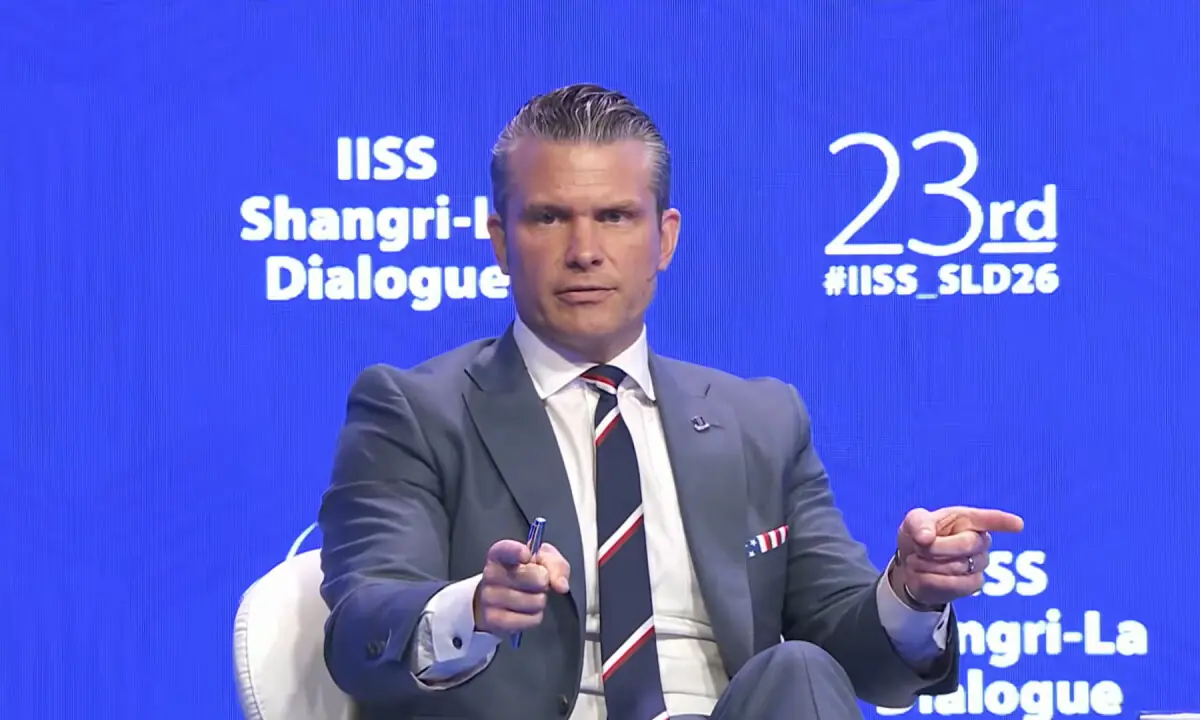
US Defense Secretary Pete Hegseth used the Shangri-La Dialogue in Singapore to publicly credit Pakistan with helping broker an opening in US-Iran diplomacy, calling the relationship between Washington and Islamabad an "unexpected development" and a "true friendship" that is still forming.
Pakistan has been serving as the official go-between in US-Iran peace talks, a role that produced an April 8 ceasefire between the two countries. Hegseth praised both Prime Minister Shehbaz Sharif and Chief of Army Staff Field Marshal Asim Munir by name, describing their contribution to the negotiations as meaningful to broader global peace efforts.
The remarks came during a question-and-answer session at the three-day security forum. Hegseth had just finished praising US defence ties with Indo-Pacific nations and called India a "critical anchor" in the region. When asked about former director of national intelligence Tulsi Gabbard's concerns over Pakistan's future missile capabilities, and whether India's Agni-VI programme posed a comparable risk, Hegseth declined to name either country as a threat to the United States.
"We're not pointing fingers, at least from our view, right now, at either country and calling them a threat to us," he said. He acknowledged that both India and Pakistan are nuclear-armed states and that each would naturally perceive threats from the other, including potential intercontinental ballistic missile development, but framed this as understandable rather than alarming from Washington's perspective.
The diplomatic signalling here is layered. By bracketing India and Pakistan as near-equals in the same breath, Hegseth avoided a direct hierarchy while still elevating Pakistan's profile significantly. Pakistan's interlocutor role in the Iran talks gives Islamabad a piece of strategic leverage it has rarely held in recent years, and Washington appears willing to reward that publicly.
President Donald Trump has been effusive about Pakistan's leadership in recent months, calling Shehbaz "great" and Munir "fantastic" and even referring to the army chief as "my favourite field marshal." In February, at the inaugural meeting of the US-led Board of Peace, Trump described Munir as a "tough man" and a "serious fighter." The pattern of repeated, personalised praise from the US president and his cabinet is unusual and signals a deliberate relationship-building effort at the top level.
Hegseth also repeated the US and Pakistani position that Trump personally brokered a ceasefire between India and Pakistan during their May 2025 military conflict. India's Prime Minister Narendra Modi has publicly rejected this characterisation, a pushback that has irritated Trump. The continued repetition of the claim by senior US officials keeps the friction with New Delhi simmering even as Washington insists the two relationships are not in competition.
Secretary of State Marco Rubio said in November 2025 that the strengthening of US-Pakistan ties did not come at the expense of the US relationship with India. That framing is now being stress-tested in real time. Washington is openly celebrating Pakistan's diplomatic role, personalising its praise of Pakistani military leadership, and disputing India's account of the May ceasefire, all while calling India a "critical anchor" for regional security.
For markets and investors tracking South Asia, the signals matter. A Pakistan that holds a valued diplomatic role with Washington is a Pakistan with slightly more external support for its economy and institutions, which remain under significant stress. For India, the dynamic reinforces why New Delhi has been reluctant to align too closely with any single power, preferring strategic autonomy as a hedge.
The next indicators to watch are whether Islamabad's mediator role extends beyond the Iran file, whether Trump moves to formalise any defence or economic package for Pakistan, and whether India responds to the repeated ceasefire-credit dispute in a way that forces Washington to choose a clearer position.
Qatar's foreign ministry said mediators including Qatar, Pakistan, and Oman have reached "very progressive stages" in efforts to end the US-Iran war, pushing Brent crude down more than four percent.
Qatar confirmed it is mediating between the US and Iran but said no direct talks are currently planned. The clarification follows conflicting statements from President Trump, who claimed talks are under way, and Tehran, which denied any dialogue is happening.
Saudi Aramco reported sharply higher second-quarter 2026 profits as the Iran war restricts global oil supply and pushes crude prices up. Other oil supermajors also posted outsized earnings, raising concerns about sustained fuel cost pressure for importing economies.
President Trump called current Iran negotiations the "last chance" to end five months of conflict, pushing oil prices higher. Tehran denied formal talks are taking place, raising the risk of a diplomatic breakdown with direct consequences for global energy markets.