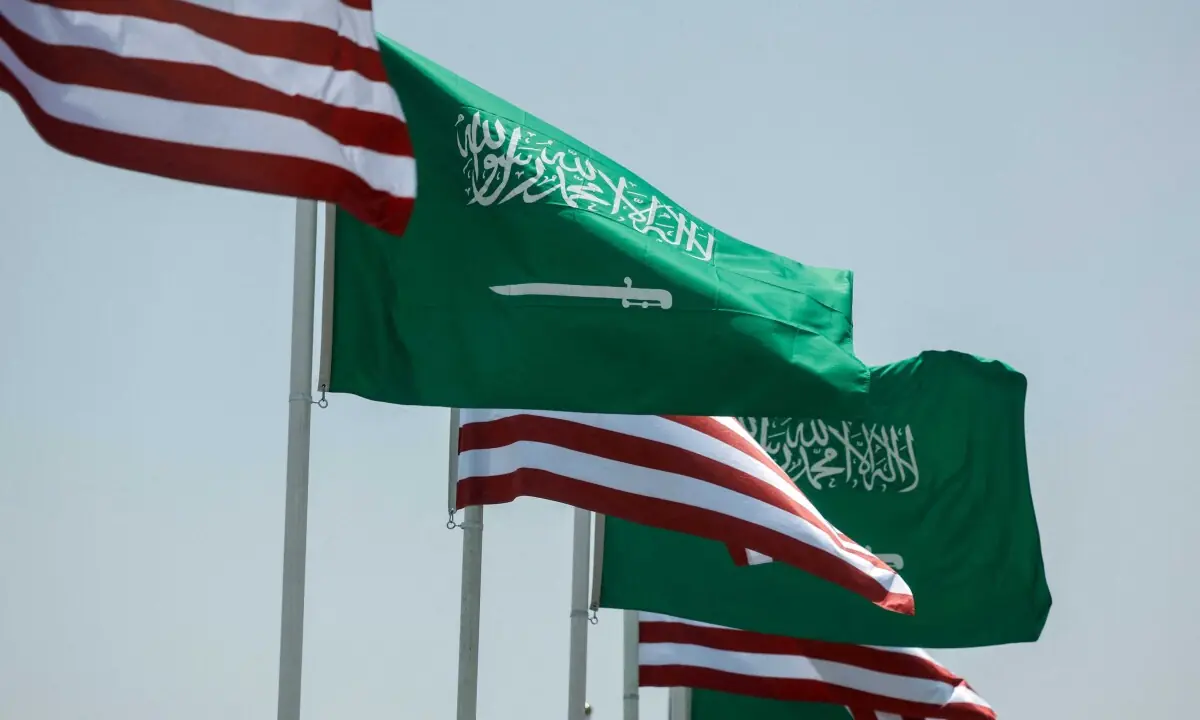
The United States and Saudi Arabia signed two nuclear cooperation agreements on Wednesday, setting up a civilian nuclear programme in the Gulf kingdom and opening the door to a multi-billion-dollar, decades-long energy partnership. US Energy Secretary Chris Wright and Saudi Energy Minister Prince Abdulaziz bin Salman signed the deals, which the US Energy Department said lay the legal foundation for cooperation under Section 123 of the US Atomic Energy Act.
One agreement covers peaceful nuclear cooperation; the second covers bilateral safeguards. The department said together they advance US economic and strategic goals, including nuclear non-proliferation. The full text of neither agreement was released publicly.
The Wall Street Journal reported that one provision could allow US companies to build a uranium enrichment facility inside Saudi Arabia. The Energy Department did not confirm or deny that detail. It is exactly the kind of clause that has made US lawmakers from both parties and Israeli officials uneasy for years, over fears that enrichment capability on Saudi soil could eventually be redirected toward weapons development.
Why the enrichment question matters
Enriching uranium is the technical step that sits closest to weapons production. The US signed a civilian nuclear deal with the UAE in 2009, but that agreement explicitly excluded domestic enrichment. Saudi Arabia's deal carries no such public commitment, at least not yet. Experts have long warned that if Iran acquired a nuclear weapon, several Gulf states would feel pressure to match it. A Saudi enrichment programme, even a civilian one, would sharpen that risk considerably.
Matthew Kroenig of the Atlantic Council said before the signing that allowing Saudi enrichment capability would be "a mistake" and that Washington should not strengthen ties with Riyadh "at the expense of its effective nuclear weapons non-proliferation standards." Jennifer T. Gordon, also of the Atlantic Council, took the opposite view, calling the deal a "win for the US over Russia and China" and arguing that Saudi Arabia had already decided to build a civil nuclear programme. The only open question, she said, was whether it would buy American technology or turn to Moscow or Beijing.
That competitive framing is central to how the Trump administration is selling the deal. Wright insisted the agreements "uphold the highest standards of nuclear safety and non-proliferation, while relying on the world's best nuclear technology and scientists." From Washington's perspective, locking Saudi Arabia into a US-built nuclear supply chain is strategically preferable to watching Russia or China fill the gap.
Geopolitical backdrop
The deal lands at an unusual moment. The United States is currently at war with Iran, a conflict that started largely over concerns about Tehran's nuclear programme. Peace talks are stalled. Saudi Arabia, like Iran, has consistently asserted its right to a civilian nuclear programme. The two countries are regional rivals, and any step that appears to legitimise Saudi nuclear ambitions carries obvious escalatory symbolism.
Washington had for years tried to link a Saudi nuclear deal to a broader package: Saudi normalisation of ties with Israel and a formal US-Saudi defence pact. Pakistan and Saudi Arabia signed a mutual defence pact in September 2025, adding another layer of strategic complexity to Riyadh's security posture. Whether a US-Saudi defence agreement is still part of the equation was not addressed in the announcement.
The agreement will go to the Republican-controlled Congress for review. Lawmakers there are unlikely to block it. The US maintains over 50 such Section 123 nuclear cooperation agreements with countries around the world, though their scope varies widely. The Saudi deal's actual terms, including any enrichment provisions, will face closer scrutiny once the text is made public.
For US energy and defence contractors, this is a significant commercial opening. "Decades-long" and "multi-billion-dollar" are the department's own words, and Saudi Arabia's scale of ambition for civilian nuclear power is well established. The real test will come in the fine print: whether the safeguards are strong enough to hold if the political relationship between Washington and Riyadh ever deteriorates.