
Qatar Signals Progress in US-Iran War Talks
Qatar's foreign ministry said mediators including Qatar, Pakistan, and Oman have reached "very progressive stages" in efforts to end the US-Iran war, pushing Brent crude down more than four percent.
Key Takeaways
June 7, 2026 · 4 min read · By Rishabh Bhardwaj
·
AI-assisted, human-reviewed · Our editorial standards
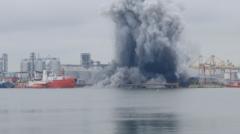
Ukraine has claimed strikes on five cargo vessels it says were carrying illegal goods through the Sea of Azov and coastal waters under Russian occupation. The announcement came as Russian President Vladimir Putin prepared to deliver a key speech, and as Ukrainian officials acknowledged responsibility for a drone explosion that affected Romanian territory.
The Sea of Azov sits between mainland Russia and Russian-occupied eastern Ukraine. It connects to the Black Sea through the Strait of Kerch, which is controlled by Russia. Since the full-scale invasion began in 2022, these waters have become a contested supply corridor, with Ukraine targeting what it describes as vessels supporting Russian military and economic activity in occupied zones.
Ukraine did not specify the nationalities of the ships, what cargo they carried beyond calling it illegal, or the method used in the strikes. No independent confirmation of the vessel damage was immediately available. The strikes, if successful, would represent continued Ukrainian pressure on Russian logistics and supply lines through maritime routes that Russia has used to move goods to and from occupied territories.
Separately, Ukrainian officials acknowledged that a Ukrainian drone caused an explosion on Romanian territory. Romania is a NATO member, which makes any incident on its soil involving weaponry from the conflict legally and politically sensitive. The exact location within Romania, the scale of the damage, and whether any casualties occurred were not detailed in the available information. Ukraine's admission, however, represents a notable step: countries at war rarely publicly accept responsibility for incidents that cross into allied or neutral territory.
NATO member states bordering Ukraine, including Romania, have previously reported falling drone debris from the conflict zone. Each such incident raises questions about escalation thresholds and alliance obligations under Article 5, which treats an attack on one member as an attack on all. Ukraine's acknowledgment here is likely intended to manage diplomatic fallout and preserve its relationship with Bucharest and the broader NATO alliance.
The timing of Ukraine's announcements coincides with preparations by Russian President Vladimir Putin for a significant public address. The subject and content of the speech were not disclosed in the available details, but major Putin addresses in the context of this war have historically been used to announce mobilization measures, territorial claims, or strategic shifts. Markets and governments across Europe tend to monitor such speeches closely for signals about Russian intent, ceasefire conditions, or escalation.
The convergence of Ukrainian military action, a cross-border drone incident, and a looming Putin speech creates a concentrated period of risk that analysts and policymakers in European capitals will be watching carefully.
For shipping operators and insurers, Ukraine's stated strikes on cargo vessels in the Sea of Azov add to an already high-risk maritime environment. War-risk premiums on Black Sea and Azov Sea routes have remained elevated since 2022. Any confirmed strikes on commercial vessels, even those alleged to be carrying illegal cargo, tend to push those premiums higher and can affect which operators are willing to work those routes at all.
The broader picture is one of sustained Ukrainian effort to contest Russian control of occupied coastal territory not just on land but through economic pressure at sea, targeting supply lines that Russia depends on to sustain its position in places like Zaporizhzhia and the parts of Donetsk and Luhansk oblasts it controls. Cutting or disrupting those maritime supply routes, even partially, adds friction to Russian logistics at a moment when both sides are under significant pressure.
What to watch: the content of Putin's speech for any change in Russian strategic posture, Romania's official response to Ukraine's drone admission, and any independent confirmation of damage to the five targeted vessels.
Qatar's foreign ministry said mediators including Qatar, Pakistan, and Oman have reached "very progressive stages" in efforts to end the US-Iran war, pushing Brent crude down more than four percent.
Qatar confirmed it is mediating between the US and Iran but said no direct talks are currently planned. The clarification follows conflicting statements from President Trump, who claimed talks are under way, and Tehran, which denied any dialogue is happening.
Saudi Aramco reported sharply higher second-quarter 2026 profits as the Iran war restricts global oil supply and pushes crude prices up. Other oil supermajors also posted outsized earnings, raising concerns about sustained fuel cost pressure for importing economies.
President Trump called current Iran negotiations the "last chance" to end five months of conflict, pushing oil prices higher. Tehran denied formal talks are taking place, raising the risk of a diplomatic breakdown with direct consequences for global energy markets.