
Qatar Signals Progress in US-Iran War Talks
Qatar's foreign ministry said mediators including Qatar, Pakistan, and Oman have reached "very progressive stages" in efforts to end the US-Iran war, pushing Brent crude down more than four percent.
Key Takeaways
June 25, 2026 · 4 min read · By Rishabh Bhardwaj
·
AI-assisted, human-reviewed · Our editorial standards
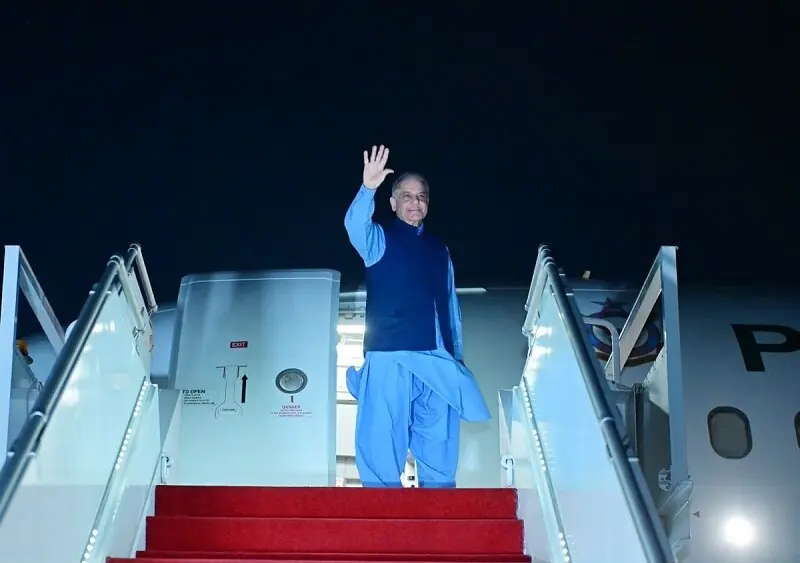
Pakistani Prime Minister Shehbaz Sharif and Chief of Defence Forces Field Marshal Asim Munir flew to Switzerland on Sunday to attend technical-level talks between the United States and Iran at Burgenstock, days after a landmark peace deal ended more than 100 days of war between the two countries.
The talks follow a 14-point agreement signed on Thursday by US President Donald Trump and Iranian President Masoud Pezeshkian, with Prime Minister Sharif signing as mediator. The deal established a framework to end the conflict, reopen the Strait of Hormuz, lift the US blockade on Iran, and set a 60-day timeline for further negotiations. Pakistan and Qatar are the named mediators in the process.
Pakistan's Foreign Office confirmed on Saturday that the Burgenstock discussions would involve representatives from both the US and Iran, alongside the two mediating countries. The Prime Minister's Office said Sharif and Field Marshal Munir are accompanied by a high-level delegation. The technical talks are intended to advance the understandings set out in what is being called the Islamabad Memorandum of Understanding.
On the American side, US Vice President JD Vance said he intends to travel to Switzerland "soon." US special envoy Steve Witkoff and Jared Kushner, President Trump's son-in-law, are already on the ground in Switzerland. Vance told Fox News that negotiations with Iran "are going well" but that the US "has all the cards," signalling Washington intends to press its position on the terms of implementation.
Iran confirmed it is sending a delegation, with foreign ministry spokesperson Esmaeil Baghaei saying Tehran will use the talks to "press for the fulfilment of the other side's commitments." Baghaei specifically named Israel's ongoing attacks on Lebanon as an obligation the US must address, stating that Washington is "obligated to compel the Zionist regime to cease its attacks." He warned that if any part of the agreement is not implemented, "the entirety of the agreement will be jeopardised," a signal that Tehran sees the deal as conditional and fragile.
The core economic weight of this agreement sits in two places. First, the Strait of Hormuz reopening directly unblocks one of the world's most critical oil shipping lanes, through which roughly 20 percent of global petroleum trade passes. Its closure had contributed to the economic crisis referenced in the agreement's context. A functioning Strait restores a key pressure valve for global energy markets.
Second, the deal includes a provision for a $300 billion reconstruction fund for Iran, to be facilitated by the US once a final agreement is reached on Iran's nuclear ambitions. That final agreement does not yet exist. The 60-day negotiation window now running means the fund and the full normalisation of US-Iran relations remain contingent on those nuclear talks concluding successfully.
Pakistan's role in this process is notably elevated. Sharif signing as mediator on the original deal, and now leading the Pakistani delegation to technical follow-up talks, places Islamabad in a diplomatically significant position between Washington and Tehran. For a country that has historically navigated complex relationships with both the West and the Islamic world, this mediation role carries real strategic weight.
The immediate test for the Burgenstock talks is whether both sides can agree on an implementation schedule for commitments already made. Iran's public posture going in is assertive: it says it has held up its end and is waiting for the US to act. The US posture, as stated by Vance, is confident but non-specific. Whether the gap between those two positions can be bridged in the days ahead will determine whether the 60-day window leads to a durable settlement or a breakdown.
The international community has broadly welcomed the original deal, and the presence of senior Pakistani and Qatari mediators at the technical level suggests both sides still want the process to hold. But Iran's explicit warning that incomplete implementation could void the entire agreement means the next several weeks carry significant risk for energy markets, regional stability, and the broader reconstruction timeline.
Qatar's foreign ministry said mediators including Qatar, Pakistan, and Oman have reached "very progressive stages" in efforts to end the US-Iran war, pushing Brent crude down more than four percent.
Qatar confirmed it is mediating between the US and Iran but said no direct talks are currently planned. The clarification follows conflicting statements from President Trump, who claimed talks are under way, and Tehran, which denied any dialogue is happening.
Saudi Aramco reported sharply higher second-quarter 2026 profits as the Iran war restricts global oil supply and pushes crude prices up. Other oil supermajors also posted outsized earnings, raising concerns about sustained fuel cost pressure for importing economies.
President Trump called current Iran negotiations the "last chance" to end five months of conflict, pushing oil prices higher. Tehran denied formal talks are taking place, raising the risk of a diplomatic breakdown with direct consequences for global energy markets.