India to Restore UPI Merchant Fees, PhonePe Gains Most
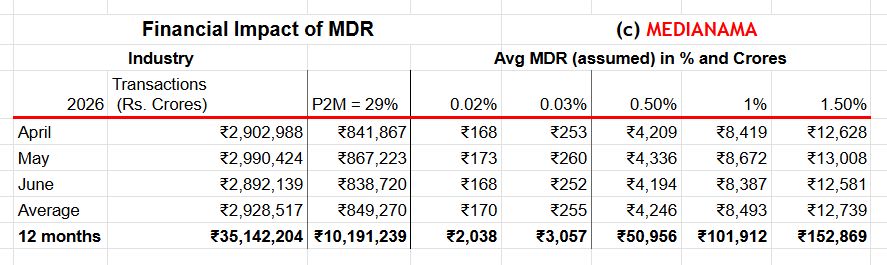
India's government plans to amend the Payment and Settlement Systems Act to restore UPI merchant discount rates, ending the zero-MDR regime in place since January 2020.
Key Takeaways
July 2, 2026 · 4 min read · By Rishabh Bhardwaj
·
AI-assisted, human-reviewed · Our editorial standards

India's Department of Telecommunications published draft spectrum assignment rules on June 18, 2026, that set out how the government allocates radio frequencies without an auction. The rules cover 19 categories of users under the Telecommunications Act, 2023, but leave out every operator running consumer satellite broadband, including Starlink, Eutelsat OneWeb, and Jio Satellite Communications.
The draft, called the Telecommunications (Spectrum Assignment by Administrative Process) Rules, 2026, is open for public comment until July 18, 2026. It builds a detailed framework for traditional geostationary satellite services but says nothing about the non-geostationary orbit (NGSO) operators that run constellations of low-orbit satellites to deliver fast, low-latency internet to homes and businesses.
On the satellite side, the Department of Telecommunications has priced and set conditions for Geo-Stationary Orbit (GSO) services, where a single satellite holds a fixed position above the equator. Covered services include teleports, television channels, Direct-to-Home TV, Digital Satellite News Gathering, corporate Very Small Aperture Terminal (VSAT) connections, and BSNL's satellite phone service. For commercial GSO VSAT, fees are revenue-linked: operators pay 3% of adjusted gross revenue (AGR) for speeds up to 128 kbps, 3.5% up to 512 kbps, and 4% up to 2 Mbps. BSNL's satellite phone service pays 1% of AGR. A non-refundable application fee of Rs 1,000 applies to every applicant.
NGSO operators, which are the ones behind consumer satellite broadband, do not appear in the fee schedule or anywhere else in the draft. Starlink, OneWeb, and Jio Satellite Communications already hold Global Mobile Personal Communication by Satellite (GMPCS) licences and authorisations from the Indian National Space Promotion and Authorisation Centre (IN-SPACe). What they lack is assigned spectrum. Because the government cannot assign spectrum until it publishes a price and conditions, commercial satellite broadband effectively cannot launch in India as long as NGSO remains absent from the rules.
The omission is striking given that the Telecom Regulatory Authority of India (TRAI) issued final recommendations in May 2025, after a reference trail stretching back to 2021, advising a charge of 4% of AGR for NGSO fixed satellite services. This draft implements none of those recommendations. TRAI and DoT have been working through satellite spectrum policy for over four years, making the exclusion a deliberate choice rather than an oversight.
For the services the rules do cover, a licence alone is not enough to get spectrum. Operators must first clear security and site checks for their radio equipment. The government then issues a letter of intent before the actual assignment follows. The rules also require that key managerial personnel at the company meet security criteria that the Central Government specifies, attaching individual-level obligations alongside company-level ones.
Even after spectrum is assigned, operators cannot connect their network to public telecommunications networks, including the internet, landline phones, or mobile networks, without Central Government permission. The rules set no timeline, process, or criteria for that permission, leaving a gap that could delay commercial operations indefinitely even for operators who receive spectrum.
The government also retains the right to modify, vary, or make technical adjustments to an assignment on its own if it decides this is expedient, for reasons such as managing interference or re-farming spectrum. Operators must comply within the government's timeline, though the assignment duration itself does not shrink.
On the security front, Bloomberg reported in June 2026 that security agencies had frozen Starlink's final clearances over national security concerns, a hurdle separate from the missing spectrum framework. Starlink has disputed that report, saying it remains in active discussions with the government.
The broader context matters here. India's National Broadband Mission 2.0 promotes satellite broadband specifically for remote and hilly areas that fibre cannot easily reach. Keeping NGSO spectrum rules unresolved stalls the very services the government's own broadband program is meant to deploy. Operators, investors, and rural connectivity advocates will watch whether DoT addresses NGSO in a separate rulemaking or folds it into this framework before the public comment window closes on July 18.
India's government plans to amend the Payment and Settlement Systems Act to restore UPI merchant discount rates, ending the zero-MDR regime in place since January 2020.
India's government has introduced the Taxation and Other Laws (Amendment) Bill, 2026, proposing changes to payments regulation, income tax, and the Finance Act to attract FDI and support Make in India. The Bill's final shape will depend on parliamentary debate and committee review.
The government's Taxation and Other Laws (Amendment) Bill, 2026, proposes to replace the blanket UPI MDR ban with a system allowing the Centre to notify which payment modes stay fee-free.
Prime Minister Narendra Modi inaugurated the Rs 5,000 crore Bhogapuram greenfield airport in Andhra Pradesh, built under a public-private partnership model. He also laid foundation stones for infrastructure projects worth nearly Rs 18,000 crore in the state, signalling a broad investment push for the region.