
Qatar Signals Progress in US-Iran War Talks
Qatar's foreign ministry said mediators including Qatar, Pakistan, and Oman have reached "very progressive stages" in efforts to end the US-Iran war, pushing Brent crude down more than four percent.
Key Takeaways
May 4, 2026 · 2 min read · By Rishabh Bhardwaj
·
AI-assisted, human-reviewed · Our editorial standards
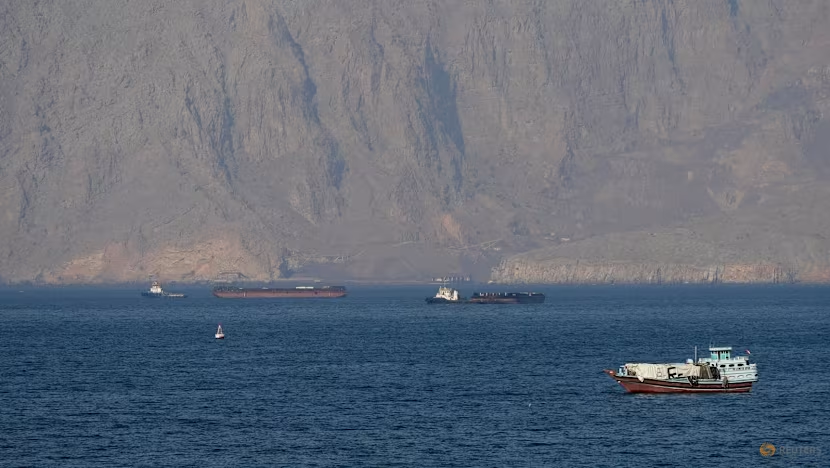
Iran's military claimed it turned back a US warship attempting to enter the Strait of Hormuz, a narrow chokepoint through which roughly one-fifth of global oil trade passes. US Central Command (CENTCOM) denied a separate Iranian claim of a missile strike on American forces, calling it false. The two accounts are directly contradictory, and neither side has offered independent verification.
The incident follows a public warning by Iranian forces that US military vessels would not be permitted to enter the strait. That warning came after President Donald Trump said the US would "guide out" ships stranded in the Persian Gulf following what Iran described as a US-Israeli war on Iran. The precise nature of that conflict and what ships were stranded is not detailed in available reporting.
The Strait of Hormuz is one of the world's most critical energy corridors. Saudi Arabia, Iraq, the UAE, Kuwait, and Iran all export oil through it. Any credible disruption, or even the sustained threat of one, typically pushes crude prices higher and raises insurance costs for tankers transiting the region.
A standoff between US naval forces and Iran at this chokepoint is particularly sensitive for energy markets. Traders watch Hormuz closely because a closure or blockade, even a partial or temporary one, could rapidly tighten global oil supply. That pressure would ripple quickly into fuel costs for consumers and input costs for manufacturers worldwide.
The gap between Iran's account and CENTCOM's denial is wide. Iran claims both a naval confrontation and a missile strike; the US rejects the missile claim outright. Without independent confirmation, the key facts in dispute include whether any warship was redirected, whether any missile was fired, and what rules of engagement currently govern US naval movement in and around the strait.
What is clear is that tensions in the Persian Gulf are running high enough that both sides are making public statements designed to signal resolve. Iran's warnings are aimed at deterring US military movement; CENTCOM's denial is aimed at preventing the Iranian narrative from taking hold internationally.
Watch for official US Navy statements on current fleet positioning in the Gulf, any corroborating satellite or ship-tracking data, and whether crude oil futures react to the contested reports in early trading sessions.
Qatar's foreign ministry said mediators including Qatar, Pakistan, and Oman have reached "very progressive stages" in efforts to end the US-Iran war, pushing Brent crude down more than four percent.
Qatar confirmed it is mediating between the US and Iran but said no direct talks are currently planned. The clarification follows conflicting statements from President Trump, who claimed talks are under way, and Tehran, which denied any dialogue is happening.
Saudi Aramco reported sharply higher second-quarter 2026 profits as the Iran war restricts global oil supply and pushes crude prices up. Other oil supermajors also posted outsized earnings, raising concerns about sustained fuel cost pressure for importing economies.
President Trump called current Iran negotiations the "last chance" to end five months of conflict, pushing oil prices higher. Tehran denied formal talks are taking place, raising the risk of a diplomatic breakdown with direct consequences for global energy markets.