
Qatar Signals Progress in US-Iran War Talks
Qatar's foreign ministry said mediators including Qatar, Pakistan, and Oman have reached "very progressive stages" in efforts to end the US-Iran war, pushing Brent crude down more than four percent.
Key Takeaways
May 9, 2026 · 2 min read · By Rishabh Bhardwaj
·
AI-assisted, human-reviewed · Our editorial standards
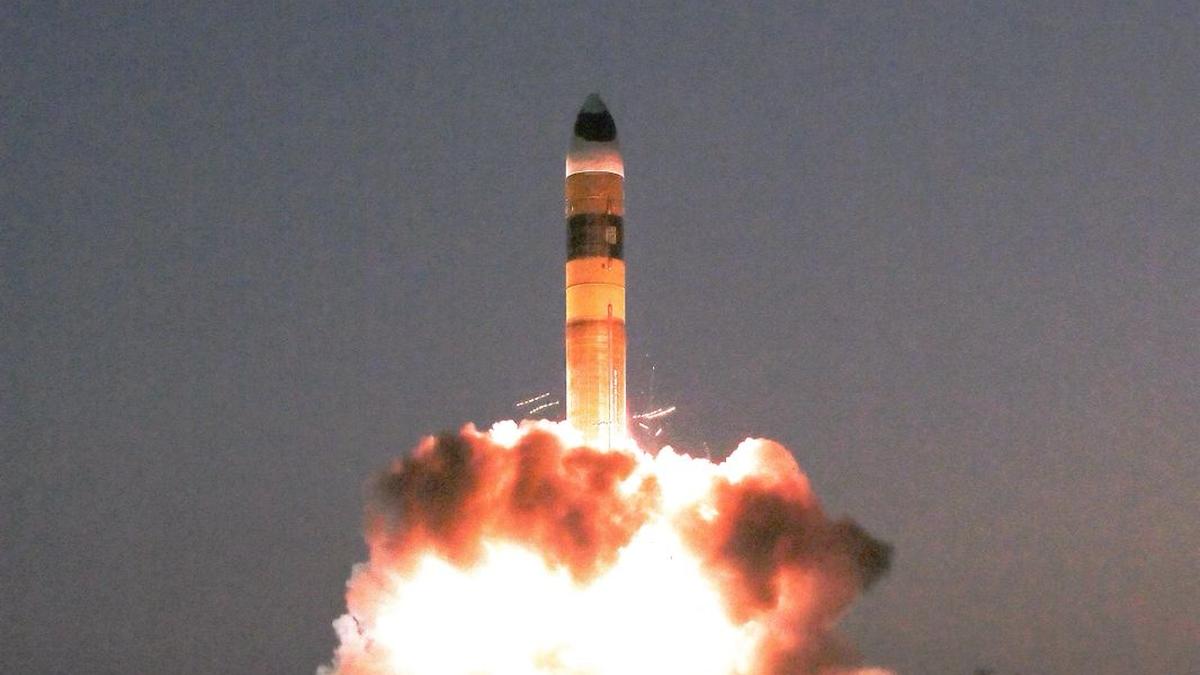
India has successfully flight-tested an advanced variant of the Agni ballistic missile, with the trial conducted over the Indian Ocean Region. The test involved multiple payloads aimed at different targets spread across a wide geographical area, a configuration that signals a significant step in India's strategic deterrence capability.
Testing a missile with multiple payloads against spatially distributed targets is the defining feature of a Multiple Independently Targetable Re-entry Vehicle, or MIRV, system. In a MIRV-equipped missile, a single launch can release several warheads, each guided to a separate target. This makes the weapon far harder to intercept than a single-warhead missile, because a defensive system would need to track and destroy several fast-moving objects simultaneously.
India crossed into MIRV territory in March 2024 when it tested the Agni-5 under Mission Divyastra, the first publicly confirmed MIRV test in the country's missile programme. This latest flight trial appears to build on that capability, though the specific Agni variant tested has not been named in the available information.
The Indian Ocean Region as a test corridor is itself a deliberate choice. It allows India to test long-range trajectories without overflying neighbouring countries, while demonstrating reach across a strategically critical maritime zone where India, China, and several other powers compete for influence.
A credible MIRV capability strengthens India's second-strike deterrence, the assurance that even after absorbing a nuclear first strike, India can retaliate with enough surviving missiles to inflict unacceptable damage. Adversaries with missile defence systems, notably China and Pakistan, must now account for the possibility that a single incoming Agni could release multiple warheads on different targets.
India's Defence Research and Development Organisation (DRDO) has been the driving force behind the Agni programme, with each successive test expanding the range, accuracy, and payload complexity of the missile family. The Agni series ranges from the short-range Agni-1 to the intercontinental-range Agni-5, with longer-range variants reportedly under development.
The broader implication for India's nuclear posture is that its deterrent is becoming more survivable and more difficult to neutralise in a pre-emptive strike, a shift that carries weight in the context of both the India-Pakistan and India-China security equations. Observers will watch for any official confirmation of the variant tested, the number of payloads deployed, and whether the trial feeds into a near-term induction into active service.
Qatar's foreign ministry said mediators including Qatar, Pakistan, and Oman have reached "very progressive stages" in efforts to end the US-Iran war, pushing Brent crude down more than four percent.
Qatar confirmed it is mediating between the US and Iran but said no direct talks are currently planned. The clarification follows conflicting statements from President Trump, who claimed talks are under way, and Tehran, which denied any dialogue is happening.
Saudi Aramco reported sharply higher second-quarter 2026 profits as the Iran war restricts global oil supply and pushes crude prices up. Other oil supermajors also posted outsized earnings, raising concerns about sustained fuel cost pressure for importing economies.
President Trump called current Iran negotiations the "last chance" to end five months of conflict, pushing oil prices higher. Tehran denied formal talks are taking place, raising the risk of a diplomatic breakdown with direct consequences for global energy markets.