
Qatar Signals Progress in US-Iran War Talks
Qatar's foreign ministry said mediators including Qatar, Pakistan, and Oman have reached "very progressive stages" in efforts to end the US-Iran war, pushing Brent crude down more than four percent.
Key Takeaways
May 2, 2026 · 2 min read · By Rishabh Bhardwaj
·
AI-assisted, human-reviewed · Our editorial standards
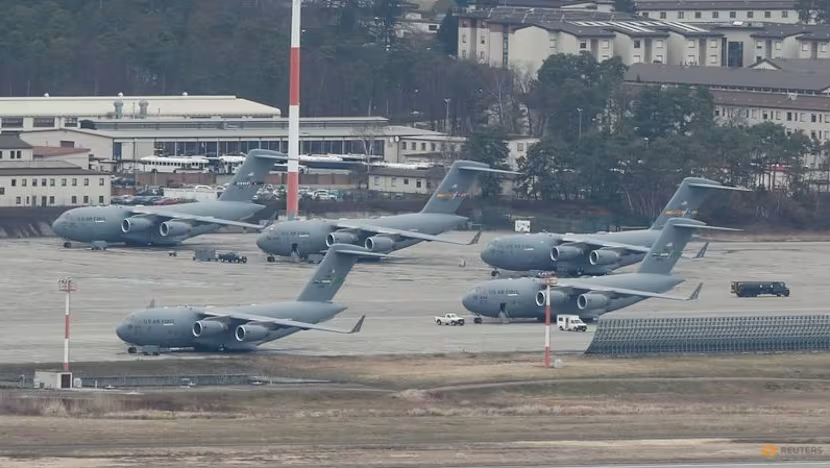
Germany's defence minister has called on European nations to take greater responsibility for their own security, responding directly to a US announcement that it plans to draw down its troop presence in Europe.
The statement marks a significant shift in tone from Berlin. For decades, Germany relied heavily on the American security umbrella through NATO, keeping its own defence spending low and avoiding large-scale military commitments. That posture has been under sustained pressure since Russia's full-scale invasion of Ukraine in 2022, and the latest US signal accelerates the debate considerably.
A US troop drawdown from Europe would reduce the forward deterrence that Washington has maintained since the Cold War. American forces stationed on the continent, particularly in Germany, Poland, and the Baltics, serve both a practical and symbolic role: they signal that an attack on a NATO ally triggers an immediate American military response. Thinning that presence, even partially, weakens that signal and puts pressure on European members to fill the gap themselves.
Germany is the largest economy in the European Union and NATO's most strategically central member in continental Europe. When Berlin speaks about burden-sharing, other capitals listen. A public call from the defence minister to step up carries more political weight than routine summit communiqués.
European governments have already been moving in this direction. Several NATO members crossed the alliance's 2% of GDP defence spending target in recent years, and the European Union has been building new frameworks for joint procurement and capability development. But a formal US drawdown would force those efforts to move faster and at larger scale.
The details of the US drawdown, how many troops, from which countries, and on what timeline, will determine how urgent the European response needs to be. Germany's own defence budget trajectory will be closely watched, as will any coordinated EU or NATO response. Whether this call from Berlin translates into concrete spending commitments or remains rhetorical is the key question in the weeks ahead.
Qatar's foreign ministry said mediators including Qatar, Pakistan, and Oman have reached "very progressive stages" in efforts to end the US-Iran war, pushing Brent crude down more than four percent.
Qatar confirmed it is mediating between the US and Iran but said no direct talks are currently planned. The clarification follows conflicting statements from President Trump, who claimed talks are under way, and Tehran, which denied any dialogue is happening.
Saudi Aramco reported sharply higher second-quarter 2026 profits as the Iran war restricts global oil supply and pushes crude prices up. Other oil supermajors also posted outsized earnings, raising concerns about sustained fuel cost pressure for importing economies.
President Trump called current Iran negotiations the "last chance" to end five months of conflict, pushing oil prices higher. Tehran denied formal talks are taking place, raising the risk of a diplomatic breakdown with direct consequences for global energy markets.