
Qatar Signals Progress in US-Iran War Talks
Qatar's foreign ministry said mediators including Qatar, Pakistan, and Oman have reached "very progressive stages" in efforts to end the US-Iran war, pushing Brent crude down more than four percent.
Key Takeaways
June 10, 2026 · 3 min read · By Rishabh Bhardwaj
·
AI-assisted, human-reviewed · Our editorial standards
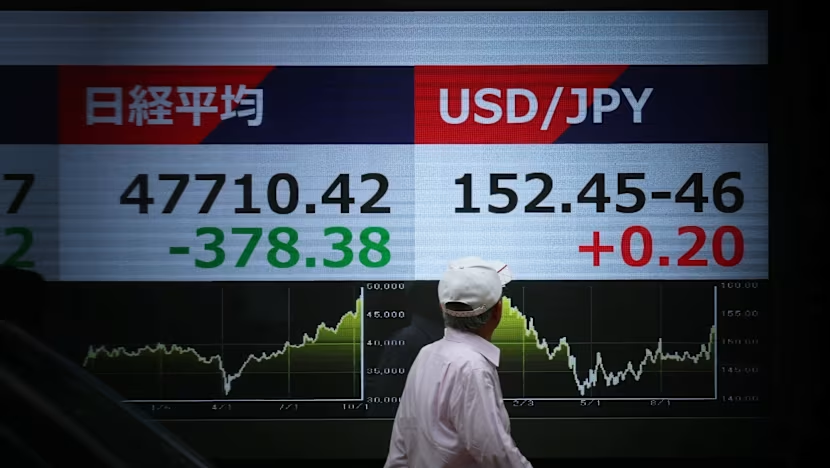
Asian stocks fell and oil prices rose after the United States launched military strikes against Iran, following President Donald Trump's statement that Tehran had shot down a US Apache helicopter in the Strait of Hormuz. The escalation pushed investors toward caution, driving a broad sell-off across regional equity markets.
Trump confirmed the strikes after announcing that Iranian forces had downed an American Apache helicopter in the Strait of Hormuz, one of the world's most critical shipping corridors. Roughly 20 percent of global oil supply passes through the strait each day, which means any military activity there carries immediate consequences for energy markets and global trade.
Oil prices climbed on the news, reflecting the market's concern about supply disruption risk. When tensions rise in the Gulf, traders typically price in a risk premium on crude, since a closure or sustained conflict in the Strait of Hormuz would choke off tanker traffic and tighten global supply fast.
Asian equity markets slid in response, with investors pulling back from riskier assets. The pattern is familiar: geopolitical shocks in the Middle East tend to trigger a flight to safety, pushing money out of stocks and into assets like gold, US Treasuries, and the dollar. That rotation can happen quickly, especially when the news involves direct US military action against a major oil-producing state.
The immediate question for markets is whether the strikes represent a contained response or the opening move in a broader conflict. If the situation stabilises, the oil risk premium could fade and equities may recover. If Iran retaliates, the calculus changes sharply: prolonged disruption to Hormuz traffic would push oil prices meaningfully higher, feeding into inflation and adding pressure on central banks that are already navigating a difficult rate environment.
For Asia specifically, the exposure is significant. Countries like India, Japan, South Korea, and China are among the largest importers of Gulf oil. A sustained price spike would widen their import bills, pressure current account balances, and squeeze corporate margins across energy-intensive sectors.
Shipping and insurance costs are also worth watching. Any sustained military activity near the strait tends to raise war-risk insurance premiums for tankers, which eventually filters into the cost of moving goods and commodities globally.
The diplomatic track matters too. How Iran responds, and whether other regional actors are drawn in, will define how long this episode weighs on markets. Investors will be watching for any statement from Tehran, any US indication of further military intent, and any signal from Gulf states about oil production or export continuity.
For now, the story is still moving fast. The facts on the ground are limited, and the full market reaction will depend heavily on developments in the hours and days ahead. The core risk is straightforward: a military confrontation between the US and Iran, centred on the world's most important oil chokepoint, is one of the scenarios that energy and geopolitical analysts have long flagged as capable of delivering a significant global economic shock.
Qatar's foreign ministry said mediators including Qatar, Pakistan, and Oman have reached "very progressive stages" in efforts to end the US-Iran war, pushing Brent crude down more than four percent.
Qatar confirmed it is mediating between the US and Iran but said no direct talks are currently planned. The clarification follows conflicting statements from President Trump, who claimed talks are under way, and Tehran, which denied any dialogue is happening.
Saudi Aramco reported sharply higher second-quarter 2026 profits as the Iran war restricts global oil supply and pushes crude prices up. Other oil supermajors also posted outsized earnings, raising concerns about sustained fuel cost pressure for importing economies.
President Trump called current Iran negotiations the "last chance" to end five months of conflict, pushing oil prices higher. Tehran denied formal talks are taking place, raising the risk of a diplomatic breakdown with direct consequences for global energy markets.