One of America's top military commanders has privately warned Pentagon officials that the United States may lack sufficient naval and missile-defence resources to simultaneously protect Israel from Iranian attacks and defend its own forces across the Middle East. The warning, delivered by General Alexus Grynkewich, commander of US European Command, signals that the Iran conflict is straining American military capacity in ways that go well beyond the immediate battlefield.
Grynkewich reportedly told Pentagon officials that without an additional US Navy destroyer assigned to the region, commanders could soon face a direct choice between shielding American forces and continuing missile-defence operations for Israel. The significance here is not just the shortage. It is that the warning came from inside the chain of command, not from an outside critic. Grynkewich is among the senior officers responsible for managing these commitments, which makes his concern an operational signal rather than a policy opinion.
How the inventory was consumed
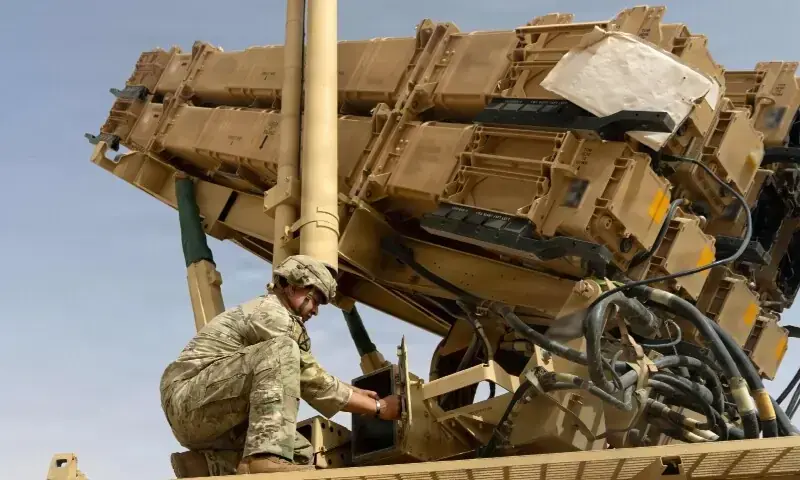
The numbers behind the warning are stark. According to an analysis by the Center for Strategic and International Studies, cited by CNN, US forces have used roughly 45 percent of their Precision Strike Missiles, at least half of their THAAD interceptors, around 50 percent of their Patriot interceptors, approximately 30 percent of their Tomahawk cruise missiles, over 20 percent of their Joint Air-to-Surface Standoff Missiles, and around 20 percent of their SM-3 and SM-6 interceptors. Separately, The Washington Post reported that US forces fired more than 200 THAAD interceptors during the conflict, roughly half the Pentagon's total reported inventory, alongside over 100 interceptors launched from Navy ships.
Israel deployed its own Arrow and David's Sling systems but leaned heavily on American firepower during the most intense exchanges. The combined draw-down has been faster than the defence industrial base can replenish. Advanced interceptors are precision-manufactured weapons that take years to produce. Firing hundreds of them in weeks is a fundamentally different consumption rate than the peacetime replacement cycle was designed to handle.
Navy destroyers fitted with the Aegis combat system are the linchpin of this missile-defence architecture. They track incoming ballistic missiles and launch SM-3 and SM-6 interceptors. But those same destroyers carry equal strategic weight in the Pacific, where they serve as a deterrent against China, in Europe, where they support NATO commitments, and in the Middle East, where they guard American bases and shipping lanes. Every destroyer anchored to Israel's defence is one fewer ship available for any other potential flashpoint.
Why this matters beyond the current conflict
For decades, American military planning has rested on the assumption that the United States can manage several crises at once. That assumption is now being tested in a concrete, quantifiable way. The Pentagon is not facing a question of overall military strength. It is facing a question of whether industrial production, stockpile depth, and force distribution can keep pace with simultaneous high-intensity demands across different theatres.
The resource pressure creates a political dilemma as well as a military one. If Pentagon planners must choose between protecting American personnel at regional bases and sustaining Israel's missile shield, that is no longer a strategic abstraction. It becomes a live operational decision with alliance consequences either way.
What the Grynkewich warning does not resolve is timeline. Replenishing THAAD and Patriot interceptors, rebuilding Tomahawk stocks, and rotating fresh destroyer deployments will all take time measured in months or years, not weeks. The gap between consumption and production was a known concern in defence planning circles before this conflict began. The Iran war has converted a theoretical vulnerability into an active constraint.
The broader lesson for defence planners and markets exposed to defence supply chains is straightforward: modern high-intensity conflict burns through precision munitions at a rate that peacetime procurement schedules were not built to match. That mismatch, now visible inside one of America's active commands, is likely to accelerate debates over defence spending, allied burden-sharing, and the pace of weapons production contracts well beyond the current conflict's end.