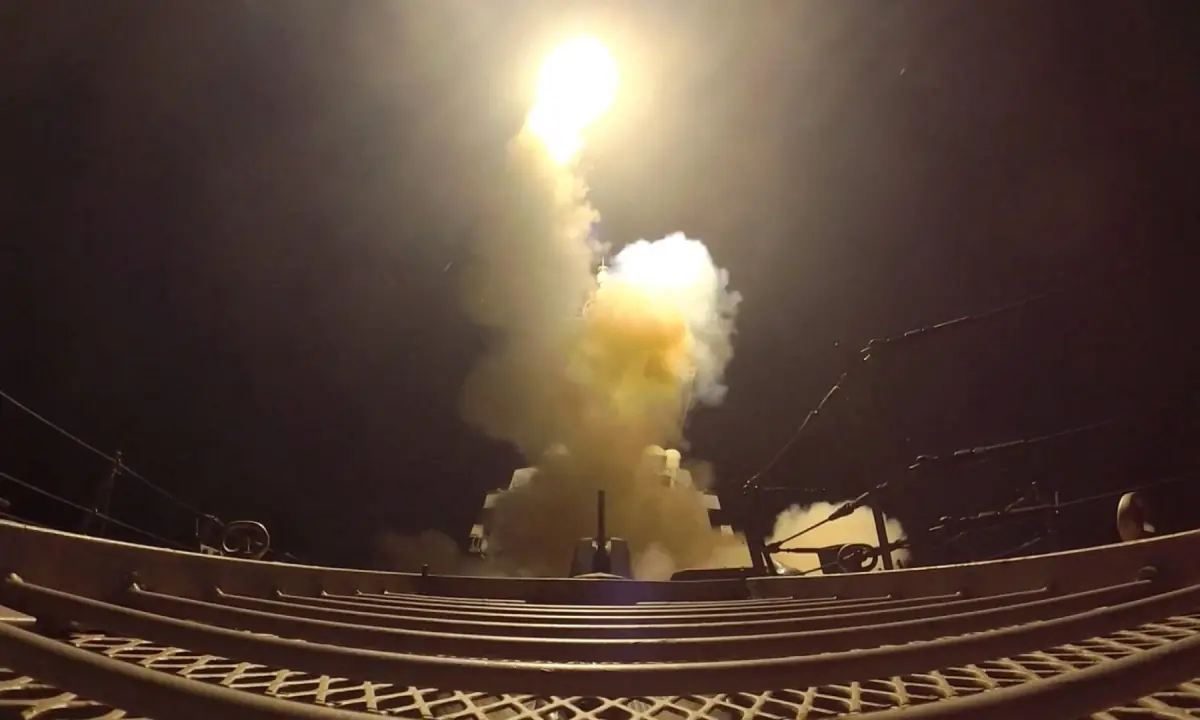
The United States carried out a second consecutive day of strikes against Iran on Monday, targeting air defence systems, coastal radar sites, missile and drone capabilities, and small boats across southern and western Iran. Iran's Revolutionary Guards hit back by launching missile and drone attacks on US military installations in Jordan, Bahrain, Kuwait, and Oman. The escalation marks a sharp collapse of a diplomatic framework that had been holding since June, and it is now pushing oil prices sharply higher while threatening one of the world's most critical shipping lanes.
US Central Command (Centcom) said its latest wave of strikes began at 2100 GMT on Sunday and used fighter aircraft, naval vessels, one-way attack aerial drones, and sea drones, the latter deployed in this capacity for the first time. The stated objective was to degrade Iran's ability to interfere with commercial shipping through the Strait of Hormuz. The previous day's strikes had hit 140 Iranian military targets, according to Centcom. Monday's wave extended to Qeshm island, Bandar Abbas, and Khuzestan province bordering Iraq. Iranian state media reported one person killed and four injured, with a water pumping station in Mahshahr city among the sites hit.
Iran's response was coordinated and multi-country. The Islamic Republic News Agency (IRNA) cited the Revolutionary Guards Corps (IRGC) as claiming strikes on Prince Hassan Air Base in Jordan, a drone command centre in Bahrain, Ali Al Salem and Ahmad Al Jaber airbases in Kuwait, and radar systems in Oman. The IRGC said its attacks set fire to fuel storage tanks and ammunition depots on the Jordanian base. It also claimed destruction of US naval facilities in Jafirah, Bahrain. The US Fifth Fleet headquarters is in Bahrain but was not among the sites named. There was no immediate US confirmation or denial of damage at these locations.
How the Strait Became the Flashpoint
The current escalation traces directly to Iran's move to assert control over the Strait of Hormuz, through which roughly a fifth of global oil trade flows. After what Iran described as a warning shot on a commercial vessel in the strait, the ship's crew abandoned it as it caught fire. The IRGC then declared the strait closed until US forces withdrew from the region. Centcom rejected that claim, posting that traffic was flowing and that Iran did not control the strait. Ship-tracking data from Kpler told a more complicated story: only six vessels passed through on Sunday, the lowest count in five weeks.
An adviser to Iran's supreme leader framed control of the strait as more strategically valuable than, in his words, dozens of atomic bombs. That framing signals how central Hormuz has become to Tehran's leverage calculus, and it explains why both sides are willing to sustain military exchanges rather than step back.
Diplomatic Collapse and Oil Market Response
The military flareup follows President Donald Trump's declaration this week that a ceasefire agreed under an interim accord signed on June 18 was effectively over. That accord had briefly stabilised expectations and pulled oil prices lower. The renewed fighting reversed that quickly: oil futures rose more than 3.5 percent when Tokyo trading opened Monday, with the US benchmark WTI jumping above $74 a barrel.
Pakistan is among the mediators trying to prevent a full breakdown. Deputy Prime Minister and Foreign Minister Ishaq Dar spoke with Iranian Foreign Minister Abbas Araghchi on Sunday and called for de-escalation. UN Secretary General Antonio Guterres, through his spokesman, said the attacks must stop. Iran's foreign ministry said the US strikes had returned insecurity to the strait and made peace efforts futile.
The conflict, which began in late February, has already sent global economic shockwaves. The latest exchange raises the stakes considerably. Any sustained closure or credible threat to Hormuz would tighten global oil supply quickly, with knock-on effects for energy prices, freight costs, and import-dependent economies, including India, which relies heavily on Gulf crude.
For now, Centcom maintains that the strait remains open and that US forces are positioned to keep it that way. But with Iran signalling it views closure as its primary point of leverage, and with diplomatic frameworks visibly fraying, the gap between those two positions is the most important variable to watch in the days ahead.