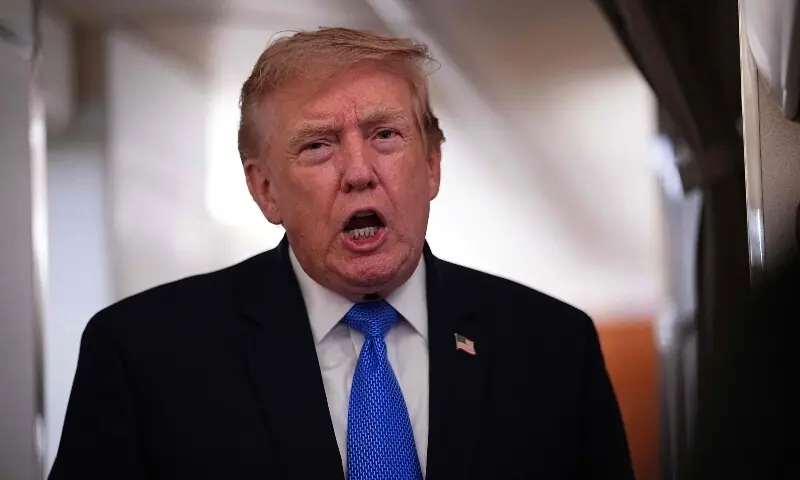
US President Donald Trump announced on Sunday that new negotiations with Iran will begin Monday afternoon, pulling back from what he described as a massive planned military strike and opening a fresh diplomatic window in a war now entering its sixth month.
The talks, according to Trump, will cover two interlinked issues: access to the Strait of Hormuz, the narrow waterway through which a significant share of global oil passes, and the broader question of Iran's nuclear programme. Trump told reporters aboard Air Force One that the "parameters" of a deal were already in place, though he offered no details on the venue or who would participate.
Oil markets reacted immediately. West Texas Intermediate crude fell 4.7 percent to $80.72 per barrel at the opening of Asian trade on Monday, a sign that investors see reduced near-term risk of a supply disruption from the region. The drop reflects the sensitivity of energy markets to this conflict: the Strait of Hormuz handles a large portion of seaborne oil exports, and any sustained closure or restriction drives up prices globally.
How the war reached this point
Washington and Tehran have been at war since February 28, 2026, when the US and Israel launched coordinated surprise strikes against Iran. The months since have been marked by on-and-off diplomacy and periodic escalations. A ceasefire agreement reached in June, which included a memorandum of understanding and provisions on Hormuz access, collapsed before a final deal could be concluded. Iran subsequently tightened its grip on the strait, demanding ships pay tolls and travel only along the Iranian coastline. The US rejected those terms, and strikes resumed last month.
In the days before Sunday's announcement, Trump had threatened to hit Iran "very hard," with reports pointing to potential strikes on energy infrastructure and US embassies across the region placed on alert. Trump said he stood down after being asked by Iran and by US partners Saudi Arabia, the United Arab Emirates, and Qatar to hold off. Iranian media disputed that Tehran had made such a request.
The White House has consistently framed the conflict as necessary to eliminate Iran's nuclear programme. Western governments accuse Iran of pursuing a nuclear weapon. Tehran insists its programme is civilian.
What Iran is saying and what Oman may offer
Iranian lawmaker Hassan Ghashghavi, spokesman for parliament's national security commission, confirmed Sunday that mediators are working to revive the June memorandum of understanding as a stepping stone to wider talks. "They know that the main issue and, in fact, the key to the matter right now is the issue of the Strait of Hormuz, so yes, there is an exchange of views," he said. Iranian President Masoud Pezeshkian posted on X that Iran "must strive to compel the enemy to remain committed to what it has signed."
Separately, Iranian foreign ministry spokesman Esmaeil Baqaei told state television that Iran was close to an agreement with Oman, which sits on the southern side of the strait, on a new transit route that would respect both countries' sovereign rights. He was clear that this would not amount to a full reopening of the strait. Before the war, vessels passed through freely. Iran now insists on retaining control and collecting tolls, a position the US has not accepted.
The volatility of the waterway was underscored Sunday when a tanker off the Omani coast reported hearing a nearby explosion. The United Kingdom Maritime Trade Operations (UKMTO) Centre confirmed the vessel and crew were safe. Maritime tracking firm Kpler reported Friday that traffic through Hormuz had dropped sharply since the dispute over access intensified.
The central tension heading into Monday's talks is straightforward: the US wants free passage restored; Iran wants to keep formal control and revenue from the strait. An Oman-brokered middle route may offer a face-saving compromise, but Baqaei's careful language suggests Iran is not ready to call it a reopening. Whether the June memorandum can be rebuilt into something durable, and whether military restraint holds long enough for that to happen, are the two questions that will define the coming days.