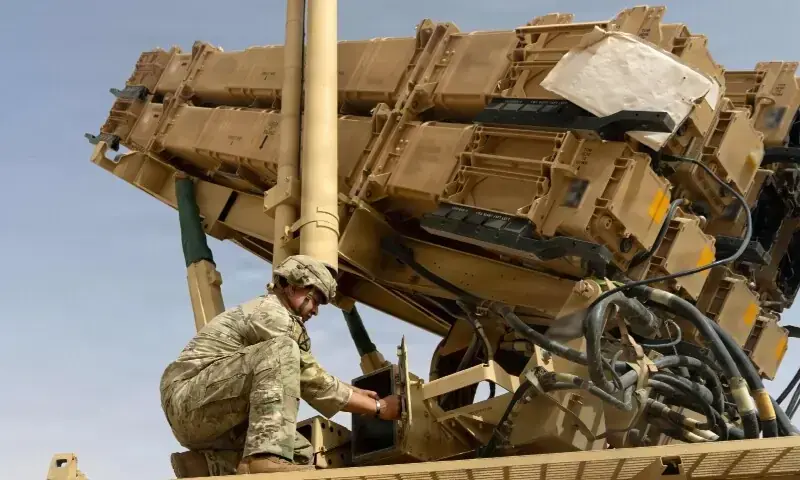
US commander warns forces too thin to defend Israel
General Alexus Grynkewich, commander of US European Command, has privately warned the Pentagon that naval assets are stretched too thin to defend Israel and protect US interests simultaneously.
Key Takeaways
August 2, 2026 · 3 min read · By Rishabh Bhardwaj
·
AI-assisted, human-reviewed · Our editorial standards

Talks between the United States and Iran over the Strait of Hormuz have ended without a breakthrough, as President Donald Trump paused plans for military strikes on Iran. Tehran, in turn, dismissed Trump's public statements about pulling back from those threatened strikes as part of what it called a psychological operations campaign.
The Strait of Hormuz is one of the world's most consequential shipping chokepoints. Roughly 20 percent of global oil supply passes through the narrow waterway between Iran and Oman. Any disruption there, whether through military action, mining, or naval blockade, would send immediate shockwaves through global energy markets and push crude prices sharply higher.
Trump's decision to halt the threatened attack, at least for now, appears to have opened a narrow diplomatic window. But Iran's response suggests the two sides are not reading the situation the same way. By framing Trump's retreat as psychological pressure rather than a genuine concession, Iranian officials are signaling they do not view the pause as a softening of the American position, and they are not prepared to offer concessions in return.
The broader standoff centers on Iranian influence over the Strait of Hormuz, the only sea route connecting the Persian Gulf to the open ocean. Iran has long held the ability to threaten or partially restrict passage through the strait as a strategic lever against Western pressure, particularly sanctions. When tensions escalate, oil markets price in a risk premium almost immediately, affecting fuel costs, freight rates, and inflation across energy-importing economies including India, which sources a large share of its crude from the Gulf region.
For global markets in August 2026, the absence of a deal is not neutral news. It means the risk of sudden escalation remains live. Traders and energy companies cannot price in a stable outcome, which tends to keep a floor under oil prices even when physical supply has not yet been disrupted. Insurance premiums for tankers transiting the Gulf have already risen during previous episodes of US-Iran tension, and that dynamic is likely to recur if the standoff continues.
Iran's framing of Trump's comments as psychological operations is also diplomatically significant. It tells other regional actors, Gulf states, China, and Russia among them, that Tehran does not believe the American posture has fundamentally shifted. That reading, right or wrong, shapes how those third parties position themselves in any follow-on negotiations.
The critical question now is whether the diplomatic pause leads to a structured negotiation or simply delays a confrontation. No timeline for resumed talks has emerged from publicly available information, and neither side has confirmed what, if anything, was agreed or proposed during the latest round of contacts.
For India, the situation carries direct economic weight. India is among the largest buyers of Gulf crude, and its refiners are acutely sensitive to both price spikes and shipping disruptions in the region. Any move toward military action or a prolonged naval standoff in the Strait of Hormuz would complicate India's energy procurement, raise import costs, and add pressure to an already watched current account position.
The next indicators to watch are whether US diplomatic envoys resume contact with Iranian counterparts, whether Iran takes any steps to reinforce its naval or missile posture in the strait, and whether Gulf producers like Saudi Arabia signal concern through their own public statements. Until one of those signals changes, the standoff sits in an uneasy holding pattern where neither escalation nor resolution has been confirmed.
General Alexus Grynkewich, commander of US European Command, has privately warned the Pentagon that naval assets are stretched too thin to defend Israel and protect US interests simultaneously.
President Trump said Saturday he is holding off on a fresh Iran strike to allow time for a deal to halt Tehran's nuclear program and reopen the Strait of Hormuz. Oil markets remain tense as Iran warned of decisive retaliation and Brent crude has already risen 24 percent in July 2026.
Chinese military researchers used outputs from OpenAI and Anthropic AI models to train domestic defence AI systems, according to a review of over 80 Chinese academic papers and patents. The finding deepens pressure on US regulators to extend export controls beyond chips to AI model outputs.
Iran has launched fresh attacks on U.S. targets, ending a brief lull and reigniting direct confrontation over the Strait of Hormuz. The resumption raises the risk of oil supply disruption through one of the world's most critical energy chokepoints.