Marvell Commits $250 Mn to India Chip Expansion
Marvell Technology will invest $250 million in India over three years, doubling its workforce and expanding offices in Bengaluru and Hyderabad to advance AI and cloud chip design.
Key Takeaways
July 19, 2026 · 4 min read · By Rishabh Bhardwaj
·
AI-assisted, human-reviewed · Our editorial standards
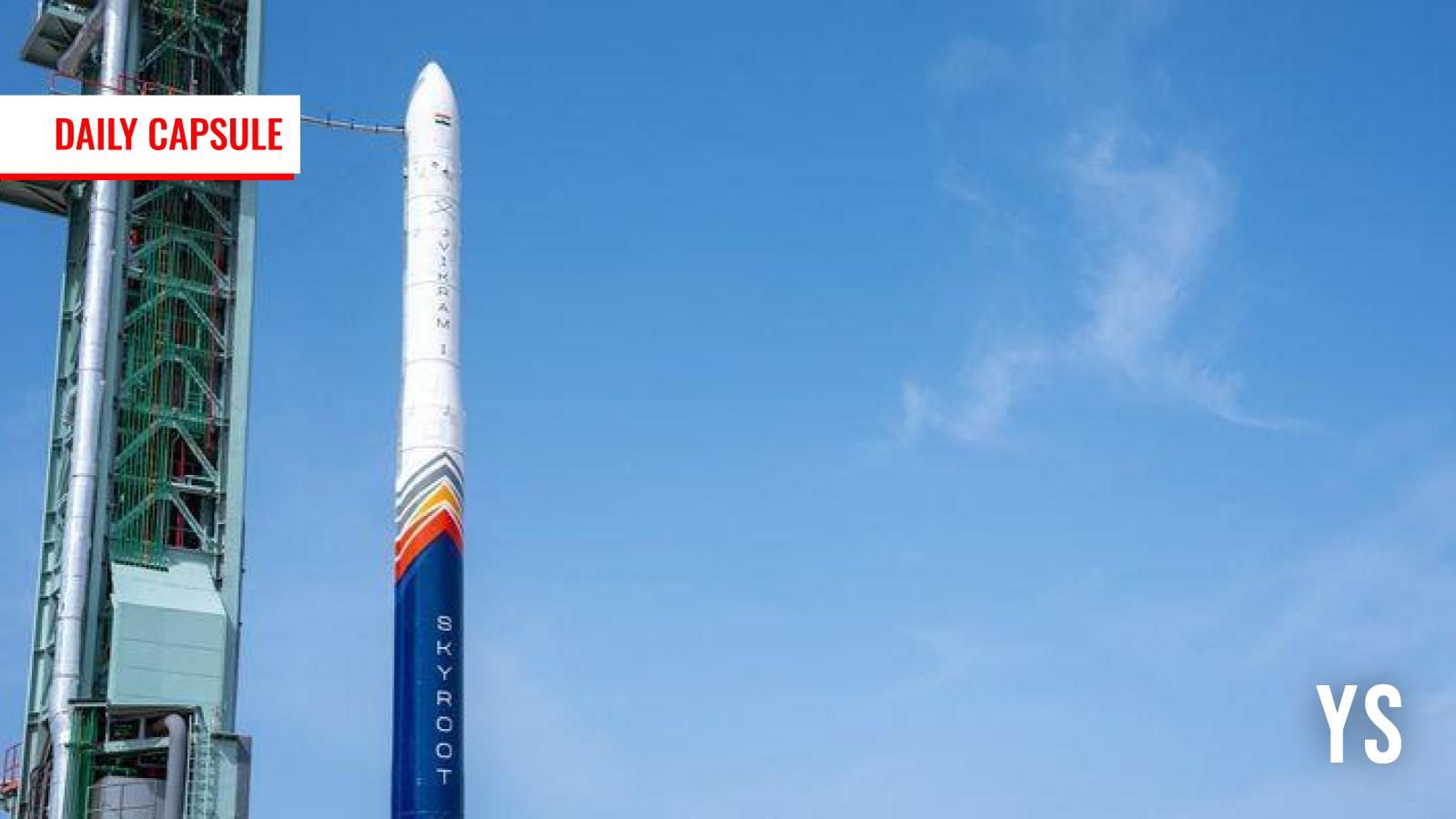
India's first privately developed orbital rocket has reached orbit. Skyroot Aerospace's Vikram-1 completed a successful launch under Mission Aagaman, marking a turning point for India's commercial space sector and proving that private Indian companies can now design, build, and fly orbital-class vehicles entirely on their own.
Until now, orbital launches from India were the exclusive domain of the Indian Space Research Organisation (ISRO). Vikram-1's success changes that equation. It follows Skyroot's earlier milestone of the Vikram-S suborbital flight in November 2022, which was the first privately built Indian rocket to reach space at all. The jump from suborbital to orbital is technically significant: orbital launches require far greater velocity, precision, and structural engineering to place a payload into a stable trajectory around Earth.
Vikram-1 is a four-stage launch vehicle capable of carrying payloads of up to 350 kg to low Earth orbit, the band of space roughly 160 to 2,000 km above the planet where most Earth observation, communications, and scientific satellites operate. That payload range sits squarely in the sweet spot of the fast-growing small satellite market, which has expanded sharply over the past decade on demand from defence, climate monitoring, broadband connectivity, and Earth imaging applications.
The commercial logic is straightforward. A private orbital launch capability means Indian satellite operators and global customers now have a domestic private option for reaching orbit, rather than depending solely on ISRO or foreign launch providers. That adds competition, could reduce launch costs over time, and shortens the queue for missions with Indian-origin payloads.
For India's broader space economy, this is a structural shift. The government opened the space sector to private players, and Skyroot has now demonstrated end-to-end execution at the orbital level. That proof point will matter for investor confidence, future contracts, and the pipeline of other Indian space startups watching closely.
On a different frontier, a Gurugram startup is tackling a gap that most global AI companies have not bothered to close. Shunya Labs, founded in 2025 by Ritu Mehrotra and Sourav Bandyopadhyay, is building voice AI infrastructure designed for the way people in India actually speak: in multiple languages, with regional accents, and often switching between languages mid-sentence.
The founders identified this problem while building United We Care, a mental health platform. Most commercial voice AI systems are trained on standard, unaccented English, which makes them unreliable for the vast majority of Indian users. Rather than work around that, Mehrotra and Bandyopadhyay built new infrastructure from scratch.
The Shunya platform has three layers. First, a speech-to-text model that converts spoken input into text. Second, an orchestration layer that processes that text with context and memory, so the system can hold a coherent conversation. Third, a text-to-speech model that converts the response back into natural-sounding voice. The company says the full stack can run on a standard CPU, whether on a smartphone, inside a car, or on a company's own servers, and it works without an internet connection.
Shunya claims this architecture cuts deployment costs to roughly one-twentieth of comparable providers, while covering more than 220 languages including 55 Indian languages. The company is targeting enterprise clients in banking, healthcare, telecom, and automotive, sectors where voice interfaces interact with tens of millions of Indian users who are far more comfortable in their native language than in English.
The broader context matters here. India has over a billion mobile users and a deeply multilingual population. Voice is often the most accessible interface for users with low literacy or limited familiarity with touchscreen keyboards. Building reliable voice AI for Indian languages is not a niche problem; it is a foundational infrastructure challenge for any company trying to serve that market at scale.
Separately, protests against data centre expansion are planned across at least 125 locations in the United States, marking the first coordinated national pushback against AI infrastructure buildout. And Meta is reported to be in talks with Anthropic about leasing computing capacity, a move that could reposition Meta as a cloud provider competing with Amazon, Microsoft, and Google.
Marvell Technology will invest $250 million in India over three years, doubling its workforce and expanding offices in Bengaluru and Hyderabad to advance AI and cloud chip design.
Microsoft, Nvidia, SpaceX, and Palantir have joined the newly formed Open Secure AI Alliance alongside dozens of U.S. and European tech companies. The group aims to set shared AI security standards as fallout from a cyber attack on OpenAI pushes the industry toward coordinated defenses.
Skyroot Aerospace's Vikram-1 became India's first privately built rocket to reach orbit, making India only the third country after the US and China with a private orbital launch capability.
India has approved a ₹1.25 lakh crore ISM 2.0 that replaces the earlier grant-only model with a grant-plus-equity structure, co-investing alongside private venture capital in fabless chip design startups.