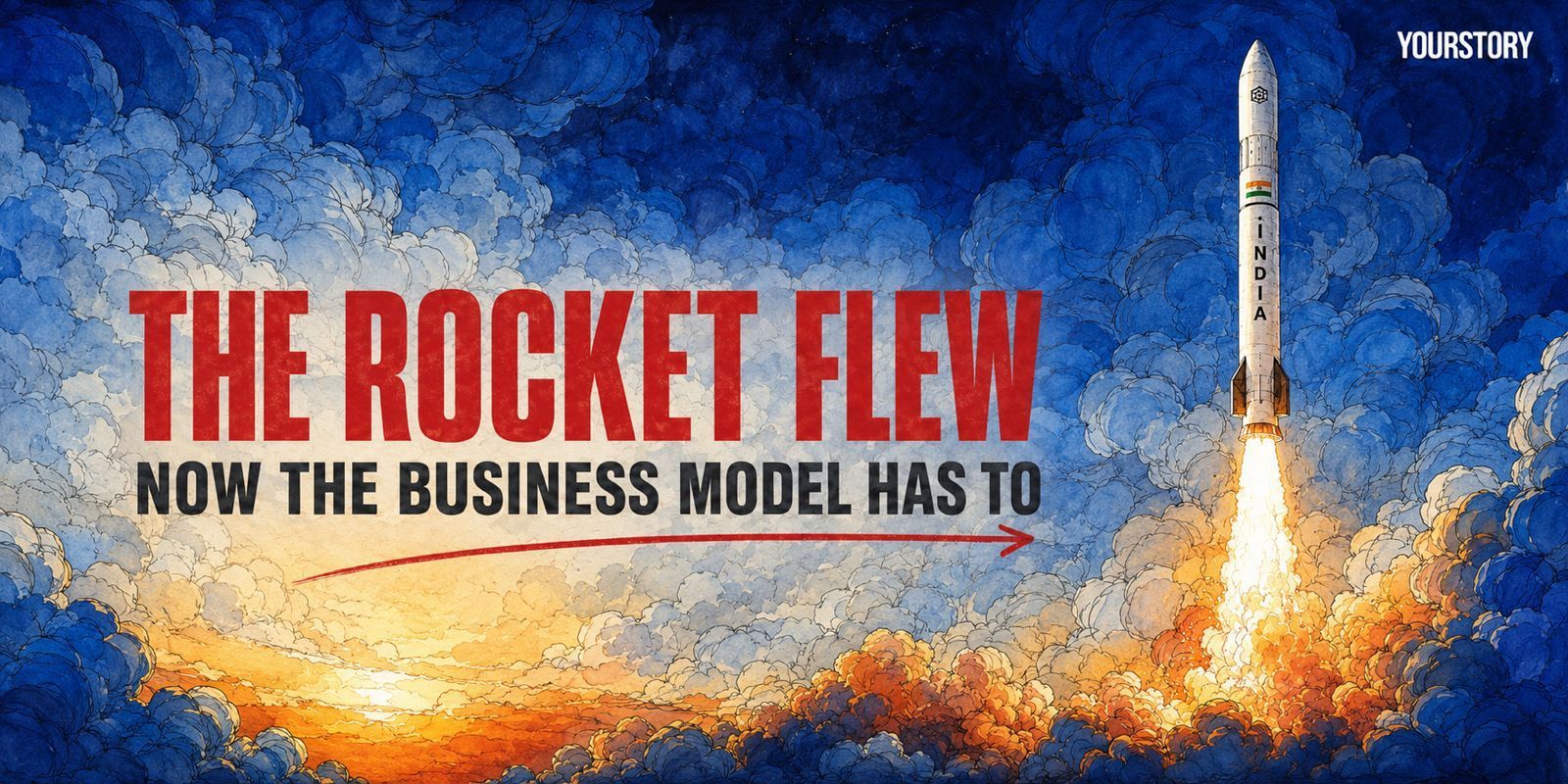
Skyroot Aerospace's Vikram-1 rocket lifted off from the Satish Dhawan Space Centre at Sriharikota last weekend and reached a 450-kilometre low Earth orbit within 15 minutes, making India only the third country after the United States and China where a private company has independently reached orbit. The mission, called Aagaman, also deployed the company's own SCOPE satellite and a spacecraft from startup Grahaa Space. Skyroot did it on its first attempt, a milestone most global launch startups have never managed.
The engineering achievement is real and significant. But it is also the easier half of the problem. The global record of the past decade shows clearly that building a rocket and building a rocket business are entirely different challenges, and the second one is where most companies have broken apart.
Why rocket science is not enough
Between 2015 and 2022, dozens of American small-launch startups raised billions of dollars and built genuinely impressive technology. Several reached orbit. Most failed commercially. Virgin Orbit completed four successful orbital missions and still went bankrupt in 2023. Astra was valued at roughly $2.1 billion at its public listing and was taken private in 2024 for around $10 million. Relativity Space raised over $1.3 billion, reached space, and then cancelled its small rocket entirely. ABL Space Systems raised more than $500 million and pivoted to missiles. These were engineering successes and business failures.
The structural cause was demand, or the lack of it. From 2019 to 2023, SpaceX's Transporter rideshare missions carried an estimated 81 percent of the world's small satellites at per-kilogram prices that dedicated small launchers could not match. There simply were not enough dedicated launches to sustain an entire sector. Even Rocket Lab, the small-launch segment's clearest survivor, diversified aggressively: by 2023 roughly two-thirds of its revenue came from satellite manufacturing and space systems, not launch. A launch vehicle without a reliable customer base is a science project, however brilliant.
India's space startups have been capital-efficient by necessity. The entire Indian spacetech sector attracted roughly $330 million in private equity and venture capital from 2022 through late 2025. A single Chinese funding round in 2025, for rocket maker Space Pioneer alone, raised $351 million. "Capital efficiency helps you survive the early innings," says Vishesh Rajaram, Founding Partner at Speciale Invest, which backed Agnikul Cosmos in 2018 and has since invested in GalaxEye, Kawa Space and InspeCity. "It doesn't help you outspend a state-backed competitor once the game moves to constellation-scale manufacturing."
India's demand engine, switching on at the right moment
What is different now, and what the Vikram-1 celebration has largely obscured, is that India is assembling a domestic demand engine at precisely the moment its supply side has matured. The centrepiece is the Space-Based Surveillance-3 (SBS-3) programme, under which India plans to deploy 52 satellites over five years for persistent military surveillance, with over half expected to be built and delivered by private companies. The urgency behind SBS-3 was sharpened by Operation Sindoor in May 2025, which demonstrated how central space-based assets are to modern military operations.
"SBS-3 is not a subsidy, it's a Rs 27,000 crore demand signal," says Rajaram. "Thirty-one of fifty-two military surveillance satellites going to private players is the first large-scale proof that the government will trust private hardware with national security missions. It tells growth-stage investors there's a durable, non-cyclical revenue pool behind these companies beyond venture rounds."
Around that anchor, supporting structures are arriving. The Antariksh Venture Capital Fund, anchored by IN-SPACe and managed by SIDBI Venture Capital, entered its deployment phase in July 2026 with a Rs 60 crore investment in Dhruva Space. The Research, Development and Innovation (RDI) scheme, launched in July 2025, is beginning to bridge laboratory breakthroughs to commercial products: Dhruva Space's Rs 105 crore grant for Project Garud, a 500-kg satellite platform, is a live example. The institutional foundation includes the Indian Space Policy of 2023, liberalised FDI norms, and IN-SPACe's active push urging government ministries to source from domestic space companies.
The commercial validation is already happening. Pixxel has signed around 65 clients including Rio Tinto, BP, and India's Ministry of Agriculture, and holds a NASA contract to supply hyperspectral Earth-observation data. Digantara holds analytics contracts with US Space Command, has been selected for the US Missile Defense Agency's SHIELD contract vehicle, and closed a $50 million round led by Reliance Industries, the largest private spacetech investment in India in 2025. These are dollar revenues won in open competition against American and European rivals.
India's sector is unusually well positioned because it spans the full value chain, not just launch. Of India's targeted $44 billion space economy by 2033, satellite communications is projected to account for $14.8 billion and Earth observation around $8 billion. Launch enables everything, but the recurring revenue lives in data and services, and India has strong players at launch, manufacturing, sensors, software, and analytics simultaneously.
Sector funding rose 94 percent in 2025 to $157 million and has accelerated further in 2026. Skyroot became India's first spacetech unicorn. Vikram-1's successor, Vikram-1U, will lift 550 kilograms; Vikram-2 targets a tonne by 2027. Agnikul Cosmos's Mission-02 will attempt India's first orbital booster recovery. "For economically viable, frequently flyable missions, the philosophy is about rapid reuse, complete flexibility and modularity," says Srinath Ravichandran, Co-founder and CEO of Agnikul Cosmos.
India's broader target is to grow its space economy from $8.4 billion today, about 2 percent of the global market, to $44 billion and an 8 percent global share by 2033, with $11 billion in exports. The global graveyard of well-funded launch companies is a standing reminder that the industry forgives nothing. But India is entering its commercial phase with the one asset that the historical record says matters most: a government increasingly willing to act as anchor customer, at the precise moment its private sector has proven it can deliver. Vikram-1 settled the engineering question. Rocket economics decides everything that comes next.