
Qatar Signals Progress in US-Iran War Talks
Qatar's foreign ministry said mediators including Qatar, Pakistan, and Oman have reached "very progressive stages" in efforts to end the US-Iran war, pushing Brent crude down more than four percent.
Key Takeaways
July 7, 2026 · 4 min read · By Rishabh Bhardwaj
·
AI-assisted, human-reviewed · Our editorial standards
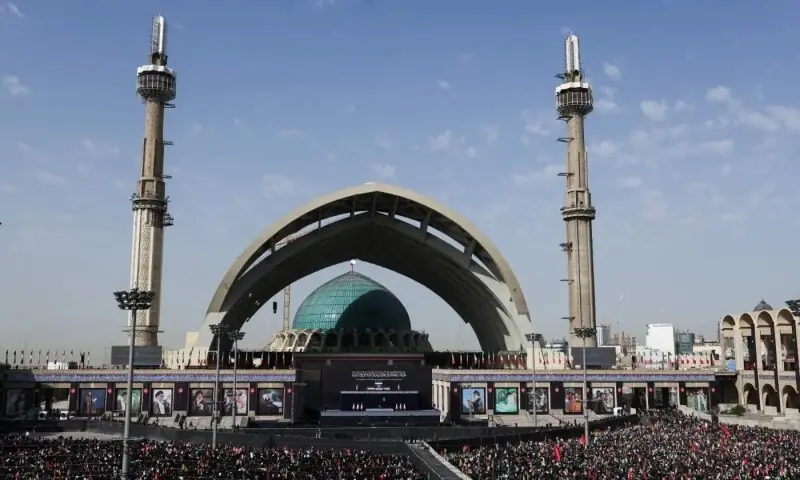
Funeral ceremonies for Ayatollah Ali Khamenei, Iran's assassinated supreme leader, began on Saturday in Tehran, drawing enormous crowds to the Imam Khomeini Grand Mosalla complex and opening six days of state mourning that Iranian authorities say could draw 15 to 20 million people to the capital alone.
Khamenei, who led the Islamic Republic from 1989 until his death, was killed on February 28, 2026, during a US-Israeli strike on the first day of the military conflict with Iran. He was 86. His assassination also killed other family members, including an infant granddaughter, whose remains will be buried alongside him during the same ceremonies.
The funeral procession follows a carefully planned route. Khamenei's coffin will lie in state until Monday, then move through Tehran in a formal procession. On Tuesday it travels to the clerical city of Qom, on Wednesday to holy Shia sites in Iraq, and on Thursday to Khamenei's home city of Mashhad in northeastern Iran for burial. The six-day arc is designed to carry maximum symbolic weight across Iran's religious and political geography.
The ceremonies carry political significance well beyond grief. The most closely watched question is whether Mojtaba Khamenei, named supreme leader a week after his father's killing, will appear in public for the first time. He has communicated only through written statements since taking the role and is reported to have been wounded in the same strikes that killed his father, though the severity of those injuries has never been confirmed. His presence or absence will be read as a signal of the new leadership's stability.
Iranian officials who survived the conflict presented a united front on Friday. Parliament speaker Mohammad Bagher Ghalibaf, who has also led negotiations with the United States, was visibly emotional. Ahmad Vahidi, appointed chief of the Revolutionary Guards after his predecessor was killed in the same strikes that killed Khamenei, was seen publicly for the first time since those events. Ghalibaf called on Iranians to attend in large numbers, saying "the nation's call for vengeance must ring in the ears of the whole world." Army chief Amir Hatami vowed that Israel and the US "will pay for the blood of the martyred leader."
International attendance reflected the conflict's geopolitical reach. Pakistani Prime Minister Shehbaz Sharif, whose government has been mediating between Tehran and Washington, paid his respects. Russia sent Dmitry Medvedev, now deputy head of the Russian security council, representing President Vladimir Putin. Delegations from Hamas, Hezbollah, and the Taliban government in Afghanistan also attended.
After roughly five weeks of fighting, Iran and the United States reached an initial accord that has put the conflict on hold. But Iranian officials have been explicit that Tehran is prepared to resume hostilities if the terms are not met. The rhetoric at the funeral, including chants of "death to America" and "revenge, revenge" from the crowd at the Grand Mosalla, underscores how politically charged the ceasefire period remains. The ceremonies, framed as a show of strength to Iran's adversaries, are a direct expression of that pressure.
Practically, the event is the largest public mobilisation Iran has attempted since the 1989 burial of Ruhollah Khomeini, Khamenei's predecessor. Authorities have imposed heavy security, blocked roads, and are expected to close airspace over Tehran. With temperatures forecast above 35 degrees Celsius, water tankers have been stationed along routes to cool attendees. State television has broadcast crowd safety guidelines, a precaution reflecting past crowd crush tragedies at similar Iranian events.
On the ground, AFP journalists reported Tehran's streets were unusually quiet ahead of the ceremonies, with normally congested areas largely free of traffic. At the Grand Mosalla, mourners carrying red banners had been arriving since Friday evening. Some walked several kilometres to reach the venue. "We came because we promised the supreme leader we would stand by him to the very end," said Reza, a 37-year-old university professor who spoke to AFP.
The next three days will be the most revealing. Whether Mojtaba Khamenei appears, how large the crowds actually prove to be, and whether officials maintain their unified public posture will all shape how Iran's new leadership is perceived domestically and internationally, at a moment when a fragile ceasefire is still being tested.
Qatar's foreign ministry said mediators including Qatar, Pakistan, and Oman have reached "very progressive stages" in efforts to end the US-Iran war, pushing Brent crude down more than four percent.
Qatar confirmed it is mediating between the US and Iran but said no direct talks are currently planned. The clarification follows conflicting statements from President Trump, who claimed talks are under way, and Tehran, which denied any dialogue is happening.
Saudi Aramco reported sharply higher second-quarter 2026 profits as the Iran war restricts global oil supply and pushes crude prices up. Other oil supermajors also posted outsized earnings, raising concerns about sustained fuel cost pressure for importing economies.
President Trump called current Iran negotiations the "last chance" to end five months of conflict, pushing oil prices higher. Tehran denied formal talks are taking place, raising the risk of a diplomatic breakdown with direct consequences for global energy markets.