India to Restore UPI Merchant Fees, PhonePe Gains Most
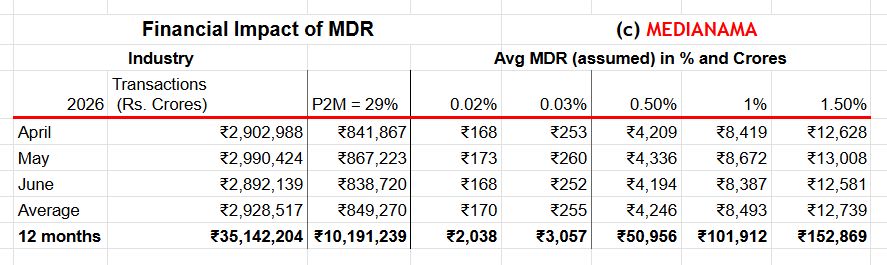
India's government plans to amend the Payment and Settlement Systems Act to restore UPI merchant discount rates, ending the zero-MDR regime in place since January 2020.
Key Takeaways
July 3, 2026 · 3 min read · By Rishabh Bhardwaj
·
AI-assisted, human-reviewed · Our editorial standards

India's retirement savings framework got a structural overhaul in 2026. The Employees' Provident Funds Scheme, 2026 has replaced the decades-old 1952 version, operating under the Code on Social Security, 2020. For most salaried workers, the practical question is simple: will you earn more than 8.25% on your provident fund balance? The short answer is no, at least not through the central system.
The Employees' Provident Fund Organisation (EPFO) has kept the interest rate at 8.25% for the financial year 2025-26. That figure applies to contributions made under the central scheme and has not changed with the new framework. Workers relying on EPFO directly will see the same return they received in the previous year.
The 2026 scheme is not just a rename. It formally brings provident fund administration under the Code on Social Security, 2020, a broader labour law consolidation that had been pending implementation for several years. The new framework also brings digital services into the official structure, meaning online claims, transfers, and account management now have a legal basis within the scheme itself rather than operating through administrative workarounds.
The more consequential shift involves private PF trusts. Many large employers, particularly in the private sector, run their own exempted provident fund trusts instead of depositing with EPFO directly. These trusts have historically had some flexibility in setting their own interest rates. Under the new rules, private trusts cannot declare an interest rate that exceeds the central government's declared rate by more than 2 percentage points. In practice, that caps private trust returns at a maximum of 10.25% for 2025-26, assuming EPFO holds at 8.25%.
This ceiling has two effects. For employees in exempted trusts, it removes the possibility of significantly higher returns that some well-managed trusts had occasionally provided in earlier years. For the regulatory framework, it limits risk-taking by private trusts, which are obligated to invest conservatively but had no hard ceiling on what they could promise members relative to actual market returns.
The cap creates a tighter link between what private employers promise workers and what the government considers a sustainable, low-risk return. Trusts that previously declared aggressive rates will now need to align much more closely with EPFO's benchmark or face regulatory scrutiny.
For employees, the immediate consequence is clarity. If you are in a company-run PF trust, your employer can now offer at most 2 percentage points above the EPFO rate. That is still potentially better than the central scheme, but the gap is firmly bounded. Workers should check with their HR or payroll teams whether their employer runs an exempted trust or contributes directly to EPFO, as the applicable rate differs.
The 8.25% rate itself remains competitive against many fixed-income options, especially given the tax treatment of EPF contributions and returns for eligible employees. Interest credited to EPF accounts within the prescribed limits continues to be tax-free, making the effective yield meaningfully higher than a comparable taxable instrument at the same nominal rate.
What to watch next is whether EPFO revises the interest rate for 2026-27, which would then reset the ceiling for private trusts as well. The EPFO central board of trustees typically recommends a rate each year before the government formally notifies it. Any movement in that rate, up or down, will now automatically shift the cap on private trust payouts, making the central rate more systemically important than it was under the older fragmented structure.
India's government plans to amend the Payment and Settlement Systems Act to restore UPI merchant discount rates, ending the zero-MDR regime in place since January 2020.
India's government has introduced the Taxation and Other Laws (Amendment) Bill, 2026, proposing changes to payments regulation, income tax, and the Finance Act to attract FDI and support Make in India. The Bill's final shape will depend on parliamentary debate and committee review.
The government's Taxation and Other Laws (Amendment) Bill, 2026, proposes to replace the blanket UPI MDR ban with a system allowing the Centre to notify which payment modes stay fee-free.
Prime Minister Narendra Modi inaugurated the Rs 5,000 crore Bhogapuram greenfield airport in Andhra Pradesh, built under a public-private partnership model. He also laid foundation stones for infrastructure projects worth nearly Rs 18,000 crore in the state, signalling a broad investment push for the region.