India to Restore UPI Merchant Fees, PhonePe Gains Most
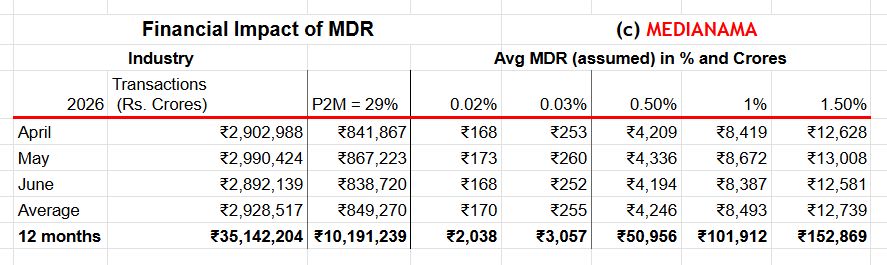
India's government plans to amend the Payment and Settlement Systems Act to restore UPI merchant discount rates, ending the zero-MDR regime in place since January 2020.
Key Takeaways
May 7, 2026 · 2 min read · By Rishabh Bhardwaj
·
AI-assisted, human-reviewed · Our editorial standards
Tamil Nadu is heading toward a political inflection point, and the key question is how Governor Ravi Arlekar handles the government formation process if the current political arithmetic shifts. A former Tamil Nadu government official, well-versed in parliamentary conventions, has laid out what the Governor can and cannot do under established practice.
The official draws a clear line: the Governor is fully within rights to ask parties or alliances to submit letters of support before inviting someone to form a government. That is standard practice. What crosses the line, however, is conducting a head count, personally tallying legislators to verify majority. That role belongs exclusively to the floor of the House.
The reasoning is rooted in constitutional logic. The legislature, not the Raj Bhavan, is the proper arena to test political strength. A vote of confidence on the floor is the only legitimate mechanism to determine who commands a majority. Any attempt by the Governor to pre-empt that process by independently verifying numbers creates a procedural overreach that undermines legislative supremacy.
Parliamentary conventions in India have evolved through contested government formations in states like Goa, Manipur, and Karnataka, where Governors were accused of acting beyond their remit. Those cases established, through court rulings and public discourse, that the Governor's role is largely ceremonial in this context, invite the single largest party or pre-poll alliance, set a reasonable deadline for a floor test, and step back.
Letters of support serve one purpose: to give the Governor a prima facie basis to identify who is likely to command a majority. They are not a substitute for a floor test, and their submission does not itself confer legitimacy on any claimant.
What this means in practice is that the Governor must act quickly, transparently, and within a narrow procedural lane. Delays in inviting a claimant, or conditions attached beyond a floor test deadline, have historically drawn constitutional challenges and Supreme Court intervention.
For Tamil Nadu, where the DMK holds power and any realignment would involve significant political maneuvering, the Governor's conduct will be closely watched. The floor of the House remains the final and only credible test of majority, and that principle, the former official makes clear, is non-negotiable under Indian parliamentary practice.
India's government plans to amend the Payment and Settlement Systems Act to restore UPI merchant discount rates, ending the zero-MDR regime in place since January 2020.
India's government has introduced the Taxation and Other Laws (Amendment) Bill, 2026, proposing changes to payments regulation, income tax, and the Finance Act to attract FDI and support Make in India. The Bill's final shape will depend on parliamentary debate and committee review.
The government's Taxation and Other Laws (Amendment) Bill, 2026, proposes to replace the blanket UPI MDR ban with a system allowing the Centre to notify which payment modes stay fee-free.
Prime Minister Narendra Modi inaugurated the Rs 5,000 crore Bhogapuram greenfield airport in Andhra Pradesh, built under a public-private partnership model. He also laid foundation stones for infrastructure projects worth nearly Rs 18,000 crore in the state, signalling a broad investment push for the region.