Vikram-1 Reaches Orbit, Shunya Labs Builds Indian Voice AI
Skyroot Aerospace's Vikram-1 became India's first privately developed rocket to reach orbit under Mission Aagaman, a landmark for the country's commercial space sector.
Key Takeaways
July 19, 2026 · 4 min read · By Rishabh Bhardwaj
·
AI-assisted, human-reviewed · Our editorial standards
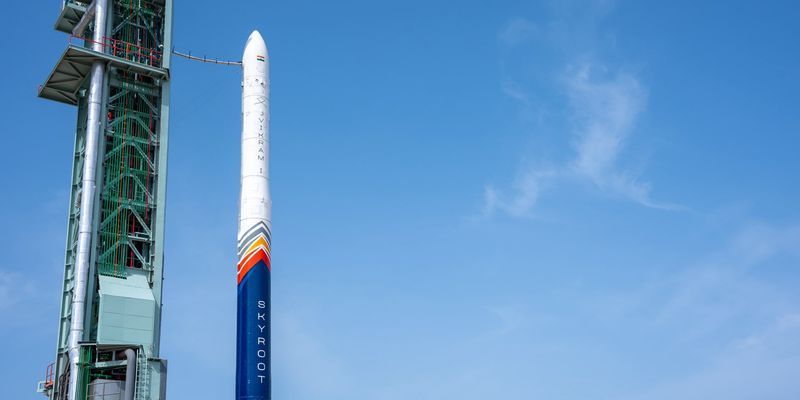
Skyroot Aerospace's Vikram-1 rocket reached orbit on July 18, 2026, becoming India's first privately built orbital launch vehicle to succeed. The mission, named Aagaman, marks a clear shift in how India participates in the global space economy: where ISRO once carried the entire burden of reaching orbit, a private company has now done it independently, end to end.
Prime Minister Narendra Modi called the launch "a defining moment in India's space journey" and said the growing private sector role is "opening new frontiers and accelerating innovation." Lt. Gen. A. K. Bhatt (Retd.), Director General of the Indian Space Association, said Skyroot had "shattered legacy boundaries" by executing the country's first fully private orbital flight.
Vikram-1 is a four-stage rocket capable of carrying up to 350 kg to low Earth orbit (LEO), the band roughly 200 to 2,000 km above Earth where most commercial satellites now operate. Its structure is all-carbon composite, which keeps weight down. Three solid-fuel stages provide the main thrust, while a restartable liquid-fuelled upper stage, powered by a 3D-printed engine, allows precise maneuvering to deploy multiple satellites at different orbital slots during a single flight. That restartability is a key commercial feature: it lets one rocket serve several customers with different target orbits in one go.
The maiden flight carried a mix of paying commercial and technology demonstration payloads. Skyroot's own SCOPE satellite flew alongside DCUBED's technology demonstrator from Germany, Grahaa Space's SOLARAS S3 Earth observation satellite, and Cosmoserve Space's EMBRACE robotic arm demonstrator, a prototype for future on-orbit debris removal. The mission also carried symbolic payloads including a floral sculpture called Cosmic Bloom and a miniature 18-carat gold rocket engraved with microscopic portraits of C. V. Raman, Vikram Sarabhai and A. P. J. Abdul Kalam.
This builds directly on Skyroot's earlier Vikram-S suborbital flight in November 2022, which became the first privately built Indian rocket to reach space at all. But suborbital flight is a fundamentally different, easier problem. Reaching orbit requires a rocket to accelerate to roughly 7.9 km per second, enough speed to remain in continuous free-fall around Earth rather than simply going up and coming back down. Vikram-1 clearing that bar is the meaningful technical jump.
The launch validates a chain of structural reforms that began with India's Indian Space Research Organisation progressively opening the sector and culminated in the Indian Space Policy 2023. That policy formally allowed private companies to participate across the full value chain, including building and launching their own rockets, owning and operating satellites, and selling downstream data services. IN-SPACe, the Indian National Space Promotion and Authorisation Centre set up to authorize and support private players, has been the operational enabler of these reforms.
The numbers show the pace of that opening. India had one space startup in 2014. By 2026, it has more than 400. The government puts the current value of India's space economy at around $8.4 billion and projects it could reach $40 billion to $45 billion by 2030, with a longer-term target of $100 billion by 2040. Those projections now look more credible with an orbital-capable private launch vehicle in the fleet.
Skyroot is entering a real commercial market. Demand for small satellites has grown sharply over the past decade, driven by Earth observation, broadband connectivity, climate monitoring and defence applications. This demand has created strong appetite for dedicated small-lift rockets that can place compact payloads into precise orbits without splitting a ride on a larger vehicle. Globally, Rocket Lab has built a focused business around exactly this niche, while SpaceX's reusable Falcon 9 dominates higher-volume launches. Indian startups are now competing in this segment by combining lower manufacturing costs with growing domestic satellite demand.
Skyroot is not alone in building this ecosystem. Agnikul Cosmos launched from India's first privately operated launch pad in 2024. Pixxel, Bellatrix Aerospace, Dhruva Space and SatSure are building capacity in Earth observation, propulsion and satellite manufacturing. ISRO has also accelerated technology transfers to industry under IN-SPACe's framework, compressing the learning curve for newer entrants.
For investors, insurers and satellite operators watching India, Vikram-1's success converts a policy story into demonstrated operational capability. The next question is cadence: how quickly Skyroot can build, price and fly repeat missions, and whether reliability holds as launch frequency rises. That commercial track record, not this single flight, will determine how large a share of the global small-lift market Indian rockets can realistically capture.
Skyroot Aerospace's Vikram-1 became India's first privately developed rocket to reach orbit under Mission Aagaman, a landmark for the country's commercial space sector.
Over 140 firms including Visa, Google, Coinbase, and BlackRock unveiled Open USD, a governance-shared dollar stablecoin with no minting fees and reserve earnings returned to partners.
India's AI sector faces a deepening GPU supply crunch, with demand for data centre capacity running at more than double available supply in 2025. Smaller enterprises are being pushed to the back of a tiered allocation system dominated by hyperscalers and sovereign programmes, forcing startups to optimise existing
Anthropic released Claude Sonnet 5, which scored 63.2 percent on SWE-bench Pro and offers Opus 4.8-level agentic performance at lower cost. The US government also lifted export controls on the company's advanced Mythos 5 and Fable 5 models, restoring international access.