Marvell Commits $250 Mn to India Chip Expansion
Marvell Technology will invest $250 million in India over three years, doubling its workforce and expanding offices in Bengaluru and Hyderabad to advance AI and cloud chip design.
Key Takeaways
July 5, 2026 · 3 min read · By Rishabh Bhardwaj
·
AI-assisted, human-reviewed · Our editorial standards
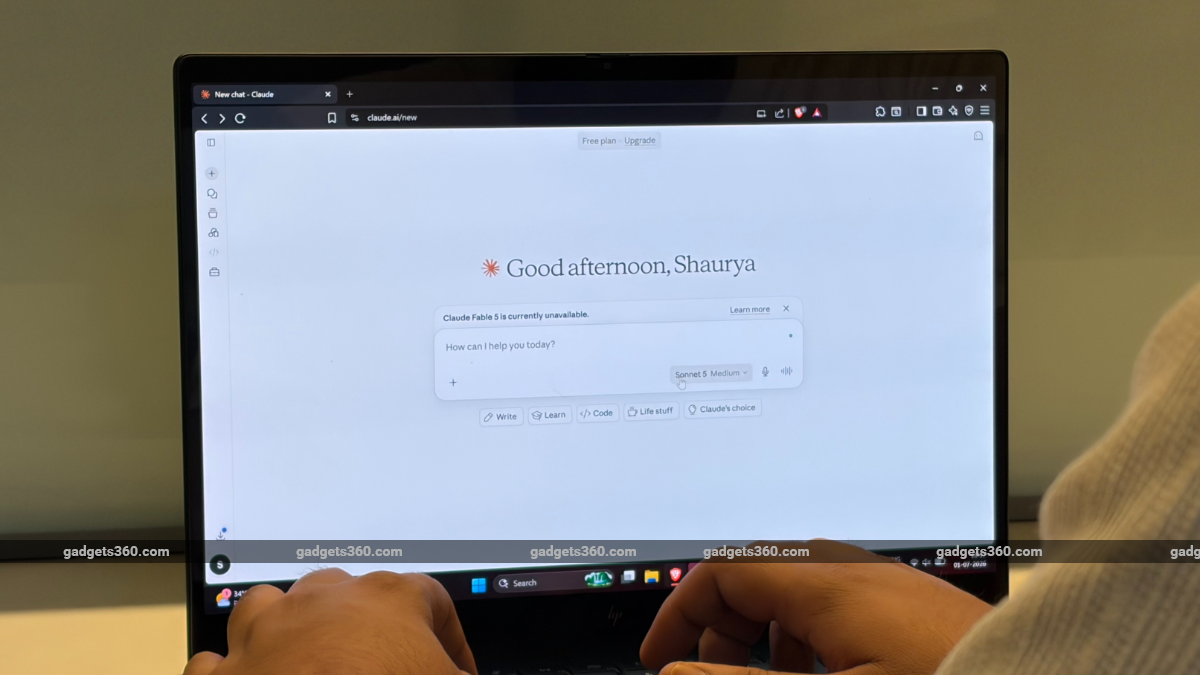
Anthropic has released Claude Sonnet 5, a new AI model that improves on its predecessor in agentic tasks, while also confirming that US government export restrictions on two of its most advanced models have been lifted.
The company says Sonnet 5 outperforms the previous Claude Sonnet 4.6 on agentic search, meaning tasks where an AI independently browses, retrieves, and acts on information without step-by-step human guidance. On the industry-standard SWE-bench Pro coding benchmark, which tests an AI's ability to resolve real software engineering problems, Sonnet 5 scored 63.2 percent. That is up from Sonnet 4.6's 58.1 percent but still below the flagship Opus 4.8, which scored 69.2 percent.
The practical pitch from Anthropic is cost efficiency. Sonnet 5 is positioned as a mid-tier model that matches Opus 4.8 on most agentic tasks while coming in at a lower price point. For developers and companies building AI-powered workflows, that gap matters: running fewer top-tier model calls on the same tasks can meaningfully reduce operating costs at scale.
The second major development involves a reversal in US trade policy. Weeks ago, the US administration placed export controls on Claude Mythos 5 and Fable 5, two of Anthropic's most capable models. Mythos 5 is described as cybersecurity-trained, and Fable 5 is classified as a "Mythos-class" model, putting both in a high-capability tier that triggered federal restrictions. Those rules barred Anthropic from making the models accessible to foreign nationals.
The US government has now removed those controls. Anthropic confirmed the reversal, which means the company can again offer Mythos 5 and Fable 5 internationally. The original restrictions were notable because they targeted specific AI models by capability class, a relatively new form of technology export control. The rollback signals either a policy reassessment or a negotiated adjustment, though the exact basis for the reversal has not been disclosed.
Together, the two announcements shape Anthropic's competitive position on two separate fronts. The Sonnet 5 release targets the growing market for AI agents: software that can autonomously complete multi-step tasks like coding, research, or data processing. This segment is attracting significant enterprise spending, and benchmark improvements, even incremental ones, directly influence procurement decisions at large technology buyers.
The export control reversal is strategically larger. Restricting Mythos 5 and Fable 5 to domestic users would have capped Anthropic's addressable market for its highest-capability products at a time when global enterprise and government contracts are a key revenue growth area. Reinstating international access removes that ceiling and lets the company compete directly against rivals such as OpenAI and Google DeepMind for deals outside the United States.
The episode also illustrates a broader dynamic: advanced AI models are increasingly treated as dual-use technology by governments, much like certain semiconductors or encryption software. The fact that specific model versions were named in an export control order, and then removed from one, shows how quickly the regulatory environment around frontier AI can shift. Businesses building on these models need to track policy changes closely, since access to specific model versions can be interrupted or restored with little warning.
For now, Anthropic moves into the second half of 2026 with a refreshed mid-tier model, restored access to its top-tier lineup abroad, and a clearer cost-performance story to pitch to enterprise customers.
Marvell Technology will invest $250 million in India over three years, doubling its workforce and expanding offices in Bengaluru and Hyderabad to advance AI and cloud chip design.
Microsoft, Nvidia, SpaceX, and Palantir have joined the newly formed Open Secure AI Alliance alongside dozens of U.S. and European tech companies. The group aims to set shared AI security standards as fallout from a cyber attack on OpenAI pushes the industry toward coordinated defenses.
Skyroot Aerospace's Vikram-1 became India's first privately built rocket to reach orbit, making India only the third country after the US and China with a private orbital launch capability.
India has approved a ₹1.25 lakh crore ISM 2.0 that replaces the earlier grant-only model with a grant-plus-equity structure, co-investing alongside private venture capital in fabless chip design startups.