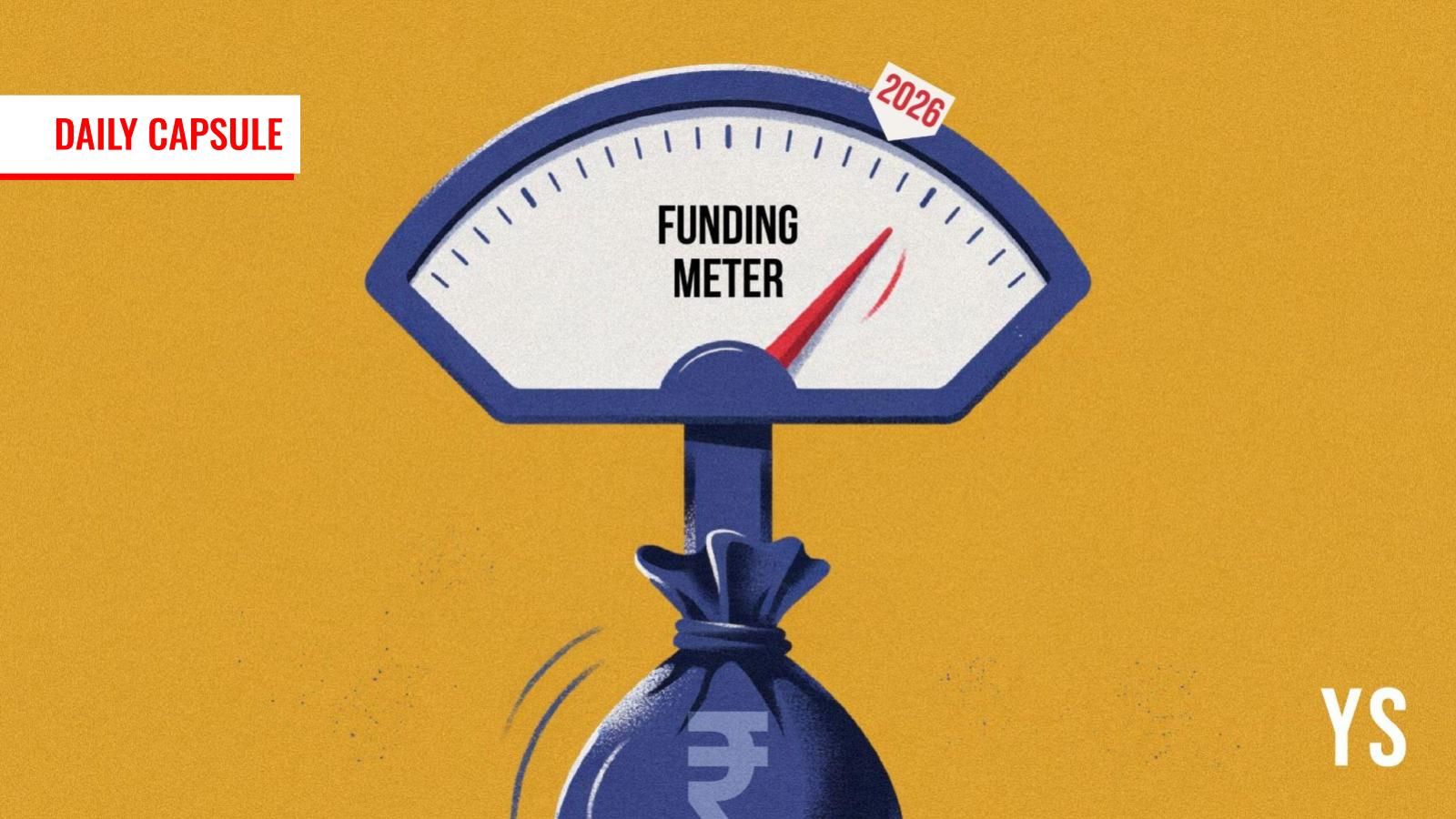
Indian startup funding hit $6.9 billion in the first half of 2026, a 21% jump from $5.7 billion in the same period last year, according to YourStory Research. The rebound puts the ecosystem on pace to exceed full-year 2025 totals, driven by a sharp late surge in June when weekly deal value crossed $1 billion for the first time this year.
The headline numbers look strong, but the deal count tells a more nuanced story. At 584 deals in the first six months of 2026, transaction volume actually fell from 621 deals in the same period of 2025. Fewer deals at higher average values signal a flight to quality: investors are concentrating larger cheques into more mature or higher-conviction bets rather than spreading capital widely across early-stage experiments.
Two deals did much of the heavy lifting in June. Fintech platform CRED and AI startup Sarvam between them pushed weekly funding above the $1 billion mark, a milestone the ecosystem had not crossed at any earlier point in 2026. When a single fortnight accounts for that much of a half-year total, it underscores how concentrated large-cap fundraising has become, and why the broader pipeline of smaller startups still faces a tighter funding environment.
Addverb scales from five people to a global robotics business
Noida-based Addverb offers a useful case study in how an Indian deep-tech company can build durable revenue in a sector most founders avoided a decade ago. The intralogistics automation company started with a five-person team and has grown to more than 1,000 employees and over 300 clients worldwide, including Reliance, Flipkart, Unilever, and ITC.
CEO Sangeet Kumar says early growth required active market education. When Addverb launched, warehouse automation was largely confined to large consumer goods corporations. The company had to convince logistics operators that the productivity and reliability gains justified the upfront cost, a sales challenge that doubled as market creation.
The product portfolio has since expanded well beyond conveyor systems. Addverb now builds automated guided vehicles, autonomous mobile robots, and, more recently, general-purpose humanoid robots. It has also developed proprietary software tailored to different industries and warehouse environments, giving it recurring revenue potential alongside hardware sales.
Financially, Addverb reported annual revenue of around Rs 660 crore in 2025. It is targeting Rs 1,300 crore in the current fiscal year, which would represent a near doubling of the top line. Roughly half its revenue currently comes from India, with the rest from international markets, a geographic split that both hedges domestic cyclicality and validates its technology outside a home-market advantage.
Why the funding rebound matters and what to watch
The 21% year-on-year rise in VC inflows matters because 2025 was itself a recovery year following the sharp global pullback of 2023 and 2024. Surpassing it would confirm that Indian startup funding has returned to a genuine growth trajectory rather than a temporary stabilisation.
The comparison to the second half of 2025 is also telling. Funding in the first half of 2026 was 9% higher than the July-to-December 2025 period, suggesting momentum is building within the year, not just flattering a weak prior-year base.
Serial entrepreneur Bhavin Turakhia's new AI-native work platform Neo, backed by $30 million of his own capital, and Chinese AI model GLM-5.2 from Beijing startup Z.ai, which is drawing comparisons to DeepSeek for its coding and agentic capabilities at a fraction of US pricing, are both signals that competition for AI-related startup capital and talent will only intensify in the second half of 2026.
Investors and founders should watch whether the deal count recovers alongside deal value in the second half of the year. If the current pattern holds and large rounds remain concentrated in a handful of late-stage companies, early-stage founders will continue to face a harder fundraising environment even as the headline numbers improve.