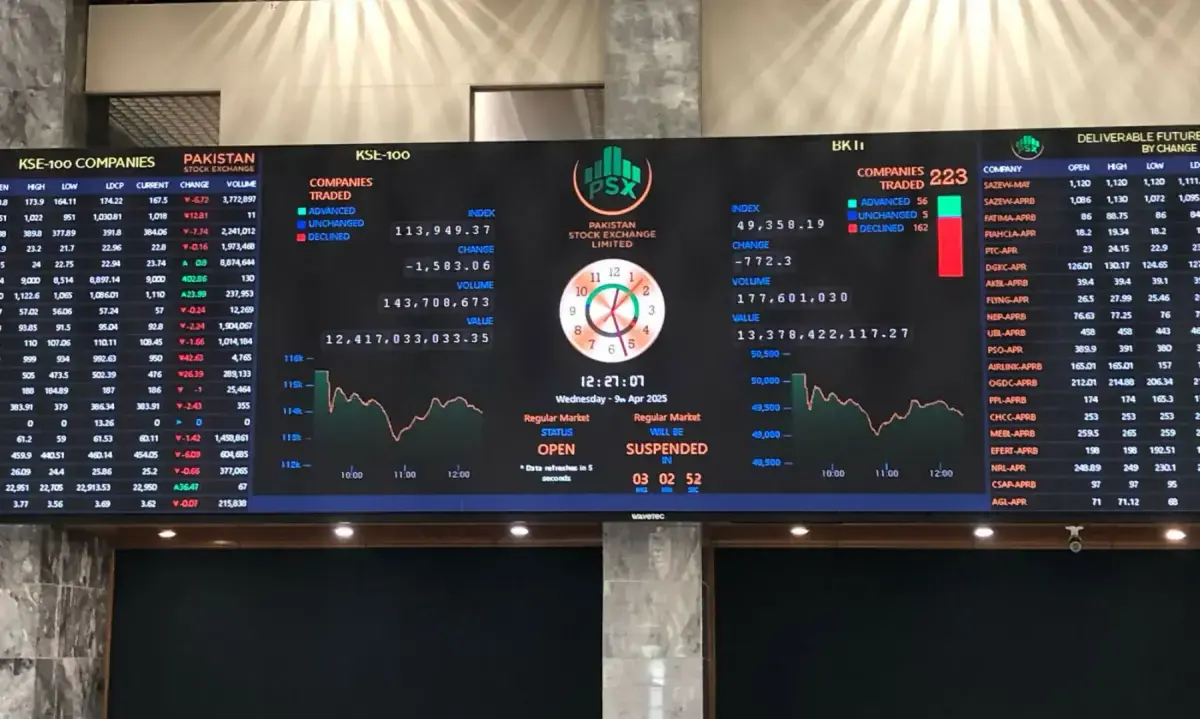
Pakistan's benchmark KSE-100 index fell 2,314 points on Monday, closing at 179,927 as escalating US-Iran military exchanges in the Strait of Hormuz triggered a broad sell-off and a sharp jump in global oil prices.
The index opened sharply lower, touching an intraday low of 179,448 points before recovering to 181,148 by mid-afternoon. Selling pressure returned in the final hours, and the index settled down 1.27 percent from Friday's close of 182,241. Total traded volume was 845 million shares, with traded value at Rs35.5 billion, both lower than recent sessions, pointing to a cautious and thinly active market.
What drove the sell-off
The direct trigger was a fresh round of strikes exchanged between the United States and Iran, which Topline Securities described as reigniting concerns over a broader regional conflict. The Strait of Hormuz is one of the world's most critical oil shipping lanes, and any disruption there ripples quickly into energy prices. Oil jumped more than three percent on Monday alone. For an oil-importing economy like Pakistan, rising crude prices mean higher import bills, wider current account pressure, and renewed inflationary risk.
Awais Ashraf, director of research at AKD Securities, told Dawn that the fighting had reduced traffic through the Strait of Hormuz to a five-week low and cast doubt on the future of an interim peace agreement signed last month between the two sides. That agreement had been a stabilising force for sentiment; renewed hostilities have now eroded that confidence.
Heavy-index stocks led the early losses, though most fell only in the range of one to 1.7 percent. The broad-based nature of the decline reflected a classic risk-off session: investors pulling back across sectors rather than reacting to any single company or domestic development. Topline Securities also noted that profit-taking after the market's recent rally amplified the move, as investors chose to lock in gains while uncertainty was rising.
One bright spot and the bigger picture
Not every sector moved lower. Refinery stocks bucked the trend, staying positive on expectations around an upcoming refinery policy that is expected to open the door to upgrades and expansions. That sector-specific optimism was enough to stand apart from the broader selling, though not enough to offset market-wide losses.
The broader context matters here. Pakistan's stock market had been on a strong run, supported by easing inflation, a stable rupee, and improving macroeconomic conditions. Topline Securities acknowledged this, noting that Monday's decline came despite an otherwise supportive domestic backdrop. The sell-off was not about local fundamentals deteriorating; it was about external risk being repriced rapidly.
CNERGY was the most traded stock by volume, with 158 million shares changing hands, pointing to retail activity concentrated in a single liquid counter even as overall volumes declined.
Friday had offered a brief respite. Value-hunting had helped the index snap a three-session losing streak, suggesting some buyers were willing to step in at lower levels. But Monday's sharp opening move showed that geopolitical fear can overwhelm that support quickly when the news flow turns negative overnight.
The core risk for Pakistan is the oil price channel. Higher crude directly pressures the import bill, complicates the fiscal position, and can feed back into consumer prices at a time when the State Bank has been cautiously managing inflation expectations. If hostilities in the Strait of Hormuz persist or intensify, the domestic economic benefits of recent monetary easing could be partially offset by imported inflation.
What to watch: whether the interim US-Iran peace agreement holds or fractures further, the direction of global crude prices in the coming sessions, and whether the upcoming refinery policy announcement provides a fresh catalyst for that sector. Any sustained oil price spike above current levels would likely keep pressure on the KSE-100 and complicate Pakistan's near-term macroeconomic management.