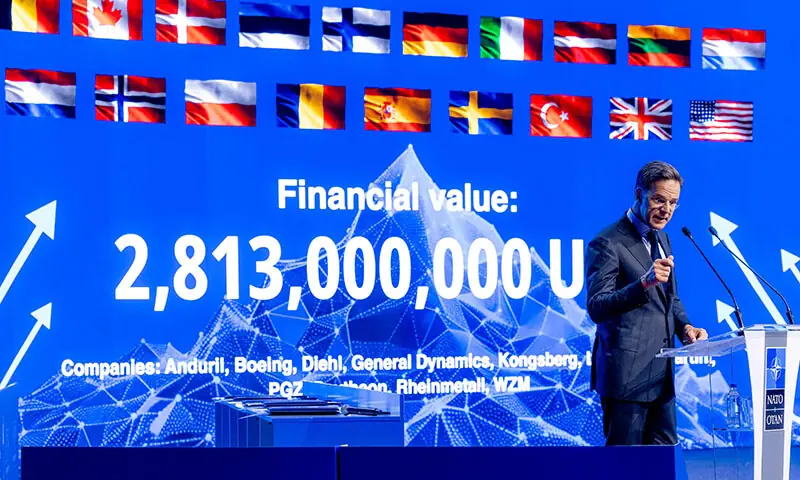
NATO leaders gathered in Ankara on Tuesday to unveil tens of billions of dollars in arms deals, sending a clear signal to President Donald Trump ahead of the alliance's summit that Europe is taking defence spending seriously. NATO Secretary General Mark Rutte led proceedings at a defence industry forum in the Turkish capital, announcing a string of deals and calling for an industrial "revolution" across the alliance.
The deals had been held back deliberately to create impact at the summit. Among the headline announcements: European countries are buying surveillance drones from US firm Northrop Grumman, and NATO is purchasing aircraft from Sweden's Saab. Saab shares jumped more than 5 percent on Tuesday, the biggest gain in Europe, after Morgan Stanley upgraded the stock. The market read was straightforward: European rearmament creates durable, long-term revenue for defence contractors.
The most strategically significant industrial deal came from US defence giant Lockheed Martin and Germany's Rheinmetall, which signed a draft agreement to jointly produce Army Tactical Missile System (ATACMS) missiles on German soil. If completed, this would be the first time ATACMS, a short-range ballistic missile, is manufactured outside the United States. That matters both for supply chain resilience and for Europe's long-term goal of reducing dependence on American military hardware.
The spending numbers
Rutte put hard figures on the table. NATO's European members and Canada spent $90 billion more on defence in real terms in 2025 than in 2024, reaching a total above $570 billion. Looking ahead, alliance members plan to invest more than $40 billion over the next five years specifically in anti-drone capabilities, a priority shaped by the war in Ukraine, where drone warfare has become central to frontline operations.
These figures are partly a direct response to Trump, who has repeatedly pressured Europe to carry more of its own defence burden and threatened to question the US commitment to NATO. Trump reinforced that message before arriving in Ankara, posting a video on Truth Social urging Europe to spend more. The forum's slick presentations and running deal totals displayed on screen were, in effect, a curated answer to that pressure.
Bigger tensions behind the deals
The summit is not purely a celebration. Tensions within NATO have sharpened since the US attacked Iran in February 2026. Trump has criticised alliance members for insufficient support during that conflict and has at times threatened to exit NATO altogether. European officials say they largely honoured commitments, including allowing US use of airspace and bases, despite not being consulted about a war that unsettled their economies and public opinion.
The US has also announced troop withdrawals from Europe and launched a six-month review of its military presence on the continent. European officials are bracing for sharp words from Trump and say they cannot predict a positive outcome from the summit.
One significant bilateral subplot involves Turkey. Trump is expected to tell Turkish President Tayyip Erdogan that the US is prepared to allow Turkey to rejoin the F-35 stealth fighter programme, according to sources cited by Reuters. Turkey was removed from the programme and sanctioned after its 2019 purchase of the Russian S-400 air defence system. Rejoining would be a meaningful diplomatic reset in a relationship that has been strained for years.
On Ukraine, NATO members are expected to reaffirm their support and pledge assistance worth approximately 70 billion euros, around $80 billion, for 2026. The urgency behind that commitment was underlined on Monday, when Russia struck the Kyiv region with missiles and drones, killing at least 28 people. The attack exposed what officials described as a critical shortage of US-made air-defence interceptors in Ukraine.
Europe's defence sector has long struggled with fragmentation, bureaucratic delays, and competition between national industries, all of which have slowed the continent's ability to produce and procure weapons at scale. The Ankara forum is being used to push firms and governments toward longer-term contracts and faster investment decisions. Whether the announcements translate into real industrial capacity, or remain largely symbolic, will become clearer over the coming months as deal details are formalised and procurement timelines are set.