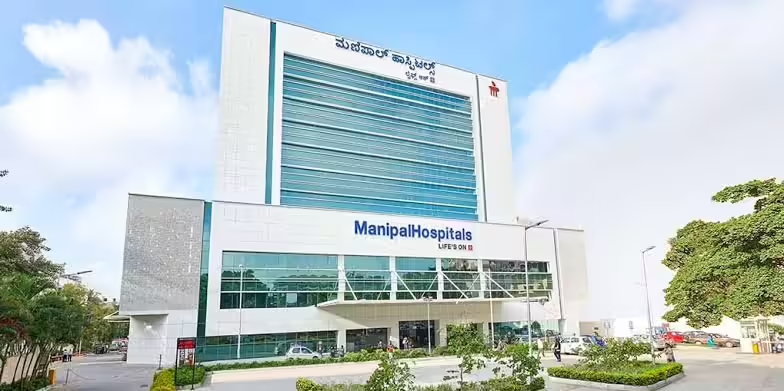
Manipal Health Enterprises has set a price band of Rs 560 to Rs 590 per share for its Rs 9,275 crore initial public offering, which opens for subscription on July 29, 2026. The issue is one of the larger healthcare listings in recent memory and will test investor appetite for hospital chains at a time when the sector trades at premium valuations.
The offering has two components. A fresh issue of Rs 8,000 crore will raise new capital directly for the company. A smaller offer for sale (OFS) worth Rs 1,275.2 crore will allow existing shareholders to exit part of their holdings, with those proceeds going to the sellers rather than the company itself.
Where the money goes
Manipal Health has earmarked the fresh issue proceeds for two specific purposes: repaying existing debt and acquiring a minority stake in Sahyadri Hospitals. Debt repayment is straightforward, it reduces interest costs and strengthens the balance sheet ahead of life as a listed company. The Sahyadri Hospitals stake buy is more strategic. Sahyadri is a prominent hospital network in Maharashtra, and a minority position there would expand Manipal's footprint in a large and competitive market without a full acquisition price tag.
The structure is worth noting. At Rs 8,000 crore, the fresh issue dominates the raise, meaning most of the capital flows into the business rather than out to selling shareholders. That tends to be a more favourable signal for incoming investors compared with OFS-heavy deals where the company itself receives little.
Why this listing matters
Manipal Health is one of India's larger private hospital operators, and its IPO will establish a public market benchmark for the company's valuation. At the upper end of the price band, Rs 590 per share, investors can calculate an implied market capitalisation once the company discloses its total share count in final prospectus filings. That figure will matter for sector comparisons with listed peers such as Apollo Hospitals and Fortis Healthcare, both of which have seen sustained re-rating over the past few years.
The debt repayment angle also gives the listing a near-term earnings catalyst. Hospital chains typically carry significant debt from building and acquiring facilities. Reducing that load post-IPO means lower interest outgo, which flows directly into net profit margins. For analysts building valuation models, a cleaner balance sheet post-listing makes future earnings more predictable.
The Sahyadri stake acquisition, funded from IPO proceeds, signals that Manipal intends to use the listing as a springboard for inorganic growth rather than simply paying down liabilities and standing still. Maharashtra is a high-value market for private healthcare given income levels and insurance penetration, so even a minority position builds optionality for a larger deal later.
For retail investors, the price band of Rs 560 to Rs 590 sets the minimum lot size investment, which will be detailed in the red herring prospectus. The band itself is relatively tight at roughly five percent, giving the company limited room to adjust final pricing based on demand at the upper end.
Grey market activity and anchor investor allocation, typically disclosed one day before opening, will be the next signals on overall demand quality. Strong anchor participation from domestic mutual funds or global institutional investors would indicate confidence in both the business model and the valuation.
The IPO window opening July 29 means the listing date will follow roughly six to seven trading days later, likely in the first week of August 2026, assuming standard timelines. Between now and then, the company's roadshow presentations to institutional investors will be the primary pricing signal for the market to watch.