The Insurance Regulatory and Development Authority of India (Irdai) has held the mandatory cession rate steady at 4% for FY27, requiring all general insurers to place that share of their reinsurance premium with state-backed GIC Re. The rate was unchanged despite pressure from new domestic reinsurance entrants, signaling regulatory intent to preserve GIC Re's market anchor role. The cession mandate functions as a guaranteed premium flow to GIC Re, insulating it from competitive erosion even as Jio-Allianz Re and Valueattics Re enter the domestic reinsurance space. Both new players are positioned to compete for the discretionary reinsurance business that sits outside the mandatory cession. For general insurers, the 4% floor limits placement flexibility and effectively subsidizes GIC Re's balance sheet at the expense of market-rate competition. The practical consequence is that new entrants must compete on the remaining reinsurance capacity rather than contesting the protected mandatory tranche. Watch whether Irdai revisits the cession rate in subsequent fiscal years as domestic reinsurance capacity deepens, and whether Jio-Allianz Re and Valueattics Re gain enough scale to pressure a regulatory review.
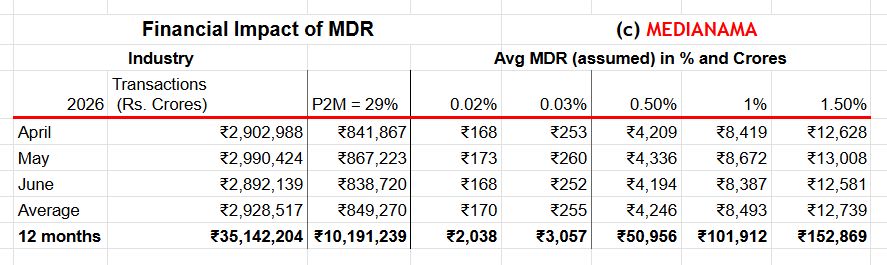
India's government plans to amend the Payment and Settlement Systems Act to restore UPI merchant discount rates, ending the zero-MDR regime in place since January 2020.
India's government has introduced the Taxation and Other Laws (Amendment) Bill, 2026, proposing changes to payments regulation, income tax, and the Finance Act to attract FDI and support Make in India. The Bill's final shape will depend on parliamentary debate and committee review.
The government's Taxation and Other Laws (Amendment) Bill, 2026, proposes to replace the blanket UPI MDR ban with a system allowing the Centre to notify which payment modes stay fee-free.
Prime Minister Narendra Modi inaugurated the Rs 5,000 crore Bhogapuram greenfield airport in Andhra Pradesh, built under a public-private partnership model. He also laid foundation stones for infrastructure projects worth nearly Rs 18,000 crore in the state, signalling a broad investment push for the region.