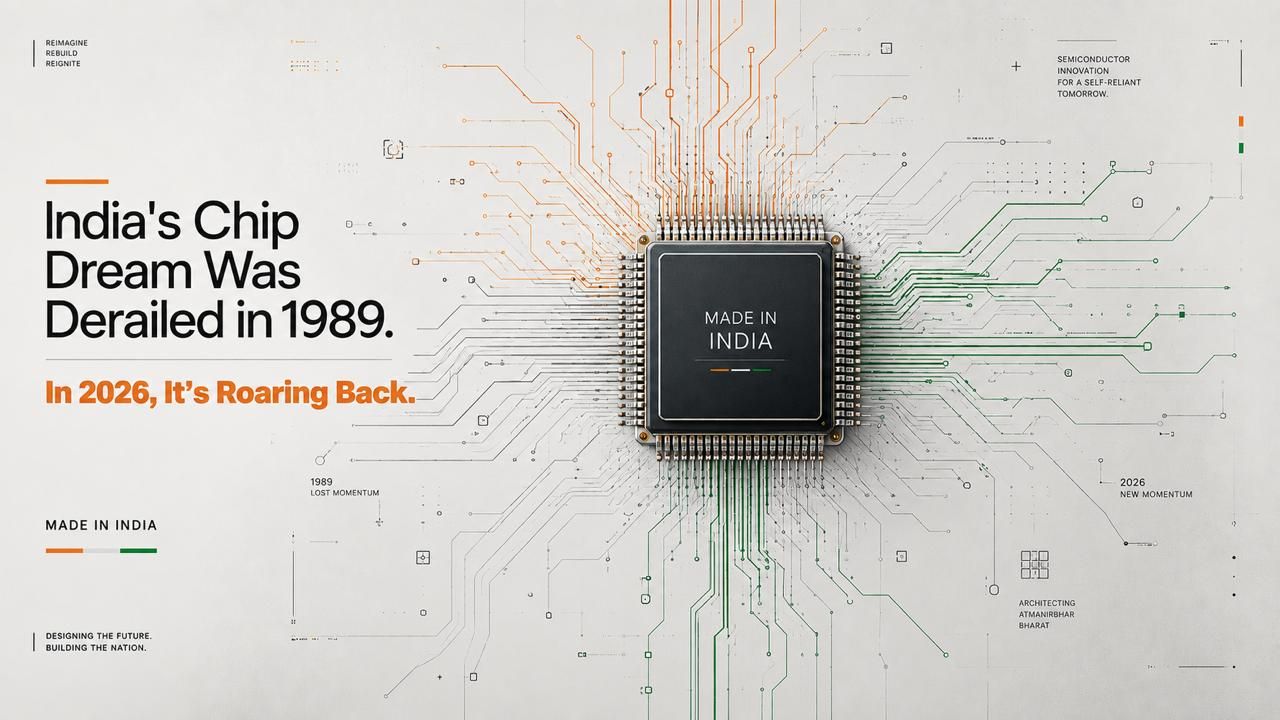
India is now shipping commercially made semiconductors for the first time in its modern industrial history. As of mid-2026, the government has approved 12 semiconductor manufacturing projects worth roughly ₹1.64 lakh crore under its India Semiconductor Mission, and the Union Cabinet has cleared a second phase called Semicon 2.0 with a further ₹1,27,500 crore outlay, even before the first phase lost momentum.
The headline number matters less than what is actually happening on factory floors. Micron Technology's facility in Sanand, Gujarat was inaugurated on February 28, 2026, and began handing made-in-India memory modules to Dell Technologies at the opening. Kaynes Semicon, also in Sanand, went from foundation stone to commercial production in 14 months, shipping roughly 6 million chips per day since March 31. CG Semi, a joint venture of CG Power, Renesas, and Stars Microelectronics, inaugurated its Sanand plant on July 4, turning that Gujarat town into India's most active chip cluster. A month later, the cabinet approved Semicon 2.0, before Phase 1 had lost any steam.
A history lesson most people get wrong
The standard narrative is that India missed the semiconductor window by half a century. That is not accurate. The Union Cabinet approved the Semiconductor Complex Limited in 1976, the same year Taiwan signed its technology transfer deal with RCA. India began producing 5-micron chips in 1984, three years before TSMC was even founded. What India lost was not capability. It was continuity.
In 1989, a fire destroyed the main production line at SCL's Mohali facility. The plant eventually resumed operations in 1997 and continued serving strategic applications, but the commercial manufacturing momentum was gone. What followed were three decades of stalled restarts, attempted in 2006, 2007, 2014, and 2022, each one failing to convert policy intent into factory-floor execution. That is the 37-year gap India is now closing.
Taiwan and South Korea offer the clearest comparison. Taiwan's government backed its institutions for five uninterrupted decades, from the 1973 creation of ITRI through to TSMC's rise as the world's dominant contract chipmaker. Samsung kept investing through the 1983 to 1985 chip price crash, losing money on every wafer, and overtook Toshiba as the world's largest DRAM maker by 1992. Commitment that survives bad years is what separates semiconductor powers from semiconductor experiments.
What has actually changed this time
The money matters, but the structure of how it flows matters more. Under India's semiconductor schemes, the central government provides fiscal support covering 50% of project cost, with states layering additional incentives. Crucially, this support operates on a pari-passu basis: government funds move alongside actual project expenditure rather than arriving only after a plant is complete. As MeitY Secretary S. Krishnan described it, this is probably the most generous industrial policy programme ever undertaken in India. Private capital no longer has to absorb all the risk for years before seeing a rupee of support.
Execution infrastructure has also matured. The India Semiconductor Mission, led by Additional Secretary Amitesh Kumar Sinha as CEO, has moved from evaluating applications to actively coordinating land, power, water, clearances, and operational bottlenecks across multiple states simultaneously. In semiconductor policy, bureaucratic execution is as much a part of the infrastructure as the cleanroom itself.
Semicon 2.0 broadens the ambition across six pillars: fabs, chip design, equipment, materials, packaging, and domestic supply chains. A fab placed inside a country's borders does not by itself create a semiconductor industry. It requires specialty chemicals, gases, substrates, precision engineering, testing, equipment servicing, process engineers, and customers willing to qualify those chips for production. The second phase is designed to build that surrounding ecosystem, not just more plants.
For Indian entrepreneurs, the quieter opportunity is everything that grows around the factory. MeitY confirmed that 24 semiconductor design companies have been approved for fiscal support under the programme. Semicon 2.0 also introduces a structure where the government co-invests equity alongside venture capital in chip design startups, plans to exit as they scale, and recycles proceeds into deep-tech research and tools. This aligns government incentives with startup growth in a way a grant or loan cannot.
The project that could most change perceptions is Tata Electronics' ₹91,000 crore wafer fab at Dholera, being built with Taiwan's PSMC. It is roughly 50% constructed as of April 2026, with first silicon targeted for late 2026. If it commissions and scales to its planned 50,000 wafer starts per month, it would shift India from assembly and packaging into commercial wafer fabrication, a structurally different and much harder capability to build.
India's decision to start at mature process nodes, 28nm to 110nm, follows sound industrial logic. Chips in that range are essential to automobiles, power management, defense, and telecom. They also give Indian manufacturers a realistic path to master the disciplines that semiconductor economics actually depend on: process control, yield, reliability, and customer qualification. Skills required to run a fab reliably are accumulated through production, not announced into existence.
Five tests will determine whether this moment becomes a lasting ecosystem or another stalled restart. Manufacturing yield, the percentage of usable chips per wafer, will decide whether plants are commercially viable. Supplier depth in chemicals, gases, and equipment will decide whether fabs remain isolated islands. Manufacturing talent, distinct from India's strong design base, must be built through years on factory floors. Customer qualification cycles, domestic and international, cannot be substituted by subsidies. And continuity of political and institutional commitment, especially through the first major semiconductor downturn, will be the hardest and most consequential test of all. Taiwan and South Korea became leaders because their institutions kept showing up after the headlines moved on. India's model will only be proven when it survives its first bad year.