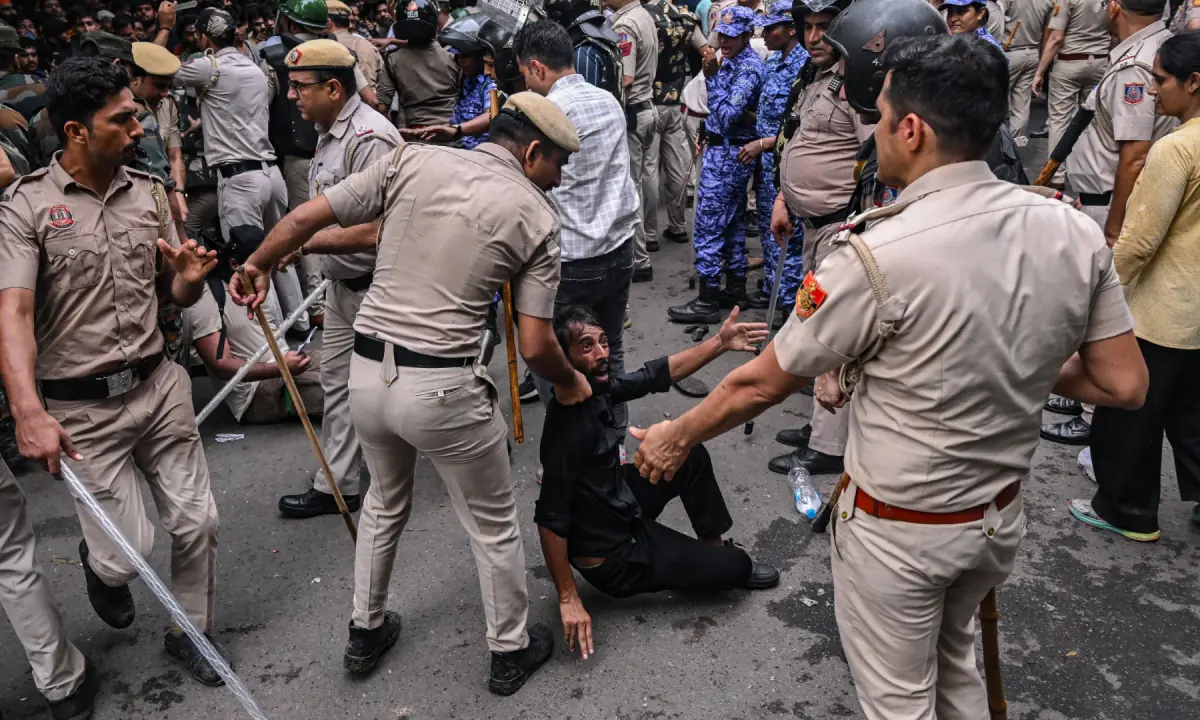
Indian police fired tear gas and used batons against thousands of protesters in New Delhi on Monday as demonstrators tried to march on parliament demanding the resignation of Education Minister Dharmendra Pradhan. The crackdown near Jantar Mantar marked one of the largest protests in the capital in five years, with students at the center of a movement that has grown rapidly into a serious political challenge for Prime Minister Narendra Modi.
The demonstrators belong to or support the Cockroach Janta Party (CJP), a satirical political movement launched in May 2026 that has amassed millions of social media followers by channeling anger over India's broken examination system and high youth unemployment. The CJP was founded by activist Abhijeet Dipke, whose supporters began a sit-in last month demanding Pradhan's resignation. Prominent activist Sonam Wangchuk joined them on June 28 with an indefinite hunger strike, which was cut short on Saturday when he was forcibly taken to hospital after 20 days.
The immediate trigger is a string of exam failures that have infuriated young Indians. Some 2.2 million aspiring medical students had to retake a national exam last month after the original test was scrapped following a question paper leak. A separate scandal involving the online marking system for tests taken by nearly two million high school students compounded the outrage. Together, they represent a systemic credibility problem for one of the world's most competitive examination pipelines.
Why It Matters
The protests reflect a deeper structural problem. Government data shows unemployment among 15-to-29-year-olds stood at 9.9 percent in 2025, more than three times the official overall rate of 3.1 percent. In urban areas, youth unemployment reached 13.6 percent. Despite India's headline economic growth, stable well-paying jobs remain out of reach for a large share of the country's young population, the world's largest. The CJP has effectively connected exam fraud to that broader job insecurity, arguing that corrupt testing systems block fair access to government employment and professional careers.
Delhi Police cut internet access in parts of central New Delhi on Monday and said they had not granted permission for the march. "Any person violating these prohibitory orders shall be liable for prosecution," Delhi Police said in a statement. The CJP called the response an attack on peaceful demonstrators, posting on X: "First, your government ignored this protest for a month, and now, when we are peacefully marching, your government is attacking us."
Inside parliament, the opposition moved quickly to amplify the street pressure. Mallikarjun Kharge, a senior leader of the Congress party, raised the issue in the upper house, saying the government was trying to suppress student voices by force. Opposition members in the lower house shouted slogans demanding Pradhan's resignation and justice for affected students. Modi, speaking publicly before the monsoon session of parliament opened, did not mention the protesters.
Wangchuk, writing from his hospital bed in a handwritten note posted on X, set out three conditions under which he would end his hunger strike: the government acknowledges responsibility for the exam failures and paper leaks; CJP protesters are allowed to reach parliament and receive assurances from lawmakers; or leaders of various parties visit him in hospital with the same commitments. The CJP separately confirmed that two of its leaders met a senior minister on Monday morning and submitted a formal letter of demands, suggesting some tentative contact between the movement and the government.
What to Watch Next
The critical variable now is whether that meeting leads to any concrete government response. Pradhan has not stepped down, and Modi has not publicly addressed the students' demands. The monsoon session of parliament gives opposition parties a formal platform to keep the pressure visible. If the government makes no concession, the CJP's large and growing social media base makes sustained mobilization plausible. If it does respond, even symbolically, it would be a notable concession to a movement that began as a satirical social media account just two months ago.
For young Indians watching from outside Delhi, the question is more direct: whether a loud, organized protest can actually force accountability on an issue, exam integrity, that affects millions of people's futures every year.