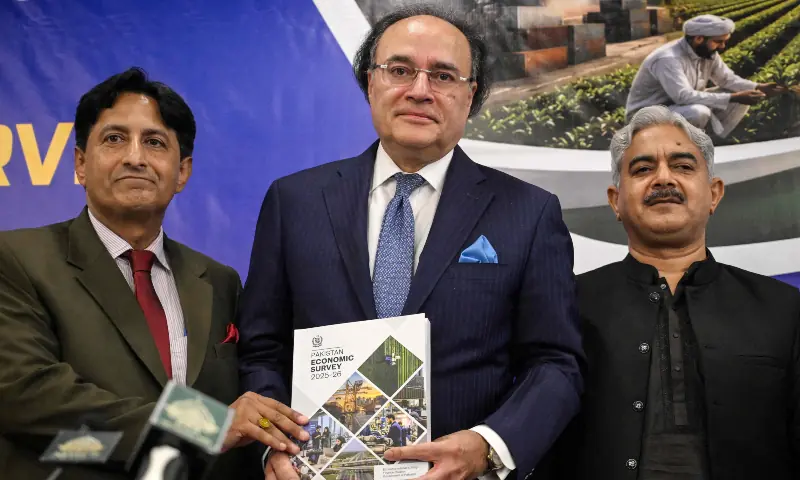
Pakistan's economy grew 3.7 percent in FY2026, its fastest pace in four years, according to the Pakistan Economic Survey (PES) FY2025-26 released on Thursday. Finance Minister Muhammad Aurangzeb presented the survey in Islamabad, describing it as a story of resilience through a difficult year. The growth figure beats last year's 3.18 percent but falls short of the government's own 4.2 percent target.
The gap to target was not entirely self-inflicted. Aurangzeb cited a sequence of external shocks: trade tariff uncertainty at the start of the fiscal year, severe floods in August and September 2025, and a regional conflict in March 2026 that also weighed on the broader Middle East economy. He noted that global GDP growth itself slipped to 3.1 percent from 3.7 percent over the same period, narrowing the room Pakistan had to outperform. Despite these pressures, the economy reached a nominal size of Rs126.9 trillion, and per capita income rose to $1,901 from $1,751 in FY2025.
What drove growth across sectors
The broadest contributor was manufacturing. The survey recorded 6.6 percent growth in the overall manufacturing sector, with large-scale manufacturing (LSM) rising 6.1 percent, also a four-year high. Critically, 16 of LSM's 22 sub-sectors posted positive growth, so the recovery was not a single-sector story. Demand signals within LSM were sharp: cement consumption rose 10 percent, fertiliser 17 percent, automobiles 31 percent, petroleum products 5 percent, and mobile phones 9 percent year-on-year.
Agriculture grew 2.89 percent, nearly doubling last year's 1.53 percent, partly because the crop sub-sector held positive despite the 2025 floods. The livestock sub-sector continued to expand. The industrial sector overall grew 3.51 percent, with construction rising 5.73 percent. The electricity, gas, and water supply segment contracted, weighed down by subsidy reductions, slower output from the Water and Power Development Authority, and a higher price deflator.
Services, which make up close to 58 percent of GDP, grew 4.09 percent, again a four-year high for that sector. The communication and information sub-sector led with 7.52 percent growth, a figure the minister linked directly to the expanding digital economy. IT exports crossed $3.8 billion for the year, with freelancer earnings alone approaching $900 million.
Fiscal and external accounts: progress with caveats
The fiscal picture improved sharply. The deficit narrowed to 0.7 percent of GDP (Rs856.4 billion) from 2.6 percent the year before, driven by a 10.1 percent rise in Federal Board of Revenue tax collections to Rs9,305.9 billion and a 23 percent drop in markup payments. The primary surplus widened to 3.2 percent of GDP from 3 percent. Provincial tax revenues grew faster still, up 25.8 percent to Rs860.7 billion. Digital tools played a visible role: digital production monitoring in cement and sugar added Rs60 billion in incremental revenue, and AI-based audit selection yielded a further Rs34 billion. The government is now targeting two million merchants on digital payment rails by June 2026 and has already exceeded its 120 million digital banking user target, reaching 133 million.
The public debt-to-GDP ratio continued to fall, from 75 percent in FY2023 to 70.7 percent in FY2025 and then to 68.5 percent in FY2026. Total public debt stood at Rs83,285 billion by end-March 2026, with debt growth contained to 3.4 percent in the first nine months compared to 6.7 percent in the same period last year. Of the $92.2 billion in external public debt, multilateral loans at $42.5 billion remain the largest chunk. IMF debt under the International Monetary Fund Extended Fund Facility stood at $9.9 billion, with $1.2 billion received during July-March FY2026.
On the external account, the current account posted a marginal surplus of $72 million in July-March FY2026, down from $1.7 billion in the same period last year. Workers' remittances rose 8.2 percent to $30.3 billion, providing a key buffer. Food exports fell roughly $1.5 billion, led by a $1.1 billion drop in rice and a $403 million drop in sugar. Textile and sports goods exports moved in the opposite direction, with sports goods up 18 percent in July-May FY2026. Foreign exchange reserves stood at $17 billion as of the press conference, with the minister targeting $18 billion by end-June 2026, the equivalent of three months of import cover.
CPI inflation averaged 6.2 percent in July-April FY2026, up from 4.7 percent in the prior year period, though the survey attributed part of that pressure to geopolitical shocks late in the third quarter. The policy rate now sits at 11.5 percent, down sharply from the 28 percent peak Aurangzeb referenced. The Pakistan Stock Exchange KSE-100 index gained 18.4 percent in July-March FY2026, supported by lower rates, stronger corporate earnings, and successful IMF programme reviews. Market capitalisation moved from Rs15,237 billion in June 2025 to Rs16,534 billion by end-March 2026.
What to watch next: the government's ability to keep the fiscal deficit below 1 percent of GDP in the full year, the trajectory of food exports as global commodity prices shift, and whether IT export momentum can carry the sector toward the $4.5 billion target Aurangzeb named. The pace of structural reform under the IMF programme will also determine whether growth can clear the 4 percent threshold that eluded the country in FY2026.