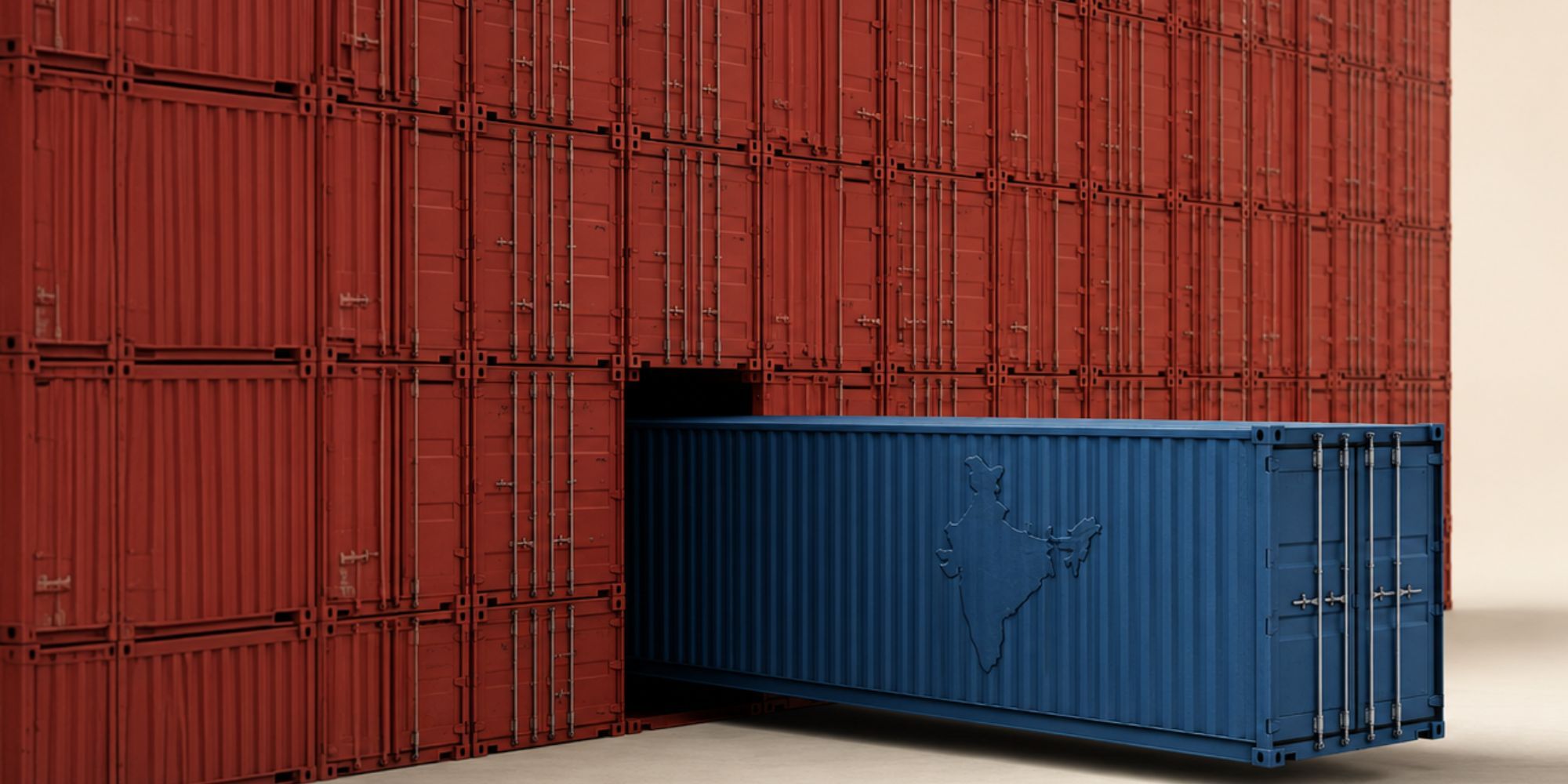
India has manufactured its first export-grade shipping container accepted into a global carrier's fleet, marking a concrete attempt to chip away at China's near-total control of a market that underpins all of international seaborne trade. Union Minister Sarbananda Sonowal unveiled the container on July 3, 2026, at the A.P. Moller-Maersk-CONCOR Inland Container Depot in Dadri, Uttar Pradesh. The box was built by DCM Shriram Group and accepted by Maersk, the world's second-largest shipping line, which immediately ordered 1,000 more.
The significance lies in the certification, not just the build. India has had limited container manufacturing before, including Jupiter Wagons' Indore plant. What is new is a box certified to EXIM grade and integrated into an international carrier's active fleet. That is a meaningfully higher bar than a domestically-used container, and Maersk's follow-on order of 1,000 units moves the relationship from prototype to procurement, however modest the volume looks against the tens of thousands major carriers buy annually.
The backdrop for this debut is striking. Chinese manufacturers control more than 95% of global dry cargo container production and close to 100% of refrigerated units, according to shipping consultancy Drewry. CIMC alone accounts for roughly 42-45% of global output. That concentration came into sharp legal focus in May 2026, when the US Justice Department unsealed an indictment against four Chinese container makers and seven executives, alleging they ran a price-fixing cartel that roughly doubled container prices between 2019 and 2021.
Why the cost gap is the real obstacle
China's dominance was not accidental. It followed a clear industrial succession: US manufacturers led first, then Japan, then South Korea dominated through the 1980s before Chinese scale, cheap steel, and state support made competing elsewhere economically unworkable. The core barrier today is cost, not capability. A standard 40-foot container costs roughly Rs 1.5-2 lakh to build in China, compared to Rs 3.5-4 lakh in India. The difference comes from steel prices, plant throughput, and the amortisation of facilities running at millions of TEUs per year. An empty box built far from an export hub must also be repositioned before it earns a single freight dollar, adding further cost.
This is precisely why the subsidy structure matters as much as the first box unveiled at Dadri. The Union Budget 2026 allocated Rs 10,000 crore over five years to a container manufacturing support programme, referred to in budget documents as the Container Manufacturing Assistance Scheme and by the shipping ministry as the Container Manufacturing Promotion Scheme. The scheme offers capital support for new plants, operating subsidies to bridge the cost gap with Chinese producers, and funding for research and development. The target is to lift India's annual container production capacity tenfold to 7.5 lakh TEUs. The groundwork for this policy push traces to a February 2025 meeting between Prime Minister Modi and Maersk's Robert Maersk Uggla.
What the Vietnam precedent tells us
India is not the first country to attempt a credible challenge. Vietnam's Hoa Phat built a container plant next to its own Vung Tau steel mill, delivered 1,000 twenty-foot containers to CMA CGM in August 2025, and now runs 200,000 TEUs per year of a designed 500,000 TEU capacity. That example cuts both ways. It shows the monopoly can be contested, but it also shows what contestability requires: captive steel supply, proximity to a major export port, and the patience to absorb losses while scaling up.
The strategic stakes extend beyond cost charts. Maersk's own history illustrates the risk of dependency. In September 2021, it agreed to sell its refrigerated container arm, Maersk Container Industry, to CIMC for $987 million. The US Department of Justice Antitrust Division concluded the deal would consolidate over 90% of global insulated and refrigerated container production in Chinese state-owned or state-controlled hands. The deal collapsed in August 2022 after it became clear it would not survive regulatory review. The episode revealed just how thin the supplier market is: there are only four global reefer container makers in total.
For India, the practical test comes after the ribbon-cutting. DCM Shriram is better known for fertilisers, sugar, and chemicals than steel fabrication at scale. The real question is whether the company can deliver consistent quality at a cost structure that remains competitive once subsidies taper. One certified container and a 1,000-unit follow-on order are meaningful firsts, not a market shift. China's producers will not cede volume without responding on price, and global carriers buy primarily on economics.
What has genuinely changed is that a credible entry now exists. For over a decade, buyers had almost no alternatives. Containers are the invisible infrastructure of global trade, the physical unit in which goods are priced, moved, and measured. A country that cannot build them depends entirely on whoever does, which until now has meant accepting Chinese prices, Chinese terms, and, if the US indictment holds, Chinese cartel behaviour. India's first EXIM-grade box does not dent that dominance today. But it is a real entry into a market where none existed, backed by policy money and an anchor customer, and that combination is what prior challengers have mostly lacked.