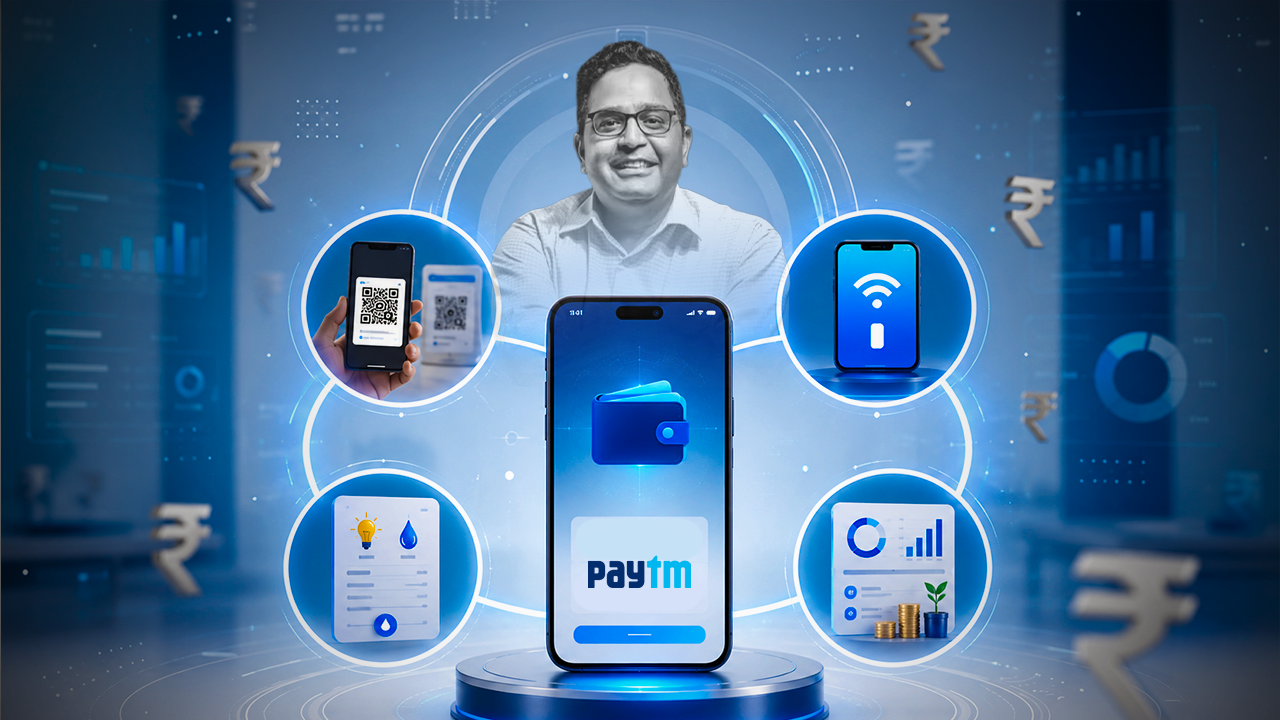
Paytm's parent company, One97 Communications, posted a net profit of Rs 220 crore for the April to June quarter of FY27, a 79% jump from Rs 123 crore in the same quarter last year. Revenue from operations grew 27% year-on-year to Rs 2,448 crore, building on a full year of profitability the company achieved in FY26.
The results, filed as an unaudited report with the National Stock Exchange, show Paytm accelerating across its core business lines after a difficult stretch that followed regulatory action on its payments bank unit in early 2024. The Q1 FY27 numbers suggest the recovery is now translating into consistent, scaled earnings rather than one-off gains.
What drove the growth
Payment services remained the engine, contributing over 56% of operating revenue and growing 32% year-on-year to Rs 1,384 crore. This segment covers the transaction fees Paytm earns from merchants and consumers using its payment gateway, QR codes, and point-of-sale devices. Financial services distribution, which includes loan referrals and insurance products, added Rs 814 crore. Marketing services contributed Rs 239 crore. Non-operating income of Rs 182 crore pushed total income for the quarter to Rs 2,630 crore.
On a sequential basis, revenue rose 8% from Rs 2,264 crore in Q4 FY26, pointing to steady momentum rather than a one-quarter spike.
Costs are rising too, but the math still works
Total expenditure for the quarter was Rs 2,383 crore, up from Rs 2,016 crore a year ago. Payment processing charges, the fees Paytm pays to card networks, banks, and infrastructure providers to move money, were the single biggest cost at Rs 794 crore, accounting for more than a third of total expenses and rising 36% year-on-year. That growth rate is faster than revenue, which is worth watching as volumes scale.
Employee costs came in at Rs 742 crore, up nearly 16%. Marketing spend jumped 69% year-on-year to Rs 169 crore, suggesting the company is investing in customer and merchant acquisition as competition in the UPI and payments space remains intense. Software, cloud, legal, cashback, and overhead costs made up the rest.
Despite rising costs across every line, Paytm still nearly doubled its profit year-on-year. The operating leverage in its model, where revenue grows faster than fixed costs, is beginning to show at scale.
Separately, Paytm disclosed a fresh grant of employee stock options worth approximately Rs 208 crore, covering 15.42 lakh equity shares under its ESOP 2019 scheme. Large ESOP grants at this stage typically serve two purposes: retaining engineering and product talent in a competitive hiring market, and aligning employee incentives with longer-term share performance. The size of the grant signals the company is investing in its workforce for sustained growth, not just near-term cost control.
Paytm shares closed at Rs 1,348.5 on the day of the results, giving the company a market capitalisation of Rs 86,396 crore, or roughly $9.09 billion. The stock's valuation now reflects a company that has moved past survival questions and into a phase where investors are pricing in earnings trajectory.
What to watch in coming quarters: payment processing charges grew faster than payment revenue this quarter, and whether Paytm can hold that gap tighter will matter for margins. Growth in financial services distribution, especially loan referrals, is also worth tracking closely since that segment carries regulatory sensitivity. If the company sustains this profit run rate through the rest of FY27, it will have cleared the bar of consistent profitability that many fintech investors have been waiting for.