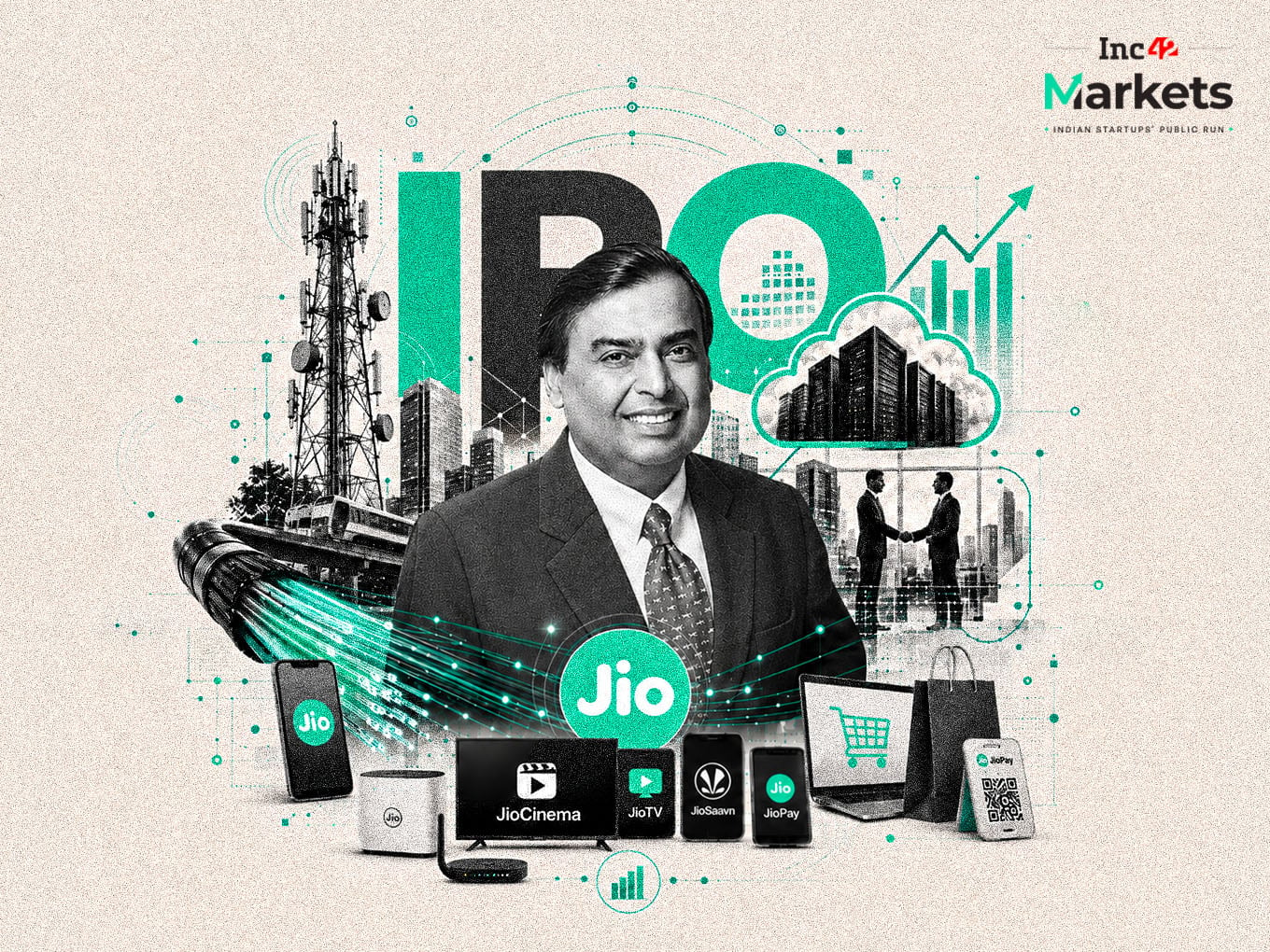
Reliance Jio has filed its Draft Red Herring Prospectus (DRHP) with SEBI, setting the stage for what could become India's largest-ever IPO. The company plans to issue up to 270 million new shares, with analysts estimating the offering could raise around Rs 37,700 crore and value Jio at approximately Rs 11 to 12 lakh crore. The filing arrives alongside a separate DRHP from the National Stock Exchange, signalling a broader return of confidence to India's primary markets after a slow first half of 2026.
The timing matters. IPO activity in 2026 has been notably weak. Companies have raised roughly $3.5 billion through public offerings so far this year, a fraction of the $20 billion raised in each of the two prior years. Geopolitical uncertainty, volatile equity markets, and inconsistent foreign inflows kept several large issuers on the sidelines. Jio was one of them. Its filing now suggests the window has opened, and other large issuers are expected to follow in the second half of the year.
A Business Built for Monetisation, Not Growth
Jio is no longer a growth story in the traditional sense. With 524.4 million subscribers, it has essentially saturated India's mobile market. The question investors must answer is a different one: how much can Jio earn from each user it already has?
Telecom businesses move through three phases: building networks, acquiring subscribers, and then monetising them. Jio has completed the first two at an extraordinary scale. The third phase is where the financial logic of this IPO lives. Analysts estimate that a Rs 10 monthly increase in average revenue per user (ARPU) across Jio's base could add roughly Rs 6,000 crore to annual profit. That arithmetic explains why even incremental pricing power carries significant weight at this scale.
Fixed wireless access (FWA) is one of the cleaner paths to higher ARPU. Jio has become a leading player in using 5G networks to deliver home broadband without laying fibre to every home. Broadband users tend to spend more, churn less, and are more likely to adopt bundled services like entertainment, cloud storage, and smart-home products. Each broadband customer pulled into the ecosystem represents a meaningful step-up in lifetime value compared with a mobile-only subscriber.
Why the Valuation Is Contentious
At Rs 11 to 12 lakh crore, investors are not simply buying a telecom operator. They are paying for what Jio might become. Reliance Industries has publicly framed Jio as the foundation of a broader digital infrastructure strategy covering artificial intelligence, cloud computing, enterprise software, data centres, satellite connectivity, and digital commerce. At Reliance's most recent annual general meeting, management positioned AI as one of the group's primary future growth engines.
That creates a valuation tension that is hard to resolve cleanly. Traditional telecom operators are priced on cash flows. Technology platforms are priced on future possibilities. Jio occupies an awkward middle ground. Its current earnings are overwhelmingly telecom-driven, but few telecom operators anywhere in the world combine Jio's subscriber scale, balance-sheet strength, and ecosystem ambition. Investors willing to pay a technology-style multiple are betting that the AI and cloud narratives eventually produce real revenue. That burden of proof has not yet been met, and the market will price that uncertainty into the stock from day one.
One structural detail in the filing is worth noting. The IPO is entirely fresh capital with no offer-for-sale component. Existing shareholders, including the large private equity and corporate investors who backed Jio's early infrastructure buildout, are not selling. That signals Reliance views this as a valuation exercise and a capital raise, not an exit. The company is creating an independent market price for its most valuable digital asset while retaining full strategic control.
That price will reverberate across the Reliance group. For years, Reliance Retail, the group's AI investments, and its emerging clean-energy businesses have been bundled inside a single conglomerate structure, making it difficult for investors to value any one of them separately. A publicly traded Jio changes that. The market price it discovers will inevitably shape how analysts and investors think about the rest of the group, effectively beginning a value-unlocking process that goes well beyond a single listing.
Watch for SEBI's observations on the DRHP, the final pricing decision, and early analyst valuations. How the market receives Jio's listing will set the tone for the several large IPOs expected to follow in the second half of 2026, including Razorpay, which has confidentially filed for a $500 to $600 million raise, and BRND.ME, the ecommerce unicorn that recently converted to a public company and plans to list within 12 to 18 months.