
Qatar Signals Progress in US-Iran War Talks
Qatar's foreign ministry said mediators including Qatar, Pakistan, and Oman have reached "very progressive stages" in efforts to end the US-Iran war, pushing Brent crude down more than four percent.
Key Takeaways
June 21, 2026 · 4 min read · By Rishabh Bhardwaj
·
AI-assisted, human-reviewed · Our editorial standards
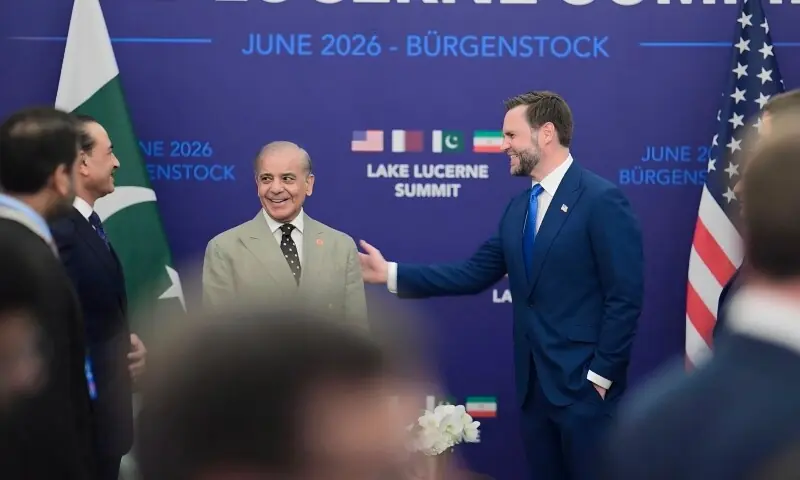
US and Iranian delegations have opened formal talks in Burgenstock, Switzerland, with Pakistan and Qatar acting as mediators, to begin translating a ceasefire memorandum into a binding, comprehensive agreement. The meeting, announced by the Qatari Foreign Ministry, marks the first direct engagement between Washington and Tehran since the Islamabad Memorandum of Understanding was signed on June 17, 2026.
The talks are described as "technical-level" sessions aimed at fleshing out the details of the MoU, a 14-point document signed by US President Donald Trump and Iranian President Masoud Pezeshkian, with Pakistani Prime Minister Shehbaz Sharif signing as mediator. The MoU established a framework to end more than 100 days of war between the two sides, reopen the Strait of Hormuz, and set a 60-day timeline for further negotiations.
Beyond the ceasefire mechanics, the agenda covers several consequential economic and security issues. Delegations are expected to negotiate terms for lifting the US blockade on Iran, unfreezing Iranian assets, and resuming Iranian oil sales. A separate tripartite meeting between Iran, the US, and Qatar focused specifically on a ceasefire in Lebanon and Iran's blocked assets, according to Iranian state broadcaster IRIB. Vice President JD Vance, who led the US negotiating team, said Iran's nuclear programme and the Lebanon ceasefire were "the two big things" to be resolved. He noted the Lebanon situation was "actually getting better" but acknowledged a cycle of retaliatory fire that needs to be broken.
Once a final deal is reached on Iran's nuclear programme, the agreement calls for the US to facilitate release of a $300 billion reconstruction fund supported by regional nations. That figure gives the negotiations significant financial weight beyond the immediate security dimensions.
The Iranian delegation is led by Parliamentary Speaker Mohammad Bagher Ghalibaf and includes Foreign Minister Abbas Araghchi, Central Bank Governor Abdolnaser Hemmati, National Iranian Oil Company CEO Hamid Bovard, and senior national security officials. The depth of that team, spanning diplomacy, finance, and energy, signals Tehran is prepared to negotiate the economic clauses in detail.
On the US side, Vance met directly with the Pakistani delegation before the formal sessions opened. US negotiators Jared Kushner and Steve Witkoff were already in Switzerland handling technical groundwork ahead of Vance's arrival at Emmen Air Base at 5:59 am local time on Sunday. Vance told reporters he could participate for only "a day or two."
Pakistan's delegation included PM Shehbaz, Chief of Defence Forces Field Marshal Asim Munir, Interior Minister Mohsin Naqvi, and Information Minister Ataullah Tarar. The Pakistani Foreign Office described the country's role as reflecting a "principled, balanced, and constructive approach," pointing to Pakistan's earlier hosting of US-Iran talks that produced the Islamabad MoU. The Qatari foreign ministry specifically praised Islamabad's "documented and continuous efforts" in supporting the process.
Qatar's foreign ministry spokesperson Dr Majed bin Mohammed Al-Ansari said technical and specialised groups have been formed to negotiate each clause of the final agreement, with separate follow-up groups established to monitor implementation of the MoU as talks continue.
Iran's foreign ministry took a firmer public posture ahead of the sessions. Spokesperson Esmaeil Baqaei said Tehran would press for "the fulfilment of the other side's commitments" and warned that if part of the US commitments goes unmet, "the entirety of the agreement will be jeopardised." That public pressure, likely aimed at the Lebanon ceasefire clause, sets up one of the harder negotiating points of the day.
No formal timeframe has been announced for how long the technical talks will run. Iranian foreign ministry spokesperson Baghaei said a one-day session was planned, but Pakistani state broadcaster PTV reported that discussions could extend into Monday and would continue "as long as necessary." Whether PM Shehbaz's delegation returns the same day has not been confirmed.
Regional support for the process has been broad. The Qatari statement acknowledged contributions from Saudi Arabia, Turkey, Egypt, and the United Arab Emirates in creating conditions for the talks to move forward. That backing matters: it reduces the risk of parallel diplomatic pressure derailing the Burgenstock process before a final agreement is drafted.
The immediate question is whether the technical groups can align on specific language around asset unfreezing, oil sales, and nuclear verification before the 60-day window in the MoU begins to tighten. Each of those issues carries its own domestic political weight in both Washington and Tehran, which is why the structured group format, rather than a single high-level negotiation, is being used to manage the complexity.
Qatar's foreign ministry said mediators including Qatar, Pakistan, and Oman have reached "very progressive stages" in efforts to end the US-Iran war, pushing Brent crude down more than four percent.
Qatar confirmed it is mediating between the US and Iran but said no direct talks are currently planned. The clarification follows conflicting statements from President Trump, who claimed talks are under way, and Tehran, which denied any dialogue is happening.
Saudi Aramco reported sharply higher second-quarter 2026 profits as the Iran war restricts global oil supply and pushes crude prices up. Other oil supermajors also posted outsized earnings, raising concerns about sustained fuel cost pressure for importing economies.
President Trump called current Iran negotiations the "last chance" to end five months of conflict, pushing oil prices higher. Tehran denied formal talks are taking place, raising the risk of a diplomatic breakdown with direct consequences for global energy markets.