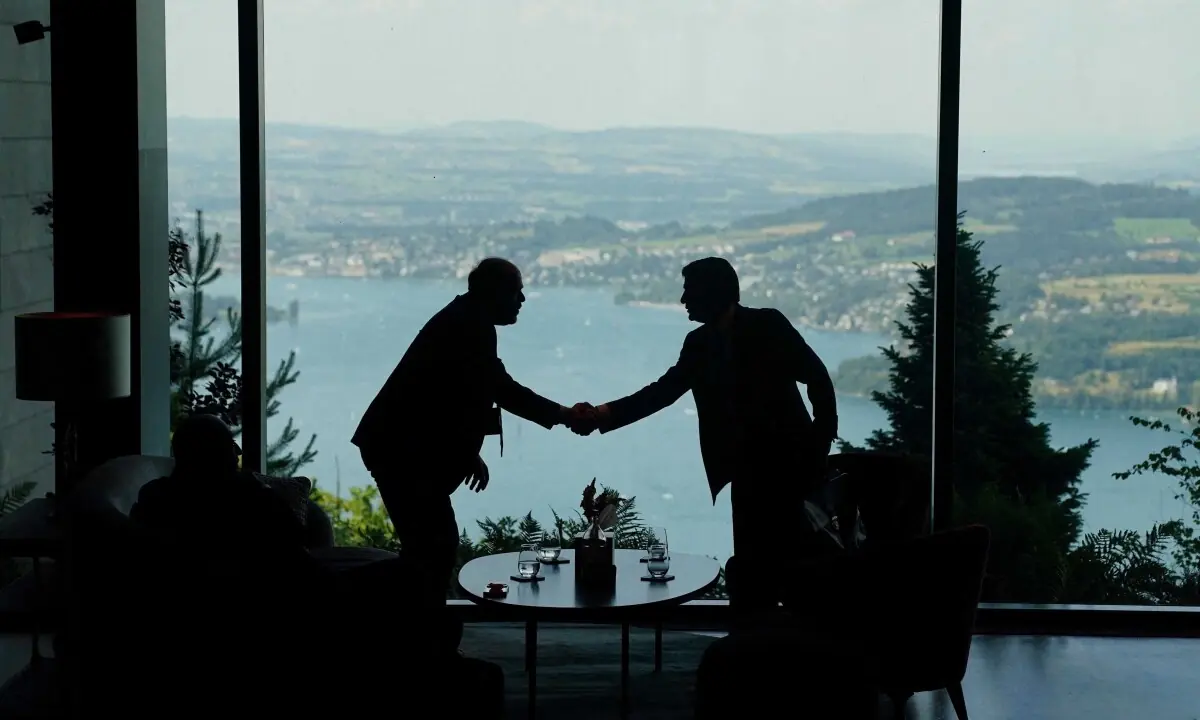
The United States and Iran agreed on a roadmap toward a final peace deal within 60 days after marathon talks at the Burgenstock resort in Switzerland, with Pakistan and Qatar jointly announcing the breakthrough on Monday. The agreement, reached under the framework of the Islamabad Memorandum of Understanding, sets up formal structures for technical negotiations and marks the most substantive direct diplomacy between Washington and Tehran in decades.
The joint statement issued by Pakistan's foreign ministry and Qatar's foreign ministry confirmed that the first session of talks under the Islamabad MoU concluded with representatives from Iran, the US, and both mediating countries present. Described as conducted in a "positive and constructive atmosphere," the summit produced three concrete outputs: a high-level political oversight committee, working groups focused on nuclear and sanctions issues plus a monitoring and dispute resolution group, and a 60-day communications line between Washington and Tehran specifically to prevent incidents in the Strait of Hormuz.
What Was Agreed
The high-level committee will receive regular reports from chief negotiators and oversee working groups on nuclear matters, sanctions relief, and compliance monitoring. A separate "de-confliction cell" involving the US, Iran, Lebanon, and the mediators will work to enforce the cessation of military operations in Lebanon as specified in the Islamabad MoU. Technical talks are set to continue through the rest of the week at Burgenstock before teams disperse.
Iranian Foreign Minister Abbas Araghchi confirmed that Iran had already secured tangible early benefits: waivers on oil and petrochemical exports, partial lifting of a blockade, release of some frozen assets, and the launch of a reconstruction and development plan. He described the Lebanon de-confliction cell as the "first real test" of the agreement's durability. The underlying 14-point deal, signed by US President Donald Trump and Iranian President Masoud Pezeshkian with Pakistani Prime Minister Shehbaz Sharif signing as mediator, also includes a framework for reopening the Strait of Hormuz and a $300 billion reconstruction fund, contingent on a final agreement on Iran's nuclear programme.
An American official confirmed that nuclear issues were discussed directly. "We've had robust discussions on all elements of the nuclear deal," the official said, adding that the teams also worked through Strait of Hormuz communication protocols and mechanisms to enforce the Lebanon ceasefire. US Vice President JD Vance, who led the American delegation, said the talks represented a historic level of direct engagement. "Never before have Iranian and American leadership met at such a high level outside of Islamabad," he told reporters. He framed the potential outcome in clear terms: if Iran gives up long-term nuclear weapons ambitions, the US is prepared to transform the bilateral relationship.
Why This Matters
The Strait of Hormuz is the world's most critical oil chokepoint, with roughly 20 percent of global petroleum trade passing through it. Any credible commitment to keep it open stabilises energy markets and lowers tail risk for global supply chains. The 60-day communications line is a direct mechanism to prevent miscalculation, which matters given that Trump, even as talks were underway, posted warnings on Truth Social threatening to hit Iran "harder" over Lebanon. Iran's chief negotiator Mohammad Bagher Ghalibaf responded publicly, telling Washington to "be careful," a reminder that the diplomatic path remains narrow.
For markets, the early concessions Iran obtained on oil and petrochemical export waivers matter immediately. If Iranian crude exports increase, global oil supply rises, which puts downward pressure on prices. The frozen asset releases add liquidity to Iranian financial institutions, including the central bank, whose governor Abdolnaser Hemmati was part of the delegation. A $300 billion reconstruction fund, if unlocked by a final nuclear deal, would represent one of the largest single capital deployment events in the Middle East's modern history, with significant implications for regional construction, infrastructure, and financial sectors.
Pakistan's role as a co-mediator alongside Qatar is notable. Prime Minister Shehbaz and Chief of Defence Forces Field Marshal Asim Munir were credited by Vance as central to bringing the parties together. Vance said he had spoken to Munir more than almost anyone else over the past several months, a signal of how deeply Pakistan embedded itself in the process. For Islamabad, the diplomatic visibility is significant at a time when it is managing its own regional pressures.
The next test arrives quickly. Technical teams remain in Switzerland through the week, and the Lebanon de-confliction cell is the immediate operational challenge. Vance acknowledged ceasefires are "a little bit messy" and that the situation requires continuous management. If the cell holds and the communication line prevents new Hormuz incidents, the 60-day window for a final deal becomes credible. If either mechanism fails, the political capital invested by all four parties risks eroding fast. The coming weeks will show whether the Burgenstock summit was a turning point or a pause.