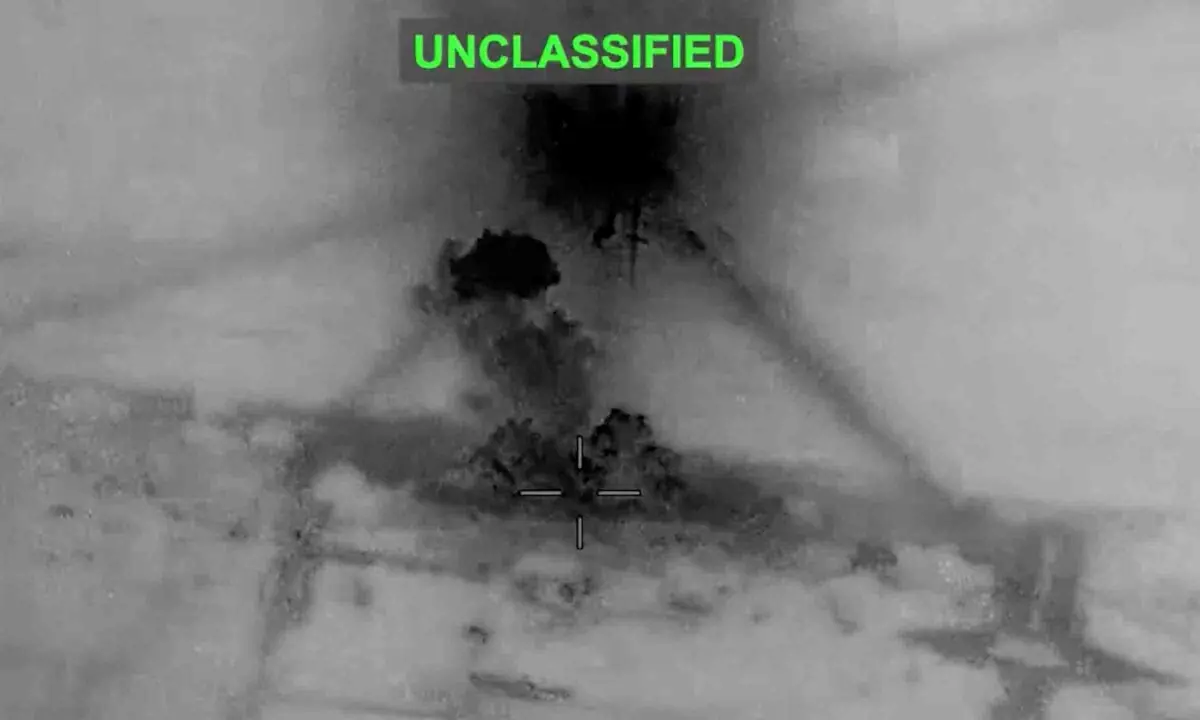
The United States and Iran exchanged direct military strikes on Friday and Saturday, putting the fragile ceasefire that ended their February 2026 war under its most serious stress yet. The confrontation began when Washington accused Tehran of attacking a commercial ship transiting the Strait of Hormuz, and it escalated fast enough to rattle oil markets, suspend a UN maritime evacuation operation, and draw sharp new warnings from both sides.
US Central Command said American forces struck Iranian missile and drone storage facilities plus coastal radar positions, calling the action a response to what it described as "unwarranted aggression against commercial shipping by Iranian forces" that "clearly violated the ceasefire." President Donald Trump had earlier called the Iranian drone strike on the vessel "a foolish violation of our ceasefire agreement," and Vice President JD Vance posted a blunt warning: "violence will be met with violence" if Iran attacked again.
Iran did not wait. Within minutes of Vance's post, Iranian state television reported that the Revolutionary Guards said they had targeted US sites in the Gulf region in retaliation. The Guards added that "if the aggression is repeated, our response will be broader than this," raising the real possibility of a tit-for-tat spiral even as negotiators work toward a final settlement.
Why the Strait of Hormuz is the pressure point
The Strait of Hormuz is the world's single most important oil chokepoint, with roughly a fifth of global oil and gas exports passing through it in normal times. Iran has warned vessels not to enter or leave the Gulf without its permission, though ships have kept moving. Tracking platform Kpler reported that around half of the 42 vessels that made the passage on Thursday used a non-approved southern route along Oman's coast, effectively defying Tehran's blockade warning. The UN maritime agency had been running an evacuation operation that freed 115 vessels and 2,500 seafarers trapped by the dispute, but the latest attack forced that operation to halt.
Oil prices fell sharply despite the flare-up, a signal that markets are still betting on traffic through Hormuz recovering rather than collapsing. That optimism is fragile. If Iran moves from warning ships to systematically attacking them, the calculus changes quickly for energy prices worldwide, with direct consequences for fuel costs in import-dependent economies including India.
A separate Lebanon deal adds another layer of tension
On the same day as the strikes, Secretary of State Marco Rubio signed a trilateral framework agreement with Israeli and Lebanese envoys in Washington, aimed at stabilising the Lebanon front of the war. Rubio called it "the beginning of the beginning," noting significant work remains. Israeli Prime Minister Benjamin Netanyahu framed it as a win against Iran, saying the deal tells Tehran that Lebanon's future "is none of your business."
The framework allows the Lebanese army to return to two pilot areas in southern Lebanon, but Israeli forces stay in their security zone until Hezbollah is disarmed, and displaced civilians cannot return yet. Lebanese President Joseph Aoun called it a first step toward restoring Lebanese sovereignty, though Hezbollah supporters protested in Beirut and Hezbollah MP Hassan Fadlallah warned that the Washington signing was designed to undercut the broader US-Iran peace process. He suggested the Lebanese government could not implement the agreement without triggering civil conflict.
Iran's position is that the Lebanon front cannot be separated from the wider war and must be resolved through the main US-Iran talks. The Washington framework directly contradicts that, giving Netanyahu a political win and giving Iran a reason to harden its posture in Hormuz negotiations.
Underpinning all of this is the unresolved question of Iran's nuclear programme. International Atomic Energy Agency chief Rafael Grossi said any final US-Iran settlement must include strong verification systems to ensure Tehran does not build a nuclear weapon. Iran's pre-war stockpile of uranium enriched to 60 percent was estimated at 440 kilograms, and the interim agreement calls for that stockpile to be "downblended" under IAEA supervision. But Tehran and Washington are giving conflicting accounts of whether inspectors will even regain access to Iranian facilities, leaving the verification architecture uncertain.
The next few days will show whether Friday's exchange was a contained incident or the start of a new escalation cycle. Diplomats are trying to hold a ceasefire together while simultaneously negotiating on nuclear terms, a Lebanon framework, and Hormuz access rules. Each of those tracks can destabilise the others, and Iran now has fresh domestic pressure to respond forcefully. Watch for any further incidents in or around the strait, any change in Kpler-tracked vessel movements, and whether the UN maritime evacuation operation resumes as a sign of whether both sides are pulling back.