
Qatar Signals Progress in US-Iran War Talks
Qatar's foreign ministry said mediators including Qatar, Pakistan, and Oman have reached "very progressive stages" in efforts to end the US-Iran war, pushing Brent crude down more than four percent.
Key Takeaways
May 11, 2026 · 3 min read · By Rishabh Bhardwaj
·
AI-assisted, human-reviewed · Our editorial standards
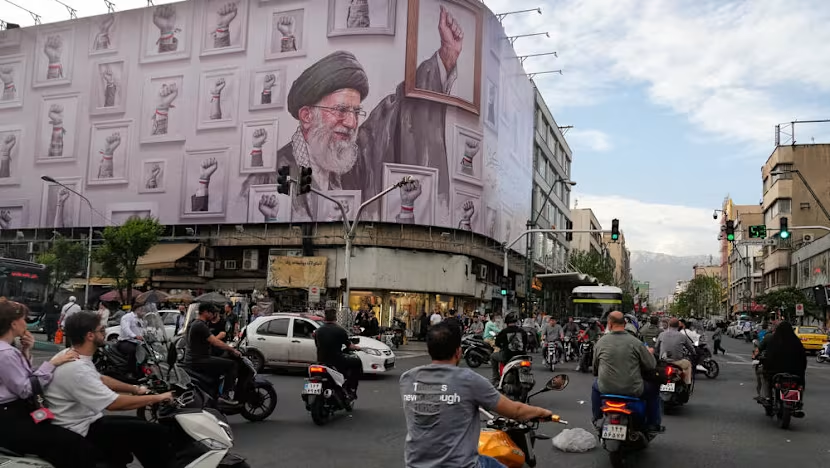
Donald Trump declared the ceasefire with Iran is on "life support" and dismissed Tehran's latest peace proposal as "garbage," sharpening a standoff that has kept the Strait of Hormuz closed and pushed fuel prices higher across global markets.
The remarks mark a significant escalation in tone from Washington. A ceasefire described as barely alive signals that whatever back-channel negotiations had been underway are not producing results the White House finds acceptable. Trump's language leaves little room for a diplomatic off-ramp in the near term.
The Strait of Hormuz remains closed. That single fact carries outsized weight for energy markets. The strait is the world's most critical oil shipping chokepoint, with roughly a fifth of global crude supply passing through it in normal conditions. Every day it stays shut, the pressure on oil prices builds, and that pressure feeds directly into fuel costs for consumers and businesses worldwide.
Trump announced he would suspend the federal gasoline tax to blunt the impact on American drivers. The federal gas tax currently sits at 18.4 cents per gallon for gasoline. A suspension would reduce the price at the pump by that amount, offering modest but visible relief to consumers at a moment when rising fuel costs are politically sensitive. The move is a short-term demand-side fix, not a resolution to the supply disruption driving prices up in the first place.
The combination of a closed strait and a collapsing ceasefire process creates a difficult environment for energy markets. Traders pricing crude oil must now weigh a scenario where the closure extends well beyond initial expectations. Longer disruptions historically push refiners to draw down strategic reserves and force buyers to seek alternative suppliers, both of which are costly and time-consuming adjustments.
Tehran put forward a peace proposal, and Trump rejected it outright. That public rejection matters because it removes ambiguity about where the US stands and makes it harder for either side to quietly reopen talks without visible concessions. When a sitting president calls a rival's offer "garbage" in public, the political cost of returning to the table rises on both sides.
The ceasefire framing is also notable. A ceasefire implies some form of active or recent hostilities, not merely a diplomatic dispute. The fact that it is described as being on "life support" rather than holding or progressing tells markets and governments that the situation is actively deteriorating, not stabilizing.
For global oil importers, including India, the closed strait and an unresolved US-Iran standoff represent a direct cost pressure. India sources a significant share of its crude from the Gulf region, and any prolonged disruption to Hormuz shipping lanes raises import costs, pressures the current account, and can feed through to domestic fuel prices and broader inflation.
The gas tax suspension, if enacted, applies only to the US market. Other countries dealing with elevated fuel costs from the same supply disruption have no equivalent offset in place. That creates an uneven global impact where American consumers get partial relief while importers elsewhere absorb the full price shock.
Watch for whether Congress moves quickly on the gas tax suspension, since the executive branch cannot unilaterally waive a legislatively set tax without congressional approval. Watch also for any signal from Tehran on whether it intends to put forward a revised proposal or hold its position, and for any movement on reopening the strait, which remains the single most important variable for energy prices right now.
Qatar's foreign ministry said mediators including Qatar, Pakistan, and Oman have reached "very progressive stages" in efforts to end the US-Iran war, pushing Brent crude down more than four percent.
Qatar confirmed it is mediating between the US and Iran but said no direct talks are currently planned. The clarification follows conflicting statements from President Trump, who claimed talks are under way, and Tehran, which denied any dialogue is happening.
Saudi Aramco reported sharply higher second-quarter 2026 profits as the Iran war restricts global oil supply and pushes crude prices up. Other oil supermajors also posted outsized earnings, raising concerns about sustained fuel cost pressure for importing economies.
President Trump called current Iran negotiations the "last chance" to end five months of conflict, pushing oil prices higher. Tehran denied formal talks are taking place, raising the risk of a diplomatic breakdown with direct consequences for global energy markets.