
Qatar Signals Progress in US-Iran War Talks
Qatar's foreign ministry said mediators including Qatar, Pakistan, and Oman have reached "very progressive stages" in efforts to end the US-Iran war, pushing Brent crude down more than four percent.
Key Takeaways
June 13, 2026 · 3 min read · By Rishabh Bhardwaj
·
AI-assisted, human-reviewed · Our editorial standards
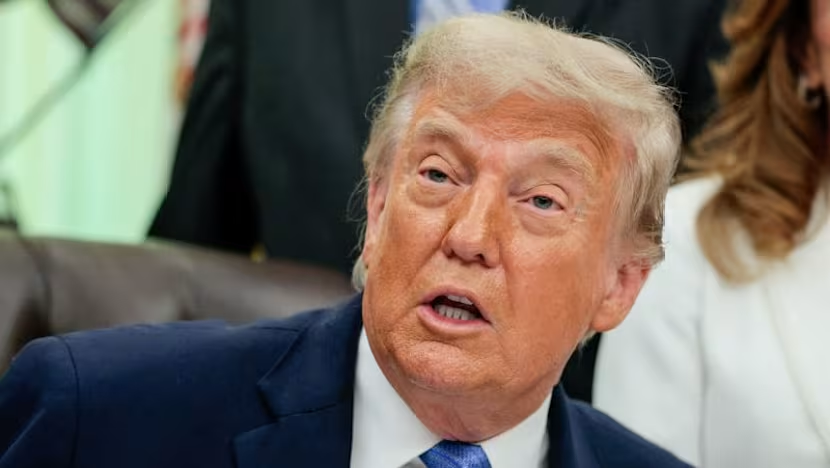
US President Donald Trump called off planned military strikes against Iran on Thursday, citing progress in ongoing diplomatic talks as the reason for pulling back from what would have been a significant military escalation.
Trump announced the cancellation himself, hours after issuing a public warning that the United States would hit Iran "VERY HARD". The sharp reversal within a single day underlines how volatile the current state of US-Iran relations remains, with military action and diplomacy running in parallel at the same time.
The sequence of events is notable. Trump first issued a stark public threat, then within hours reversed course and credited talks with creating enough progress to stand down. This pattern, escalation followed by a negotiated pause, has defined much of the current administration's approach to Iran.
The decision to cancel strikes rather than proceed removes, at least for now, the risk of a direct military exchange between the United States and Iran. A US strike on Iranian territory would have carried serious consequences: potential Iranian retaliation against US assets in the region, disruption to oil shipping lanes through the Strait of Hormuz, and a wider destabilisation of the Middle East at a time when the region is already under stress.
Oil markets are sensitive to any signal of conflict near the Gulf. Even the threat of strikes, followed by their cancellation, tends to inject short-term volatility into crude prices. Shipping insurance rates for vessels operating near Iranian waters also move in response to these signals, affecting global freight costs.
The precise nature of the diplomatic progress Trump referenced has not been disclosed. It is not clear which channel produced the movement, who the counterparties were, or what specific concessions or commitments were exchanged. That gap matters because it makes it difficult to assess whether the pause is durable or simply a temporary de-escalation before tensions rebuild.
The critical question now is whether the diplomatic progress Trump cited translates into a formal or verifiable agreement, or whether it remains an informal understanding that could break down quickly. Past rounds of US-Iran talks have stalled or collapsed after initial optimism, and the absence of detail around the current progress makes it hard to judge how much weight to place on this pause.
Iran's own response, both publicly and in any back-channel communications, will shape what happens next. If Tehran signals willingness to continue talks on terms acceptable to Washington, the pressure for military action recedes. If talks stall or Iran takes steps that Washington reads as provocation, the threat of strikes could return rapidly.
For markets, the key watch points are oil prices, Gulf shipping conditions, and any formal statement from either government about the status of negotiations. Any sign that talks are broadening into a structured process would be a materially positive signal for regional stability. A breakdown, by contrast, would likely push energy prices higher and revive risk-off sentiment across emerging market assets with Middle East exposure.
The episode also serves as a reminder that the current administration is willing to move fast in both directions, escalating and de-escalating within hours, which keeps uncertainty high even when immediate danger appears to have passed.
Qatar's foreign ministry said mediators including Qatar, Pakistan, and Oman have reached "very progressive stages" in efforts to end the US-Iran war, pushing Brent crude down more than four percent.
Qatar confirmed it is mediating between the US and Iran but said no direct talks are currently planned. The clarification follows conflicting statements from President Trump, who claimed talks are under way, and Tehran, which denied any dialogue is happening.
Saudi Aramco reported sharply higher second-quarter 2026 profits as the Iran war restricts global oil supply and pushes crude prices up. Other oil supermajors also posted outsized earnings, raising concerns about sustained fuel cost pressure for importing economies.
President Trump called current Iran negotiations the "last chance" to end five months of conflict, pushing oil prices higher. Tehran denied formal talks are taking place, raising the risk of a diplomatic breakdown with direct consequences for global energy markets.