
Qatar Signals Progress in US-Iran War Talks
Qatar's foreign ministry said mediators including Qatar, Pakistan, and Oman have reached "very progressive stages" in efforts to end the US-Iran war, pushing Brent crude down more than four percent.
Key Takeaways
May 24, 2026 · 3 min read · By Rishabh Bhardwaj
·
AI-assisted, human-reviewed · Our editorial standards
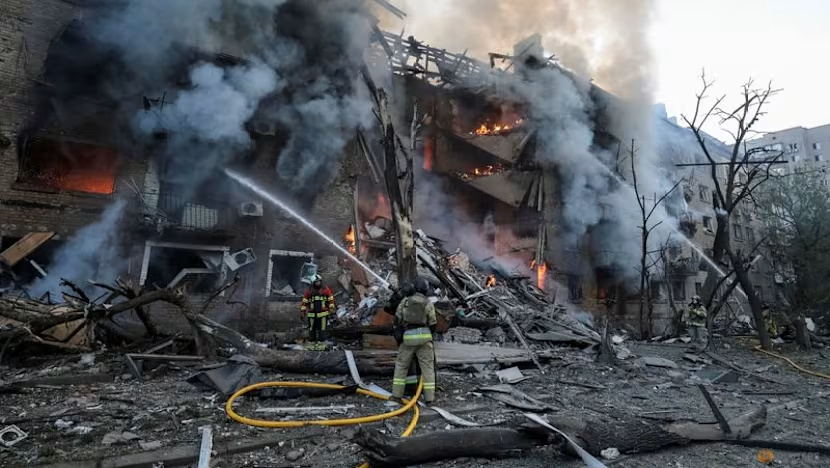
Russia fired its Oreshnik ballistic missile at Ukraine for the third time in the war, the Russian military confirmed. The strike killed four people. Moscow said the launch was a response to what it called Ukrainian terrorist attacks on civilian infrastructure inside Russian territory. The missile was used with a conventional warhead, not a nuclear one.
The Oreshnik is a relatively new addition to Russia's arsenal. It is a hypersonic intermediate-range ballistic missile capable of carrying nuclear warheads, though in all three wartime uses Russia has equipped it with conventional payloads. Its speed and flight profile make it extremely difficult to intercept with current air defense systems, which is a significant part of why Russia chooses to publicize its use.
The Oreshnik's primary value for Russia is as a signal, not just a weapon. Each confirmed launch reinforces Moscow's message that it holds escalation options Ukraine and its Western backers cannot easily neutralize. By publicly confirming the launch and naming it as a retaliatory act, the Kremlin is keeping the nuclear-capable framing in the headlines even when the warhead itself is conventional. That distinction matters legally and strategically, but the psychological weight of the weapon is the point.
Four confirmed deaths from this strike put the human toll in the immediate picture, though attacks of this scale on Ukrainian territory routinely affect civilian infrastructure, power supply, and population movement well beyond the direct casualty count.
Ukraine has been conducting strikes on Russian territory, targeting what it describes as military logistics and energy infrastructure supporting the war effort. Russia frames those strikes as attacks on civilians, which provides the stated justification for deploying a weapon of this profile. The cycle of escalatory framing on both sides is now well established and shows no sign of breaking.
Three Oreshnik launches across the full span of the war suggests Russia is using the weapon selectively, likely for both operational effect and political signaling at moments of tension. Observers should watch whether the frequency of its use increases, which would suggest either a larger stockpile than previously estimated or a deliberate shift in Russia's escalation strategy.
Western governments monitoring the conflict will note the continued conventional use, but the nuclear-capable designation keeps pressure on NATO members to weigh their own military support decisions carefully. Any shift to nuclear arming of the Oreshnik would represent a fundamental change in the conflict's character, though nothing in the current facts suggests that has occurred or is imminent.
For Ukraine, the immediate question is whether its air defense partnerships can develop any countermeasure to hypersonic missiles at this speed and range. Currently, no system deployed in Ukraine is confirmed capable of reliably intercepting the Oreshnik. That gap in coverage is a durable military problem regardless of how many individual strikes occur.
Qatar's foreign ministry said mediators including Qatar, Pakistan, and Oman have reached "very progressive stages" in efforts to end the US-Iran war, pushing Brent crude down more than four percent.
Qatar confirmed it is mediating between the US and Iran but said no direct talks are currently planned. The clarification follows conflicting statements from President Trump, who claimed talks are under way, and Tehran, which denied any dialogue is happening.
Saudi Aramco reported sharply higher second-quarter 2026 profits as the Iran war restricts global oil supply and pushes crude prices up. Other oil supermajors also posted outsized earnings, raising concerns about sustained fuel cost pressure for importing economies.
President Trump called current Iran negotiations the "last chance" to end five months of conflict, pushing oil prices higher. Tehran denied formal talks are taking place, raising the risk of a diplomatic breakdown with direct consequences for global energy markets.