The Reserve Bank of India has tightened its bad loan classification rules, moving closer to global banking standards. The key change: if any single loan belonging to a borrower is classified as a Non-Performing Asset (NPA), all other loans of that borrower will automatically be tagged NPA too. Currently, banks can treat each loan separately, which can mask the true credit risk of a borrower. An NPA is a loan where the borrower has stopped making payments for a set period. Under the old approach, a borrower could default on one loan while others remained classified as healthy, understating the bank's actual exposure to that borrower. The new rule closes that gap. Banks will now have to recognize the full extent of a stressed borrower's liabilities at once, which will likely push up reported NPA levels across the system. This raises provisioning requirements for banks, meaning they must set aside more capital as a buffer against potential losses. Investors and analysts should watch for banks with large retail or MSME loan books, where borrowers often hold multiple loans, as these could see the sharpest jump in reported bad loans.
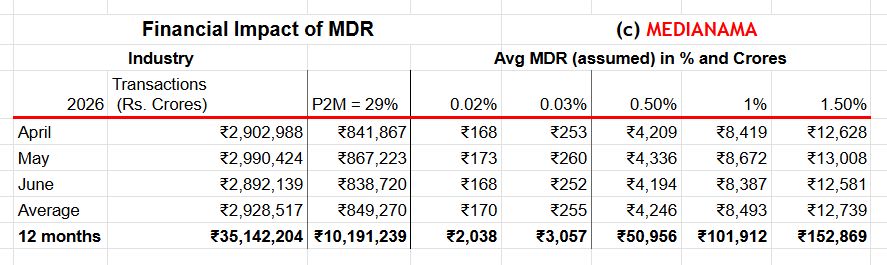
India's government plans to amend the Payment and Settlement Systems Act to restore UPI merchant discount rates, ending the zero-MDR regime in place since January 2020.
India's government has introduced the Taxation and Other Laws (Amendment) Bill, 2026, proposing changes to payments regulation, income tax, and the Finance Act to attract FDI and support Make in India. The Bill's final shape will depend on parliamentary debate and committee review.
The government's Taxation and Other Laws (Amendment) Bill, 2026, proposes to replace the blanket UPI MDR ban with a system allowing the Centre to notify which payment modes stay fee-free.
Prime Minister Narendra Modi inaugurated the Rs 5,000 crore Bhogapuram greenfield airport in Andhra Pradesh, built under a public-private partnership model. He also laid foundation stones for infrastructure projects worth nearly Rs 18,000 crore in the state, signalling a broad investment push for the region.