India to Restore UPI Merchant Fees, PhonePe Gains Most
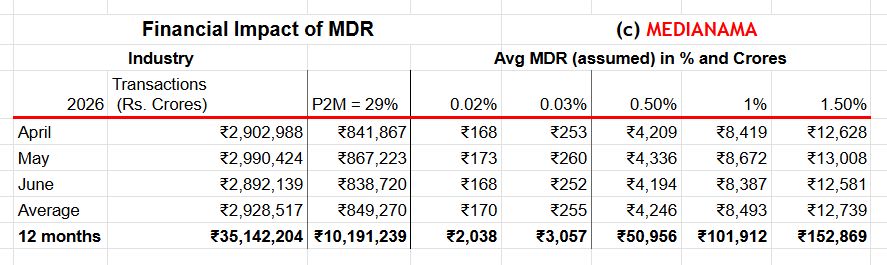
India's government plans to amend the Payment and Settlement Systems Act to restore UPI merchant discount rates, ending the zero-MDR regime in place since January 2020.
Key Takeaways
June 1, 2026 · 3 min read · By Rishabh Bhardwaj
·
AI-assisted, human-reviewed · Our editorial standards
The Reserve Bank of India is reviewing its expected credit loss framework, a set of rules that determines how much money banks must set aside to cover potential loan defaults. The review comes as concerns grow that the framework, if applied strictly, could raise borrowing costs significantly for small and mid-sized businesses.
At the center of the review is a timing problem. Rating agencies have recently recorded default rates that exceed the benchmark thresholds used in the expected credit loss model. When actual defaults run above these benchmarks, the framework can trigger higher risk weights, which is the proportion of a loan that a bank must back with its own capital. Higher risk weights make lending more expensive for banks, and that cost typically gets passed on to borrowers.
Small and mid-sized enterprises tend to have weaker credit profiles than large corporations, which already makes their borrowing more expensive. If the RBI's expected credit loss rules push risk weights higher for this segment, banks would need to hold more capital against every rupee lent to an SME. That reduces the profitability of SME lending and gives banks less reason to extend credit to smaller firms.
The practical effect could be a rise in interest rates charged to SMEs, or a tightening of credit availability, at a time when this segment is a key driver of employment and economic activity in India. SMEs already operate with thin margins and limited access to capital markets, so any increase in loan costs can have an outsized impact on their operations and expansion plans.
The expected credit loss framework itself is not new in concept. It is aligned with global accounting standards that require banks to recognize potential losses on loans early, rather than waiting until a default actually occurs. The RBI has been working to introduce this approach domestically, but the calibration of specific thresholds and risk weights has been a point of ongoing discussion between regulators and lenders.
The core question for the RBI is whether the current benchmarks in the framework accurately reflect Indian credit conditions, or whether they are set at levels that generate excessive capital requirements for certain borrower categories. Rating agency data showing default rates above benchmarks adds urgency to this calibration question.
A closer review could lead to several outcomes. The RBI might adjust the default rate benchmarks used in the model to better fit observed credit behavior in India. It could also modify how risk weights are calculated for SMEs specifically, or provide transitional relief while the framework is refined. Alternatively, it could conclude that the existing parameters are appropriate and that banks must simply adjust their lending practices accordingly.
For banks, the stakes are real. A stricter application of the framework would compress margins on SME loan books and could prompt some lenders to shift their portfolios toward larger, better-rated corporate borrowers. That would concentrate credit risk in fewer hands and reduce the flow of formal credit to the broader small business economy.
The RBI's willingness to revisit these rules signals that it is treating SME credit access as a policy priority, not just a regulatory mechanics question. The outcome of this review will shape how Indian banks price and allocate credit to small businesses over the next several years, making it one of the more consequential regulatory decisions in the near term for this segment.
No timeline for the conclusion of the review or the release of revised guidelines has been specified. Lenders and SME borrowers will be watching closely for any draft circular or policy update from the central bank.
India's government plans to amend the Payment and Settlement Systems Act to restore UPI merchant discount rates, ending the zero-MDR regime in place since January 2020.
India's government has introduced the Taxation and Other Laws (Amendment) Bill, 2026, proposing changes to payments regulation, income tax, and the Finance Act to attract FDI and support Make in India. The Bill's final shape will depend on parliamentary debate and committee review.
The government's Taxation and Other Laws (Amendment) Bill, 2026, proposes to replace the blanket UPI MDR ban with a system allowing the Centre to notify which payment modes stay fee-free.
Prime Minister Narendra Modi inaugurated the Rs 5,000 crore Bhogapuram greenfield airport in Andhra Pradesh, built under a public-private partnership model. He also laid foundation stones for infrastructure projects worth nearly Rs 18,000 crore in the state, signalling a broad investment push for the region.