India to Restore UPI Merchant Fees, PhonePe Gains Most
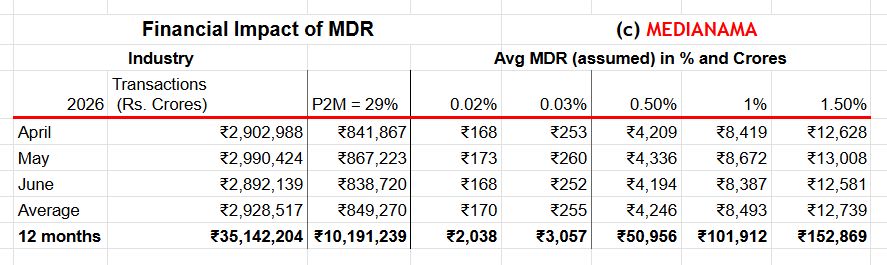
India's government plans to amend the Payment and Settlement Systems Act to restore UPI merchant discount rates, ending the zero-MDR regime in place since January 2020.
Key Takeaways
May 3, 2026 · 2 min read · By Rishabh Bhardwaj
·
AI-assisted, human-reviewed · Our editorial standards
The Rajasthan High Court has ruled that reserved-category candidates from other states cannot claim reservation benefits, including lower qualifying percentile thresholds, in Rajasthan's NEET PG counselling process. The court held that such benefits are state-specific and do not travel with the candidate across state lines.
The ruling came while dismissing a writ petition filed by the Federation of Private Medical and Dental Colleges of Rajasthan. The federation had challenged a February 18, 2026, resolution issued by the Rajasthan NEET PG counselling board, which had restricted reservation benefits to candidates with domicile ties to the state.
The court drew a clear line between eligibility and entitlement. Out-of-state candidates are not barred from Rajasthan's NEET PG seats entirely, they can still compete for unreserved seats on open-merit terms. What they cannot do is claim the relaxed cut-off percentiles or seat quotas that Rajasthan extends to its own reserved-category residents.
The court also rejected the argument that this policy amounts to 100% domicile-based reservation, which would be constitutionally harder to defend. Because the general pool of seats remains open to all, the restriction was framed as a limitation on category-specific benefits rather than a blanket exclusion.
NEET PG is the national entrance exam for postgraduate medical admissions in India. States conduct their own counselling for state-quota seats, and many extend relaxed eligibility criteria, lower percentile cut-offs, reserved seat quotas, to candidates from scheduled castes, scheduled tribes, and other backward classes. The question of whether an out-of-state OBC or SC candidate can claim those same relaxed standards has been legally contested.
This ruling reinforces the principle that state-funded reservation policies are designed to address local socioeconomic disadvantage and are not portable benefits. A candidate who qualifies for reservation in their home state does not automatically carry that entitlement into another state's counselling system.
For medical colleges in Rajasthan, the ruling settles the immediate dispute over the February 2026 counselling board resolution, giving institutions clarity on how to process applications from out-of-state reserved-category candidates. For aspirants, it means that those without Rajasthan domicile must clear the unreserved percentile threshold to secure a state-quota seat, regardless of their category status elsewhere.
Watch for whether similar challenges are filed in other high courts, as the domicile-versus-portability question in NEET PG counselling is not unique to Rajasthan and could prompt broader judicial or regulatory guidance.
India's government plans to amend the Payment and Settlement Systems Act to restore UPI merchant discount rates, ending the zero-MDR regime in place since January 2020.
India's government has introduced the Taxation and Other Laws (Amendment) Bill, 2026, proposing changes to payments regulation, income tax, and the Finance Act to attract FDI and support Make in India. The Bill's final shape will depend on parliamentary debate and committee review.
The government's Taxation and Other Laws (Amendment) Bill, 2026, proposes to replace the blanket UPI MDR ban with a system allowing the Centre to notify which payment modes stay fee-free.
Prime Minister Narendra Modi inaugurated the Rs 5,000 crore Bhogapuram greenfield airport in Andhra Pradesh, built under a public-private partnership model. He also laid foundation stones for infrastructure projects worth nearly Rs 18,000 crore in the state, signalling a broad investment push for the region.