Prime Minister Narendra Modi has appointed Infosys co-founder Nandan Nilekani to head a high-powered task force on competitive exam reforms, a day after Dharmendra Pradhan resigned as Education Minister. The task force will recommend ways to make government-conducted exams more secure, transparent, and technology-driven.
The announcement came through a post by PM Modi on Instagram, where he said those who "played with the future of students are rotting in jails" and that fast-track courts have been set up to handle cases swiftly. He added that Parliament will also move toward passing a new law with "tough provisions" against exam malpractice.
Who is on the task force
Alongside Nilekani, the panel includes S Somanath, former chairman of ISRO; Tapan Deka, former director of the Intelligence Bureau; V Kamakoti, director of IIT Chennai; Anita Karwal, former education secretary; and Amrit Lal Meena, a retired Bihar-cadre IAS officer serving as logistics expert. The mix of technology, administration, and intelligence expertise signals that the government wants reforms that span both the digital systems and the physical conduct of exams.
The task force is primarily focused on restructuring the National Test Agency, the body responsible for conducting large national-level competitive exams in India. The NTA has been under scrutiny after a series of security failures. Last month, a Dubai-based researcher exposed vulnerabilities in NTA's re-examination portal. In May 2026, a 19-year-old cybersecurity researcher publicly revealed security gaps in the CBSE On-Screen Marking system. These back-to-back disclosures, made by individuals outside the system rather than internal auditors, underlined how exposed the infrastructure has become.
Why Nilekani, and why it matters
Nilekani's selection is not symbolic. After leaving Infosys as CEO in 2009, he became the founding chairman of the Unique Identification Authority of India, where he led the creation of Aadhaar, now one of the world's largest digital identity systems. He later advised the National Payments Corporation of India during the development of UPI and led a five-member panel set up by the Reserve Bank of India in 2019 to expand UPI adoption. In January 2023, he was named co-chair of the G20 Task Force on Digital Public Infrastructure. In 2025, the Supreme Court's AI Committee appointed him as an expert to guide the judiciary's use of artificial intelligence. His track record is in building government-scale technology systems from scratch, which is precisely what the NTA appears to need.
The practical mandate of the task force is to recommend measures to strengthen NTA's technological capabilities and propose structural reforms to how exams are designed, administered, and monitored. Based on the task force's report, the government says it will implement changes "as soon as possible."
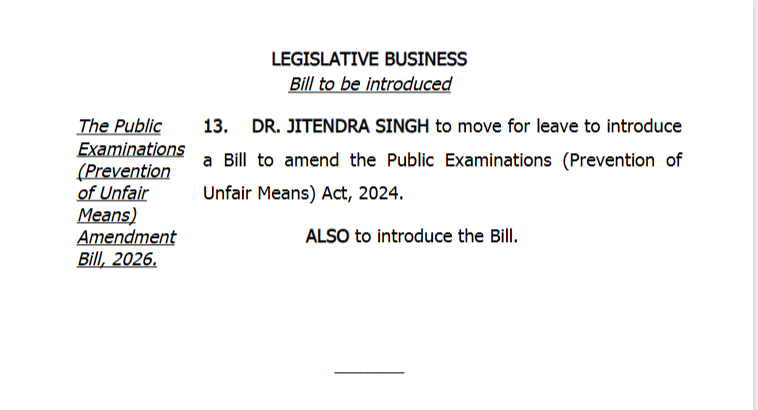
Alongside the task force, the Union government is introducing the Public Examinations (Prevention of Unfair Means) Amendment Bill, 2026 in the Lok Sabha. Science and Technology Minister Jitendra Singh will seek leave to introduce the Bill, which amends the Public Examinations (Prevention of Unfair Means) Act, 2024. The bill is designed to sharpen the legal tools available against paper leaks and exam malpractices at the national level.
Together, the task force and the legislative move represent a two-track approach: institutional reform on the technology and process side, and stronger criminal deterrence on the legal side. The pressure to act has been building since exam integrity scandals disrupted admissions cycles and triggered protests among students who lost months of preparation to compromised results.
What to watch next: the task force has no publicly stated deadline, but the government's language suggests urgency. The speed at which the task force delivers its report, and how closely the government follows its recommendations, will determine whether this becomes a structural fix or another round of well-intentioned process. The bill's passage through Parliament this session is the nearer-term signal to track.