
Qatar Signals Progress in US-Iran War Talks
Qatar's foreign ministry said mediators including Qatar, Pakistan, and Oman have reached "very progressive stages" in efforts to end the US-Iran war, pushing Brent crude down more than four percent.
Key Takeaways
June 21, 2026 · 4 min read · By Rishabh Bhardwaj
·
AI-assisted, human-reviewed · Our editorial standards
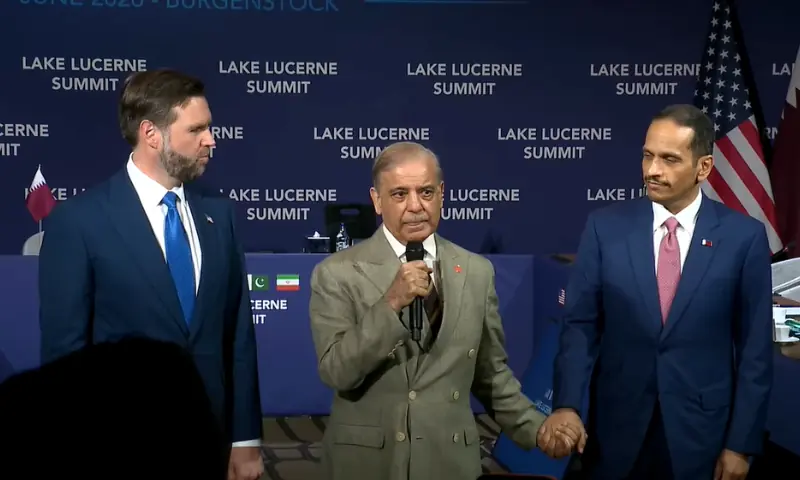
US Vice President JD Vance, Pakistani Prime Minister Shehbaz Sharif, and Qatari Prime Minister Sheikh Mohammed bin Abdulrahman Al Thani opened a four-way summit at Burgenstock, Switzerland, on Sunday to begin implementing the Islamabad Memorandum of Understanding, a 14-point ceasefire and framework deal signed by the US and Iran on June 17.
The talks bring together delegations from the United States, Iran, Qatar, and Pakistan, with Qatar and Pakistan acting as mediators. Iran's Parliament Speaker Mohammad Bagher Ghalibaf led Tehran's negotiating team, joined by Foreign Minister Abbas Araghchi, Central Bank Governor Abdolnaser Hemmati, and National Iranian Oil Company CEO Hamid Bovard, among others. Vance led the US side, with negotiators Jared Kushner and Steve Witkoff already in Switzerland handling technical groundwork before the summit opened.
The Islamabad MoU ended what the Foreign Office described as more than 100 days of war. It established a framework to formally end the conflict, reopen the Strait of Hormuz, and set a 60-day timeline for further negotiations. Sunday's technical-level session focuses on translating that broad framework into specific, binding clauses. The Qatari foreign ministry confirmed that specialised technical groups have been formed to negotiate the final agreement's clauses and that separate follow-up groups will oversee implementation and track progress.
Concrete items on the table include the unfreezing of Iranian assets, the resumption of Iranian oil sales, and the terms of a full regional ceasefire that Vance said Trump wants to extend to Lebanon. A Lebanon ceasefire was described as an active and separate track: Iranian state broadcaster IRIB reported a tripartite meeting between Iran, the US, and Qatar specifically on Lebanon and Iran's frozen assets running alongside the main quadrilateral session.
The scale of what a final deal could unlock is significant. Under the Islamabad MoU, a completed agreement on Iran's nuclear programme would trigger a $300 billion reconstruction fund supported by regional nations. Vance was direct about the US offer: "If Iran is willing to give up nuclear weapon ambitions for the long term, the US is willing to transform relations with them."
Pakistan's position at the table is not incidental. The Foreign Office said Pakistan hosted earlier rounds of US-Iran talks before the Islamabad MoU was signed, and PM Shehbaz signed the agreement as mediator. The Qatari foreign ministry's spokesperson Dr Majed bin Mohammed Al-Ansari specifically praised Pakistan's "documented and continuous efforts in supporting the negotiation process." Vance went further, saying he had spoken to Chief of Defence Forces Field Marshal Asim Munir more than anyone else over the past few months, describing Munir as one of the most important people in his life and singling him out for praise alongside PM Shehbaz.
Saudi Arabia, Turkey, Egypt, and the United Arab Emirates were also acknowledged by Qatar for helping create conditions that pushed the process forward, though none sent delegations to Burgenstock.
On the Iranian side, the tone entering talks was more guarded. Iranian foreign ministry spokesperson Esmail Baghaei said Tehran intended to "press for the fulfilment of the other side's commitments" and warned that if any part of the US obligations was not implemented, "the entirety of the agreement will be jeopardised." Iran specifically wants the US to compel Israel to stop attacks on Lebanon, which it views as a binding US obligation under the MoU.
The format of the day was structured but fluid. Iranian state media indicated the plan was bilateral meetings with mediators in the morning followed by quadrilateral talks in the afternoon, with the session designed as a single day. PTV, broadcasting live from Burgenstock, reported that technical talks between the US and Iran could extend into Monday, and no formal timeframe was announced. A senior official from Pakistan's Prime Minister's Office said it was not yet confirmed whether the Pakistani delegation would return the same day.
Vance acknowledged that ceasefire arrangements are "always a little bit messy" but said progress had been made over recent days. He framed the broader ambition as a structural shift: moving from a Middle East where Iran and Gulf states maintain an adversarial relationship to one where all parties "can work together to promote peace and prosperity." Al Thani echoed the cautious tone, calling the Burgenstock meeting "just the beginning" and committing Qatar to stay engaged until a comprehensive and permanent agreement is reached.
The immediate thing to watch is whether the technical groups can agree on MoU clause language before the current 60-day negotiating window closes. The Strait of Hormuz reopening and Iranian asset unfreezing are the most commercially sensitive items. Any breakdown on Lebanon, where active violations of the ceasefire understanding remain a live concern for Tehran, could put the entire framework at risk.
Qatar's foreign ministry said mediators including Qatar, Pakistan, and Oman have reached "very progressive stages" in efforts to end the US-Iran war, pushing Brent crude down more than four percent.
Qatar confirmed it is mediating between the US and Iran but said no direct talks are currently planned. The clarification follows conflicting statements from President Trump, who claimed talks are under way, and Tehran, which denied any dialogue is happening.
Saudi Aramco reported sharply higher second-quarter 2026 profits as the Iran war restricts global oil supply and pushes crude prices up. Other oil supermajors also posted outsized earnings, raising concerns about sustained fuel cost pressure for importing economies.
President Trump called current Iran negotiations the "last chance" to end five months of conflict, pushing oil prices higher. Tehran denied formal talks are taking place, raising the risk of a diplomatic breakdown with direct consequences for global energy markets.