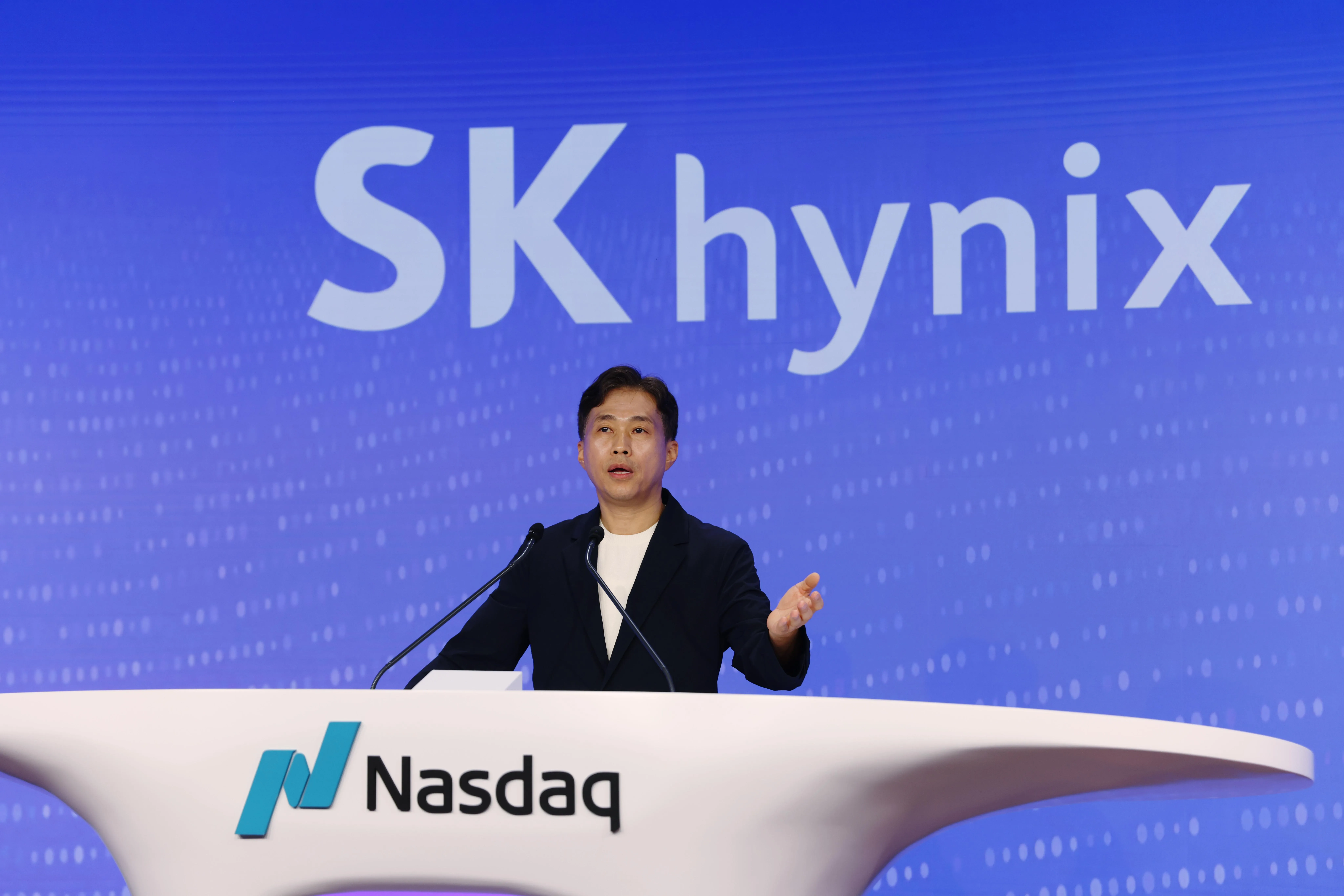
SK Hynix, the South Korean memory chipmaker that supplies high-bandwidth memory to Nvidia, made its Wall Street debut on Friday and raised $26.5 billion, setting a new record as the largest-ever US listing by a foreign company. The stock opened at $170 per share, surpassing the previous record held by Alibaba.
The listing caps a remarkable run for the company. SK Hynix crossed a $1 trillion valuation in May 2026, briefly overtaking Samsung as South Korea's most valuable company. That milestone, now reinforced by a blockbuster public debut, signals how central memory chips have become to the global AI buildout.
Why memory chips are at the center of the AI trade
SK Hynix is one of three dominant suppliers of DRAM and high-bandwidth memory, or HBM. These are not generic components. HBM is a specialised type of RAM that stacks memory chips vertically to move data much faster than conventional modules. AI accelerators like Nvidia's GPUs depend on HBM to process the enormous volumes of data required for model training and inference at scale.
As demand for AI compute has surged, so has demand for HBM. The buildout of data centres worldwide, driven by hyperscalers and sovereign AI initiatives, requires ever-larger volumes of these chips. SK Hynix has positioned itself as a primary beneficiary of that wave, with Nvidia among its most prominent customers.
The economics are straightforward. More AI servers mean more GPUs, and more GPUs mean more HBM. Because only a handful of companies can manufacture advanced HBM at volume, suppliers like SK Hynix face relatively constrained competition even as demand accelerates.
What the Wall Street debut changes
Raising $26.5 billion in a single listing gives SK Hynix substantial capital to deploy. Memory chip manufacturing is extraordinarily capital-intensive: new fabrication plants cost tens of billions of dollars and take years to come online. The fresh capital could fund capacity expansion, research into next-generation HBM, or both.
The record-breaking size of the raise also matters for market structure. It confirms that US equity investors are willing to put very large sums into non-US chip companies when the growth thesis is clear and tied to AI infrastructure. That appetite could make it easier for other Asian semiconductor firms to access US capital markets.
For the broader memory sector, the valuation benchmark set by SK Hynix's debut will influence how peers, including Micron Technology in the US and Samsung's semiconductor division, are priced relative to their own HBM ambitions and production timelines.
SK Hynix's rise also reflects a structural shift in where value accrues across the AI supply chain. Much of the public narrative focuses on chip designers like Nvidia, but memory suppliers are capturing an expanding share of the economics. HBM commands significantly higher margins than conventional DRAM, and demand shows no sign of plateauing as AI model sizes continue to grow.
What to watch next: whether SK Hynix can sustain its HBM supply advantage as Samsung and Micron accelerate their own advanced memory programmes, and whether the capital raised Friday translates into new capacity fast enough to meet demand from hyperscalers planning multi-year AI infrastructure builds.