India's National Statistical Office is launching the country's first dedicated National Household Income Survey, targeting data collection from approximately 4.5 lakh households selected via a scientifically designed sampling methodology. The absence of systematic, nationally representative income data has long been a gap in India's statistical infrastructure, forcing policymakers and researchers to rely on consumption-based proxies rather than direct income measurement. The survey addresses that directly by capturing household-level income across a nationally representative sample, providing a baseline that can inform fiscal policy, welfare program targeting, and distributional analysis. The quality of the sampling methodology will determine how credibly the data can be disaggregated by region, income bracket, or household type, the metrics most relevant for subsidy calibration, tax policy design, and social sector spending decisions. Analysts and policymakers should watch for the survey's scope definitions, field timeline, and how NSO plans to handle informal income reporting, which remains the most structurally difficult variable to capture accurately in India's predominantly informal economy.
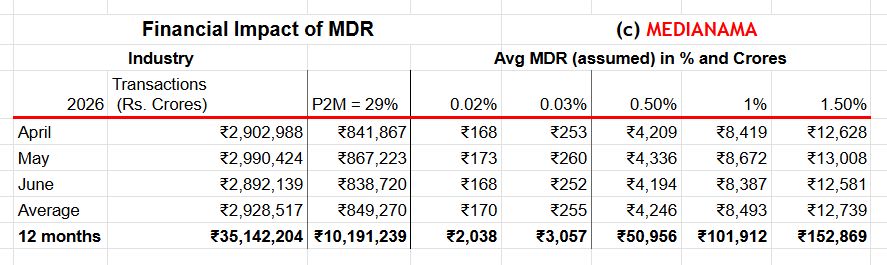
India's government plans to amend the Payment and Settlement Systems Act to restore UPI merchant discount rates, ending the zero-MDR regime in place since January 2020.
India's government has introduced the Taxation and Other Laws (Amendment) Bill, 2026, proposing changes to payments regulation, income tax, and the Finance Act to attract FDI and support Make in India. The Bill's final shape will depend on parliamentary debate and committee review.
The government's Taxation and Other Laws (Amendment) Bill, 2026, proposes to replace the blanket UPI MDR ban with a system allowing the Centre to notify which payment modes stay fee-free.
Prime Minister Narendra Modi inaugurated the Rs 5,000 crore Bhogapuram greenfield airport in Andhra Pradesh, built under a public-private partnership model. He also laid foundation stones for infrastructure projects worth nearly Rs 18,000 crore in the state, signalling a broad investment push for the region.