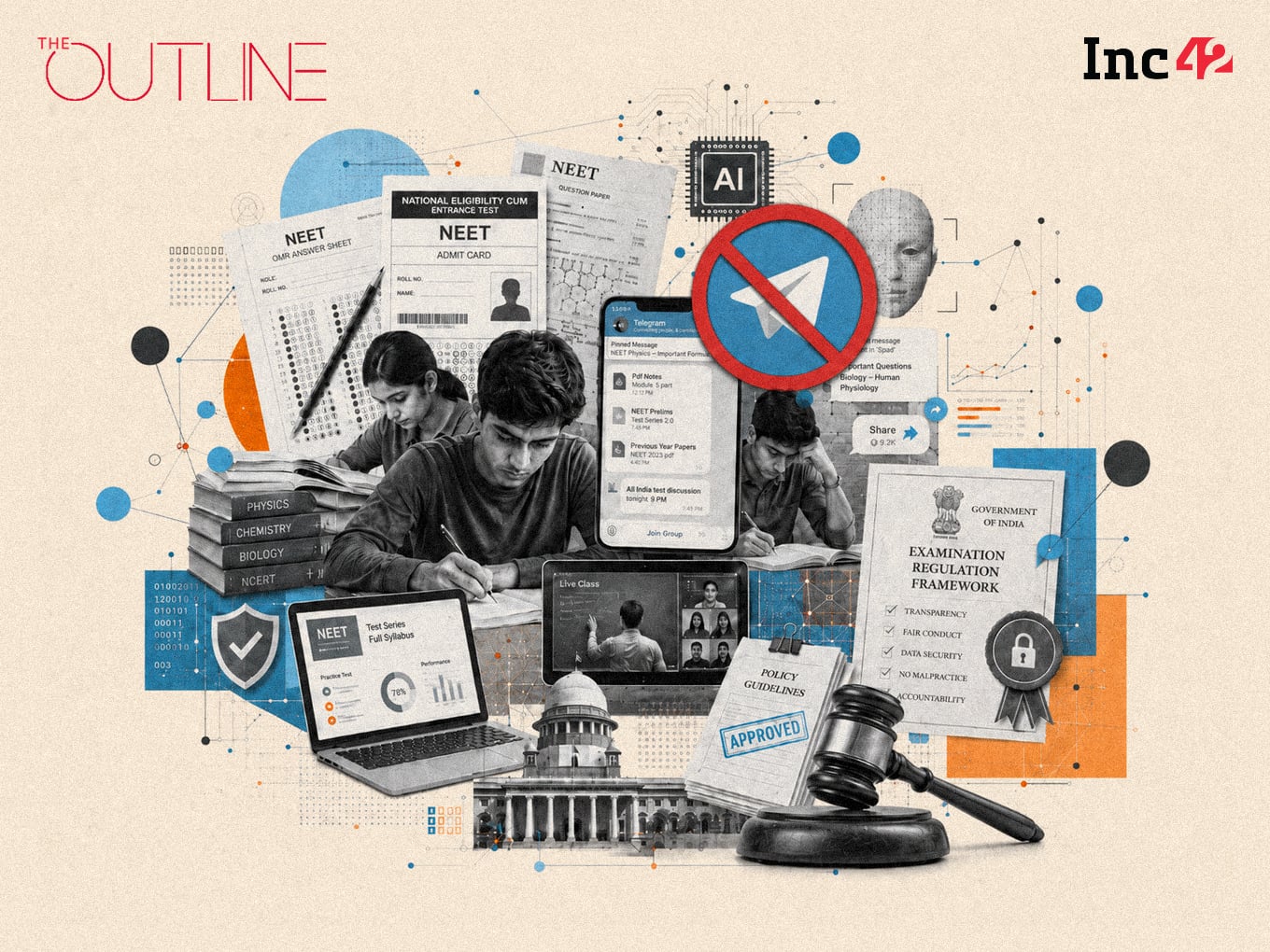
India's NEET-UG exam crisis has collided with a sweeping internet ban, exposing two separate failures at once: a broken examination integrity system and an edtech sector that has spent billions without solving the problem it was built to address.
The National Testing Agency's NEET-UG paper leak triggered the cancellation and rescheduling of an exam that over 2.2 million medical college aspirants had prepared years for. The central government's immediate response was to block Telegram under Section 69A of the Information Technology Act, citing the platform as a conduit for distributing leaked question papers. The Delhi High Court declined to interfere, ruling that the power to block "information" is broad enough to cover an entire platform and that the requirements of natural justice were satisfied. Telegram remains inaccessible in India at least until June 22.
Why Telegram, and Why Now
The government's position, as explained by lawyers familiar with the matter, is straightforward: when a platform refuses to cooperate with law enforcement requests to identify accounts spreading leaked content, a temporary block is one of the few tools available. Rahul Rai, co-founder of law firm Axiom5, framed it plainly: the leak is the core wrongful act and Telegram is the distribution channel. Sohini Mandal, founder of Nilaya Legal, described this as the first platform-wide ban of its kind in India, arguing that its short duration satisfies a proportionality test as the least restrictive option available.
Not everyone agrees. The Internet Freedom Foundation warned that treating the speech of an entire population as a single switch sets a dangerous precedent, and that a short duration does not automatically mean the least restrictive test has been met. Tech policy adviser Pranesh Prakash went further, arguing that many Telegram channels were actually running scams by backdating fake leak messages to deceive students. His case: the government should follow UPI money trails, which carry multiple layers of KYC verification, rather than cutting off a platform used by millions of legitimate students and teachers. "The necessity test doesn't pass, the proportionality test doesn't pass," he said.
The collateral damage is real. Teachers who conduct legitimate quizzes and revision sessions on Telegram have been cut off days before the rescheduled exam. Students in Tier II and III cities who relied on the platform for access to study material lost that access abruptly. Anirudh Rastogi, founder of Ikigai Law, raised a longer-term concern: the Delhi High Court's ruling now creates a precedent that any future government can invoke to block an app ahead of an election or during a protest. The "temporary" label, he warned, makes it easier to invoke, not harder.
Maheshwer Peri, founder of Careers360, called the move myopic. Blocking distribution does nothing to address insider compromise, weak paper-handling controls, or poor verification at examination centres. Organised fraud networks adapt quickly and will simply shift to another channel.
The Deeper Failure: Edtech Without Infrastructure
The more uncomfortable truth sitting underneath the Telegram debate is that India's edtech sector, which attracted billions of dollars in investment over the past decade, has produced no technology that meaningfully addresses examination fraud at scale. Edtech in India has largely replicated offline coaching in digital form: test prep platforms, cohort-based learning, and certification courses. None of these touch the infrastructure layer where paper leaks actually happen.
The reasons are partly structural. Indian venture capital is oriented toward fast consumer returns, pushing founders toward high-margin test-prep products and away from slow, unglamorous business-to-government contracts. Solving problems for NEET, CUET, and JEE requires years of engagement with government departments, fragmented state authorities, and cautious policymakers. That timeline does not fit most VC return models.
One concrete alternative already exists on paper. Dr Santosh Ramrao Butle, a professor at Swami Ramanand Teerth Marathwada University in Nanded who manages hybrid exams for roughly two to three lakh students across more than a hundred centres annually, has proposed the Secure National Examination Conduction System (SNECS). Under SNECS, no readable question paper exists anywhere in the country until 30 to 60 minutes before the exam begins. AI selects questions from an encrypted repository; unlocking the final paper requires simultaneous authorisation from multiple independent institutions; and the paper is printed directly at examination centres, paired with biometric verification. SNECS has been submitted formally to the National Testing Agency and the Ministry of Education. It has not been adopted for national implementation.
That gap between a workable technical proposal and actual government adoption captures the problem precisely. The recurring cycle of leaks is not a question of technological capacity. The tools exist. What is missing is the institutional will to replace human-handled paper logistics with systems that remove the leak opportunity entirely.
A senior faculty member at PhysicsWallah acknowledged that platforms like Telegram have genuinely democratised learning for students in smaller cities. But they also pointed to the need for stronger security measures, stricter anti-cheating enforcement, and greater accountability at every level of the examination chain.
What changes next depends on whether the government treats this rescheduled exam as a one-time crisis to be managed or as evidence that the entire paper-setting and distribution chain needs to be rebuilt. If another leak surfaces, the Telegram ban will look even less defensible. If the exam proceeds cleanly, the pressure to implement structural fixes may ease again, and the cycle will likely repeat. For edtech founders and investors, the gap is visible and the political appetite for a solution is arguably at its highest point in years. Whether that translates into serious infrastructure-layer investment, or another round of coaching-prep apps, will define what Indian edtech actually is.