
Qatar Signals Progress in US-Iran War Talks
Qatar's foreign ministry said mediators including Qatar, Pakistan, and Oman have reached "very progressive stages" in efforts to end the US-Iran war, pushing Brent crude down more than four percent.
Key Takeaways
June 22, 2026 · 4 min read · By Rishabh Bhardwaj
·
AI-assisted, human-reviewed · Our editorial standards
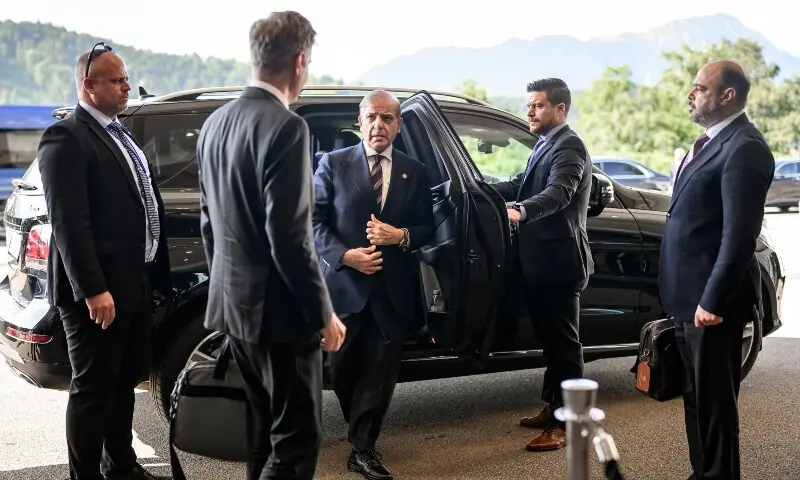
US Vice President JD Vance, Iran's Parliament Speaker Mohammad Bagher Ghalibaf, and Pakistani Prime Minister Shehbaz Sharif have all arrived at Switzerland's Burgenstock resort for technical talks on implementing the Islamabad Memorandum of Understanding, a 14-point agreement signed on June 17 between Washington and Tehran to end more than 100 days of war.
The talks are the first formal US-Iran engagement since the MoU was signed, with Pakistan and Qatar serving as mediators. The Pakistani Foreign Office confirmed that high-level delegations from the US, Iran, Qatar, and Switzerland are all present. Pakistan's role is notable: the country hosted earlier rounds of US-Iran talks and PM Shehbaz signed the Islamabad MoU as mediator, positioning Islamabad as a central diplomatic broker in a major geopolitical settlement.
The Islamabad MoU, signed by President Donald Trump and Iranian President Masoud Pezeshkian, establishes a framework to end the war, lift the US blockade on Iran, and reopen the Strait of Hormuz, a waterway through which a significant share of global oil trade passes. The deal includes a 60-day timeline for further negotiations. Once a final agreement is reached on Iran's nuclear programme, the US has agreed to facilitate a $300 billion reconstruction fund for Iran, supported by regional nations.
Vance told reporters before departing from Joint Base Andrews that the two main issues on the table are Iran's nuclear programme and the Lebanon ceasefire. On Lebanon, he said the situation is "actually getting better" but acknowledged the difficulty of sustaining a ceasefire when individual incidents prompt retaliatory fire. "You've just got to stop the shooting for long enough to get the ceasefire to keep hold," he said. Vance added he could only attend for "a day or two", while US negotiators Jared Kushner and Steve Witkoff were already in Switzerland handling technical groundwork.
Iran's delegation is substantial and signals the deal's economic weight. Led by Ghalibaf and Foreign Minister Abbas Araghchi, it also includes the Central Bank Governor Abdolnaser Hemmati and the CEO of the National Iranian Oil Company, Hamid Bovard, both critical figures if sanctions relief and oil export resumption are on the near-term agenda.
Despite the high-level attendance, there are clear pressure points. Iranian Foreign Ministry spokesperson Esmail Baghaei said Tehran expects Washington to compel Israel to halt attacks on Lebanon, warning that if the US fails to honour its obligations, "the entirety of the agreement will be jeopardised." That is a firm public position ahead of negotiations, signalling that Iran is entering the talks with leverage it is willing to name.
On timing, there is a small but notable discrepancy. Pakistan's state broadcaster PTV said talks could extend into Monday with no fixed end time, while Baghaei told IRNA that Iran expected a single-day session, with bilateral meetings in the morning and quadrilateral talks in the afternoon. The Swiss Foreign Ministry confirmed the sessions are underway but set no formal timeline.
Pakistan's Foreign Office framed Islamabad's participation carefully, saying PM Shehbaz will hold separate bilateral meetings with the US, Iran, Qatar, and Swiss delegations to "reaffirm Pakistan's enduring commitment to dialogue and durable peace in the region." Chief of Defence Force General Munir and Interior Minister Mohsin Naqvi are also present, indicating the breadth of Pakistan's engagement goes beyond pure diplomacy.
What happens at Burgenstock matters well beyond the immediate ceasefire. A credible path to lifting the US blockade on Iran and reopening the Strait of Hormuz would ease pressure on global oil supply chains that have been disrupted throughout the conflict. The $300 billion reconstruction fund, if activated, would be one of the largest post-conflict economic packages in recent history, with significant implications for regional trade flows and Gulf state investment.
The immediate watch is whether the single day of talks produces agreed milestones on nuclear negotiations and the Lebanon ceasefire, or whether the session runs into Monday as technical gaps require more time to bridge. Iran's public warnings about US compliance suggest the harder bargaining is still ahead.
Qatar's foreign ministry said mediators including Qatar, Pakistan, and Oman have reached "very progressive stages" in efforts to end the US-Iran war, pushing Brent crude down more than four percent.
Qatar confirmed it is mediating between the US and Iran but said no direct talks are currently planned. The clarification follows conflicting statements from President Trump, who claimed talks are under way, and Tehran, which denied any dialogue is happening.
Saudi Aramco reported sharply higher second-quarter 2026 profits as the Iran war restricts global oil supply and pushes crude prices up. Other oil supermajors also posted outsized earnings, raising concerns about sustained fuel cost pressure for importing economies.
President Trump called current Iran negotiations the "last chance" to end five months of conflict, pushing oil prices higher. Tehran denied formal talks are taking place, raising the risk of a diplomatic breakdown with direct consequences for global energy markets.