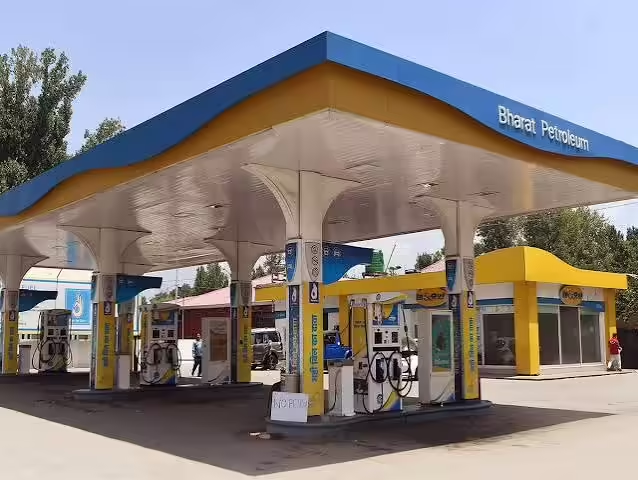
India's three largest state-owned fuel retailers, HPCL, BPCL, and IOCL, are headed for a combined EBITDA loss of up to Rs 47,700 crore in the April to June 2026 quarter, according to analyst estimates. The scale of the expected loss marks one of the sharpest profitability hits the sector has seen in recent years, driven by a combination of forces squeezing margins from multiple directions at once.
What is driving the losses
Four pressures are converging on the same quarter. First, crude oil prices rose sharply during Q1FY27, pushing up the raw material cost for refiners who must buy crude before turning it into petrol, diesel, and LPG. Second, LPG under-recoveries widened significantly. An under-recovery happens when the government-set retail price for cooking gas is lower than the actual cost of supplying it, so the retailer absorbs the gap directly. Third, fuel marketing margins, the spread between what these companies pay to procure fuel and what they sell it for at petrol pumps, stayed weak. Fourth, rupee depreciation raised the effective cost of importing crude oil, since oil is priced globally in US dollars.
Together these four factors compressed EBITDA, which stands for earnings before interest, taxes, depreciation, and amortization, the standard measure of operating profitability in the energy sector. A negative EBITDA means the core business is burning cash before any financing or tax obligations are even considered.
The three companies, Indian Oil Corporation (IOCL), BPCL, and HPCL, collectively dominate India's downstream fuel market. They control the majority of the country's refining capacity and almost all of the public petrol pump network. When all three bleed simultaneously, it signals a structural mismatch between regulated retail prices and rising input costs, not a company-specific problem.
Why retail prices have not kept pace
Petrol and diesel prices in India are formally deregulated, but in practice the state-owned oil marketing companies have not passed on the full increase in crude costs to consumers. Raising pump prices carries political sensitivity, especially in a period when household budgets are already stretched. LPG prices are more explicitly managed, with the government periodically revising rates for domestic cylinders.
The result is a familiar squeeze: input costs rise with global crude markets, but output prices at the pump or cylinder stay sticky. The gap falls on the balance sheets of HPCL, BPCL, and IOCL.
Analysts are now flagging that if crude oil prices remain elevated, fuel price hikes may become unavoidable. A meaningful increase at the pump would help restore marketing margins and partially offset LPG under-recoveries. However, the timing and size of any such move would depend on government decisions, not just commercial logic.
Rupee depreciation adds a compounding layer. Even if crude prices in dollar terms stabilize, a weaker rupee means Indian buyers pay more in local currency for every barrel imported. That raises both refining input costs and the landed cost of finished products the companies import to supplement domestic supply.
For investors, the Q1FY27 results will be a key test of how much cash these companies burned through, and whether their borrowing levels increased to fund the shortfall. All three are listed on Indian stock exchanges and carry significant weight in energy sector indices. A loss of this magnitude typically puts pressure on their credit ratings, dividend capacity, and future capital spending plans.
The government may also face pressure to clarify whether and when it will compensate the oil marketing companies for LPG under-recoveries, as it has done in previous cycles. Without that relief, the companies face the choice between raising prices themselves or absorbing further losses in the coming quarters.
What to watch next: crude oil price trajectory, any government announcement on LPG price revision or under-recovery compensation, and the actual Q1FY27 earnings disclosures from IOCL, BPCL, and HPCL, which will confirm whether the Rs 47,700 crore combined loss estimate proves accurate.